
The short answer
- Handwashing is the single most effective habitWashed properly, and at the right moments, hands do more to stop an infection spreading than anything else on this page.
- Know the six signs of sepsisSlurred speech or new confusion, no urine passed all day, severe breathlessness, mottled or discoloured skin, extreme shivering, or a feeling that something is seriously wrong. Any one of these means call 999.
- Wash soiled linen at 60°C or hotterHeat is what kills the organisms in bedding or clothing that has been in contact with a wound, urine or faeces, not the detergent.
- A recent hospital stay, a wound or a catheter raises the riskThese need the same everyday care as everything else, plus a district nurse or GP for the clinical side.
This page covers the everyday precautions you can take yourself. A wound, a catheter or a stoma is looked after by a district nurse or GP, not by a family member or a carer found through PrimeCarers.
The warning signs
What to look for, and when it is an emergency
Most infections start small and are easy to treat if you catch them early. The difficulty is that in an older person the first sign is often a change in how they seem, rather than an obvious symptom.
Signs to check for
0 of 11 ticked
Everyday signs of infection
Sepsis: call 999 or go to A&E
Sepsis is what happens when the body's response to an infection starts damaging its own organs, and it can move from a mild infection to a life-threatening one within hours. The UK Sepsis Trust records around 245,000 cases and 48,000 deaths a year in the UK, roughly five people an hour, and it is more likely in older people and anyone with a wound, a catheter or a weakened immune system. In an older person, the first sign may be confusion rather than a fever. If your parent has any one of the six signs above, call 999 or go straight to A&E and say you are worried about sepsis; do not wait to see if it passes. If your parent has had sepsis in the past twelve months and shows any new sign of infection, the NHS advises calling 111 straight away rather than waiting.
How it spreads
The four ways an infection reaches your parent, and what stops each one
Bacteria, viruses and fungi that cause infection are normally present on the skin, in the gut and all around the home. They become a problem when they move somewhere they should not be, usually by one of four routes.
Hands and everyday contact
Carries: Anything on your hands, or your parent's, from a wound, the toilet, food or an object
What stops it
Wash your hands at the moments that matter
Wounds, catheters and broken skin
Carries: Anywhere the skin is open, or a tube goes into the body
What stops it
Clean gloves only, and know the signs of infection
Continence products and laundry
Carries: Urine, faeces and anything a soiled pad or sheet has touched
What stops it
Bag it, wash it hot, dispose of it properly
Shared surfaces and equipment
Carries: Door handles, a commode, a walking frame, taps, anything more than one task touches
What stops it
Gloves and an apron, changed between jobs
Each of these routes has one habit that closes it off almost completely, and the sections below go through each one in turn: washing your hands at the right moments, using gloves and an apron for the tasks that need them, handling laundry and waste so nothing is carried further than it needs to be, and knowing what changes when your parent has a wound, a catheter or has recently been in hospital. Caring for a parent covers the wider decisions around arranging support, if this page is one part of a bigger picture for you right now.
Washing your hands
Washing your hands properly, and knowing when it matters most
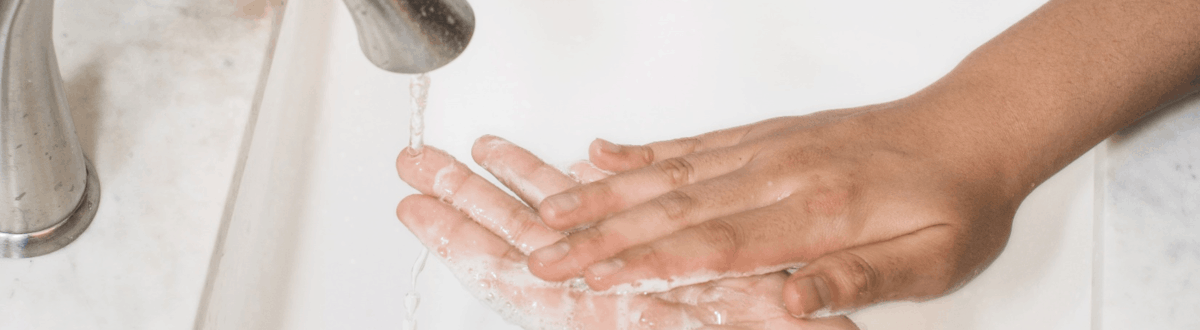
Hands are the biggest single route for spreading an infection from one task or one person to the next, and washing them properly takes about twenty seconds, the time it takes to sing Happy Birthday twice.
- 1
Wet your hands and apply soap
Step 1Wet your hands with running water first, then apply enough soap to cover both hands completely. - 2
Rub palms and between your fingers
Step 2Rub your palms together, then lace your fingers together and rub between them on both sides. - 3
Clean the backs of your hands and your thumbs
Step 3Rub the back of each hand with the palm of the other, then clasp each thumb in turn and rub it with the opposite hand. - 4
Rinse and dry thoroughly
Step 4Rinse off every trace of soap under running water, then dry completely with a disposable paper towel rather than a shared cloth towel.
The NHS sets out the full technique with pictures if you want to check yours against it. What matters as much as the technique is the moment: wash your hands before preparing or eating food, before and after any personal care task, after using the toilet or handling a commode, bedpan or continence product, before and after touching a wound or dressing, after blowing your nose or coughing, and after handling animals or rubbish.
Gloves and aprons
Using gloves and an apron without spreading germs further
Gloves and a disposable apron put a barrier between you and whatever you are dealing with, but only if you use and remove them properly. Put on wrong, or kept on for too many jobs, they can carry germs from one task to the next just as easily as bare hands.
- 1
Put on an apron and gloves before the task
Before you startAny task involving bodily fluids, a wound, laundry or waste calls for both. Gloves are inexpensive and widely available in supermarkets and pharmacies, so keep a box in the house. - 2
Change gloves between tasks
Mid-taskChange gloves between cleaning and food preparation, and between washing the top half of your parent and the bottom half, so nothing is carried from one to the other. - 3
Take gloves off inside out
AfterwardsPeel the first glove off so it turns inside out, hold it in your gloved hand, then slide two fingers under the second glove and peel it off over the first, wrapping one inside the other. - 4
Wash your hands straight after
Every timeRemoving gloves is not a substitute for washing your hands. Fold a used apron inward on itself before it goes in the bin, then wash your hands.
Gloves and an apron are there to protect your parent, not to make a personal care task feel clinical. Explaining what you are about to do and why, in the same way each time, keeps the moment calmer for both of you. Privacy and dignity goes further into keeping a parent's dignity intact as the help they need grows, and washing and dressing covers the wider routine these precautions sit inside.
Laundry and waste
Washing soiled linen and getting rid of continence waste safely
What has touched a wound, urine or faeces needs to be handled differently from ordinary washing, mostly because of heat rather than detergent.
| How to handle it | Where it goes | |
|---|---|---|
| Soiled bedding or clothing | Wear gloves to load the machine, and keep it separate from other washing rather than mixing loads | Washed at 60°C for at least ten minutes if your machine reaches that temperature, then dried fully |
| Continence pads and pants | Double-bag before putting in the bin, so nothing leaks or tears the outer bag | Usually the ordinary household bin; some councils still collect this waste separately or offer a bigger bin if you produce a lot of it |
| Used gloves, aprons and dressings | Fold inward so the soiled side is inside, then bag before disposal | The ordinary household bin, unless a district nurse tells you otherwise for a specific dressing |
Soiled bedding or clothing
- How to handle it
- Wear gloves to load the machine, and keep it separate from other washing rather than mixing loads
- Where it goes
- Washed at 60°C for at least ten minutes if your machine reaches that temperature, then dried fully
Continence pads and pants
- How to handle it
- Double-bag before putting in the bin, so nothing leaks or tears the outer bag
- Where it goes
- Usually the ordinary household bin; some councils still collect this waste separately or offer a bigger bin if you produce a lot of it
Used gloves, aprons and dressings
- How to handle it
- Fold inward so the soiled side is inside, then bag before disposal
- Where it goes
- The ordinary household bin, unless a district nurse tells you otherwise for a specific dressing
Heat, not the detergent, is what kills the organisms in soiled linen. A domestic machine that will not reach 60°C is fine for ordinary washing, but is not doing the job for anything that has been in contact with a wound, urine or faeces.
Councils have been moving away from separate yellow sack collections for continence and hygiene waste. Many now ask residents to double-bag it and put it in the ordinary bin, and only offer a separate collection or a bigger bin once a household is producing more than the normal bin can hold. Policies still vary, so it is worth checking your own council's website or ringing them directly if your parent is going through a lot of pads each week. Managing incontinence goes further into products, routines and where to get supplies, and bathing and toileting an elderly parent covers the hygiene technique that lowers the risk of a urinary tract infection in the first place, including wiping front to back.
You can get the free printable PDF to keep with this guide.
Extra care, extra risk
Extra care after a hospital stay, or with a wound or catheter
Three situations raise the risk of infection well above the everyday level, and each one calls for something on top of the habits above.
A wound or a dressing
A catheter or a stoma
If your parent has just been discharged, hospital discharge and post-operative care covers the wider checklist beyond infection risk, from follow-up appointments to arranging help at home. Where a wound, a catheter or extra watchfulness becomes a regular part of the day, it is worth writing down what works in a care plan, so that anyone else helping, a relative or a carer, does it the same way. How many visits a week does my parent need helps work out what extra help around this would cost, and you can search DBS-checked carers near your parent to see who is available.
Questions
Questions families ask about preventing infection at home
A raised temperature, redness or swelling around a wound, cloudy or strong-smelling urine, and simply seeming more tired or less like themselves than usual. In an older person, new confusion or a sudden change in behaviour is often the first sign, sometimes before anything else is obvious.
Call 999 or go to A&E if your parent has slurred speech or new confusion, has not passed urine all day, has severe breathlessness, has skin that looks mottled, discoloured or very pale, is shivering so badly or in so much muscle pain they cannot get up, or if you simply feel something is seriously wrong. The UK Sepsis Trust has more detail on these six signs.
Not for everyday contact like helping someone stand up or handing them a cup of tea. Wear gloves and an apron for personal care, wound care, handling laundry or continence products, and cleaning, and change gloves between different tasks so nothing is carried from one to the next.
60°C for at least ten minutes, if your washing machine reaches that temperature. It is the heat, not the detergent, that kills the organisms in linen that has been in contact with a wound, urine or faeces. Ordinary washing, with nothing soiled, does not need this.
In most areas, yes, once double-bagged so nothing leaks. Some councils still collect continence and hygiene waste separately, or provide a larger bin if a household produces more than the standard bin holds, so it is worth checking your own council's website. Managing incontinence covers products and routines in more depth.
Yes. Only touch either with clean gloves, and leave changing a dressing or managing the catheter itself to a district nurse unless you have been specifically shown how. Watch for spreading redness, swelling, a smell or heat around a wound, and call the GP or district nurse the same day if you see any of them.
Yes. Unpaid carers are eligible for a free NHS flu vaccine each autumn if they are the main carer for an older or disabled person, or receive Carer's Allowance, alongside your parent's own eligibility. Book through your GP surgery, a participating pharmacy, or the NHS App.