

The short answer
- The route this page worried about did open, then closedCare work was added to a shortage list in February 2022, brought workers in from abroad for three years, then lost that route to new overseas recruitment on 22 July 2025.
- Home care is still the hardest role to fillThe vacancy rate for domiciliary care was 9.1% in 2025/26, higher than any other type of care work and more than four times the rate across the wider economy.
- Pay is being pulled up by law, not by a bidding warThe National Living Wage rises to £12.71 an hour from April 2026, and most employed care workers are paid within a few pence of it either way.
- None of this sets your rate if you work for yourselfSelf-employed carers on PrimeCarers agree their own rate with a family directly. The minimum wage and the pay changes below are a floor for employees, not for you.
Figures on this page come from Skills for Care, the Home Office and gov.uk, checked in September 2026. Self-employed carer figures are what carers on PrimeCarers charge, £18 to £25 an hour with our fee included.
Six years on
What happened to overseas recruitment into care work, in order
This page was first written when the government had only proposed a points-based system, and nobody knew whether care work would be shut out of it or protected. It has been six years. Here is what happened, in order, set against what this page originally guessed.
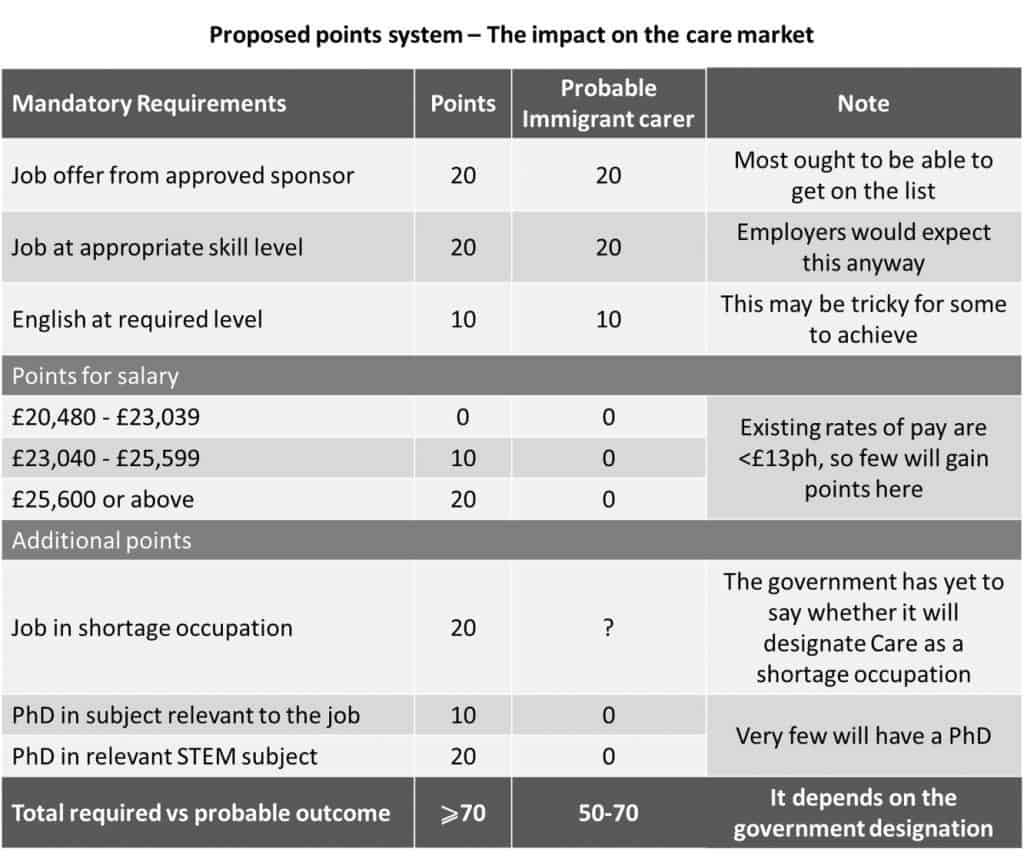
On that table, a care worker had no route in unless the government put care on its shortage occupation list, since pay in the sector fell well short of the salary bands that scored extra points on their own. That is close to what happened, but later, and by a different route, than this page assumed.
In February 2022, the government added care worker and senior care worker roles to the Shortage Occupation List, opening the Health and Care Worker visa to any employer registered with the Care Quality Commission. The points table above was never the mechanism carers used: the Health and Care Worker visa did not apply the same salary bands to care work, so a CQC-registered provider could sponsor a carer on much lower pay than most other sponsored roles required.
- 2020/2115,000
- 2021/2225,000
Care workers and senior care workers were added to the Shortage Occupation List in February 2022, opening the Health and Care Worker visa route to CQC-registered employers.
- 2022/2375,000
- 2023/24105,000
The peak year. From April 2024, only CQC-registered employers could sponsor a new care worker, the salary threshold rose, and a newly sponsored worker could no longer bring dependants.
- 2024/2550,000
- 2025/2630,000
The route closed to new overseas care worker and senior care worker applicants on 22 July 2025. A carer already sponsored can extend their stay or switch sponsor until 22 July 2028.
Skills for Care, workforce supply and demand trends 2025/26. Estimated numbers of people arriving in the UK and starting a direct care role in the independent sector in England that year.
Recruitment grew fast once the route opened, then unwound faster still. In April 2024, the government tightened the rules: only CQC-registered employers could sponsor a new care worker, the salary threshold rose, and a newly sponsored worker could no longer bring dependants into the UK. Then, on 22 July 2025, the government closed the route entirely to new overseas care worker and senior care worker applicants, after suspending the sponsor licences of 470 providers since 2022 over exploitation of the workers they had brought in. A carer already sponsored here can extend their visa or move to a new sponsor until 22 July 2028. After that date, unless the rules change again, there will be no route left to sponsor a care worker from outside the UK at all.
So the scenario this page worried about in 2020, no way in for anyone outside the UK, has arrived. It just took five years longer than expected, and came after one of the largest waves of recruitment the sector has seen. What carers are paid in 2026 sets out the fuller pay picture that followed.
The job market now
Why care work is still easier to find than most jobs
A closed visa route does not by itself say whether care work is easy or hard to find. The vacancy figures do, and they say home care specifically is still the hardest role for an employer to fill.
| 2024/25 | 2025/26 | |
|---|---|---|
| Domiciliary care | 10% | 9.1% |
| Care homes without nursing | 4.1% | 3.8% |
| Care homes with nursing | 4.7% | 3.9% |
Domiciliary care
- 2024/25
- 10%
- 2025/26
- 9.1%
Care homes without nursing
- 2024/25
- 4.1%
- 2025/26
- 3.8%
Care homes with nursing
- 2024/25
- 4.7%
- 2025/26
- 3.9%
Vacancy rate by main service type, independent sector. Adult social care overall stood at 6.2% in 2025/26, the lowest since 2015/16 and down from a peak of 10.4% in 2021/22, but still around three times the wider UK economy's rate of 2.2%. Skills for Care, workforce supply and demand trends 2025/26.
Every one of these rates has fallen over the last year, which is real progress after the shortage that followed the pandemic. Even so, domiciliary care, the hourly and live-in work most carers on PrimeCarers do, remains the hardest of the three to fill, and by some distance. If you are choosing between care settings, or deciding whether to move from a care home role into private hourly or live-in work, that gap is worth knowing.
The other side of the same numbers is who is doing the work. The number of posts filled by people with British nationality fell by 130,000 between 2020/21 and 2025/26, a drop of 10.8%, even as the total workforce grew. People with British nationality made up 84.5% of the workforce in 2020/21 and 67.5% by 2025/26. Anyone already trained and working in care in the UK, whatever their nationality, is a smaller and more sought-after group than they were, which is close to what this page said in 2020 about carers already here.
This page also predicted in 2020 that rising costs would push some families to provide care themselves, taking time off work or leaving a job rather than paying for it. That pressure on unpaid carers has grown rather than eased: in Carers UK's State of Caring 2025 survey of over 10,500 carers, 35% of working carers said they had already reduced their hours to fit caring around a job, and 47% were considering reducing their hours or leaving paid work altogether. For a carer looking for hourly or live-in bookings, that is part of what keeps demand high: families who are stretched for time and money still need some paid help, even where they cannot afford as much of it as they would choose.
None of that is likely to ease soon. The Office for National Statistics projects that the number of people aged 85 and over will roughly double, from 1.75 million in mid-2024 to 3.6 million by mid-2049, and that group needs the most hours of care per person of any age band. Become a carer: the complete guide sets out the three routes into paid care work if you are weighing up whether to start.
Pay
Why the minimum an employer can pay keeps rising
Wages did rise, roughly as this page guessed in 2020. What pushed them was the legal minimum wage, not a bidding war between employers competing for a shrinking pool of workers.
| An hour | What it is | |
|---|---|---|
| National Living Wage, 2025/26 | £12.21 | The legal minimum for an employed worker aged 21 or over. |
| National Living Wage, from April 2026 | £12.71 | Confirmed at the Autumn Budget, 26 November 2025. |
| Median independent-sector care worker pay, Dec 2025 | £12.60 | Skills for Care's own tracking, only 11p below the floor that arrived four months later. |
| PrimeCarers hourly range, self-employed | £18–£25 | Set by each carer directly, with our fee included, not a wage. |
| A home care agency, what a family pays | £28–£35 | The agency then pays its own staff separately, usually much closer to the National Living Wage than to this figure. |
National Living Wage, 2025/26
- An hour
- £12.21
- What it is
- The legal minimum for an employed worker aged 21 or over.
National Living Wage, from April 2026
- An hour
- £12.71
- What it is
- Confirmed at the Autumn Budget, 26 November 2025.
Median independent-sector care worker pay, Dec 2025
- An hour
- £12.60
- What it is
- Skills for Care's own tracking, only 11p below the floor that arrived four months later.
PrimeCarers hourly range, self-employed
- An hour
- £18–£25
- What it is
- Set by each carer directly, with our fee included, not a wage.
A home care agency, what a family pays
- An hour
- £28–£35
- What it is
- The agency then pays its own staff separately, usually much closer to the National Living Wage than to this figure.
Figures checked September 2026. The National Living Wage and Skills for Care's median pay figure apply to employees; they are not a legal floor on what a self-employed carer can charge, only a point of comparison.
Since this page first went up in February 2020, the National Living Wage has moved from £8.72 to £12.71, a rise of 46%, and most employed care workers have moved with it rather than pulling ahead of it: 26% were paid on or within 10p of the incoming floor in December 2025.
None of that rise has shrunk the market for care. Families and councils cannot generally choose to buy less care once someone needs it, so a rising wage floor tends to grow the money moving through the sector rather than cut the number of hours bought, much as this page argued in 2020. What a higher floor changes is a provider's own profit, which then depends on what it can do about its other costs rather than on how much it charges, and that is a large part of why some providers have expanded while others have closed at the same time.
Councils, who pay for care for people who cannot afford it themselves, face the same rise. The National Living Wage and higher employer National Insurance added around 10% to home care providers' costs in 2025/26, but what councils paid those providers rose by only about 5%, according to the Homecare Association, and councils overspent their adult social care budgets by £715 million in 2025/26. The average price a council paid for an hour of home care, £25.05 for 2026/27, still sits well below the £34.42 the Homecare Association calculates a provider needs to cover National Living Wage pay in full. That squeeze does not stay inside social care: a lack of a care home bed, a home care package or an NHS community bed was the leading cause of delay for patients stuck in hospital longer than they needed to be in 2025, and by January 2026 an average of 13,750 patients a day in England were medically fit to leave hospital but still there, up 12% on January 2022, much as this page warned in 2020 that a rising wage floor would add pressure on government-funded care and the services around it.
A longer-term change is coming for employed pay too. The Employment Rights Act 2025 creates an Adult Social Care Negotiating Body, the first sector-wide pay bargaining social care has had. The negotiating body is expected in 2026, with negotiations due in 2027 and the first agreement in force from 2028, backed by £500m to help councils meet the cost. It is the closest thing to what this page predicted in 2020, wages forced up by policy rather than the market alone, but it applies to employed roles and is still two years away.
If you work for yourself
What sets your rate if you are a self-employed carer
None of the wage floor above is a legal minimum on what you charge. PrimeCarers is an introductory service, not an employer, so you agree your rate directly with a family, and neither the National Living Wage nor the Fair Pay Agreement above reaches it.
What has changed is the market around that rate. An estimated 30,000 people arrived from outside the UK to start a direct care role in 2025/26, the year the route closed to new applicants, down from a peak of 105,000 in 2023/24. That is a much smaller pool of newly arrived overseas workers competing for hourly and live-in bookings than at any point since the route opened.
Worth doing given this
- Set your rate against local demand for hourly and live-in carers, not last year's rate or a guess
- Keep your ID, right to work check and enhanced DBS current on the Update Service, since that is still what a family checks first
- Consider live-in or hourly home care specifically, since domiciliary care remains the hardest role of any to fill
- Read what carers on PrimeCarers are charging right now before you set or change your own rate
Not a safe assumption
- Assuming the closed visa route raises your rate automatically: it changes supply for employers, not how many families are looking for a private carer
- Treating the incoming National Living Wage as a ceiling on your own rate rather than a comparison point
- Copying an agency's advertised price, which pays for their office costs as well as the carer's time
- Letting your vetting checks lapse because demand is currently in your favour
Vacancy rates move in both directions, and what keeps you booked once demand eases is not simply having the lowest rate. Keep your enhanced DBS check current on the Update Service, and build a profile a family can trust before they meet you: being reliable, and why it wins work sets out what that looks like day to day. If live-in work is the plan, where to find a live-in care job covers the job boards and the process.
How much can carers earn on PrimeCarers? has the current hourly and live-in ranges in full, and why become a private carer? sets out the case for setting your own rate against an agency wage.
Questions
Questions carers ask about the visa changes and pay
Eventually, yes, though by a different route than the page guessed at. Care workers were added to the Shortage Occupation List in February 2022, opening the Health and Care Worker visa to CQC-registered employers, and that route stayed open until it closed to new overseas care worker and senior care worker applicants on 22 July 2025. Full details on gov.uk.
Not a new one. Since 22 July 2025, a UK employer cannot sponsor a care worker or senior care worker applying from outside the UK. A carer already sponsored here can extend their visa or switch to a new sponsor until 22 July 2028, after which the transitional arrangements end.
Easier than most jobs, on the vacancy figures. Adult social care's vacancy rate was 6.2% in 2025/26, around three times the wider UK economy's 2.2%, and domiciliary care, hourly and live-in home care, ran even higher at 9.1%, the highest of any care setting.
No. The National Living Wage, £12.71 an hour from April 2026, is a legal floor for employees. Carers on PrimeCarers are self-employed and agree their rate directly with a family, typically £18 to £25 an hour with our fee included, well above that floor already. How much can carers earn on PrimeCarers? has the current ranges.
It is a sector-wide pay negotiation for social care, created by the Employment Rights Act 2025 through a new Adult Social Care Negotiating Body. It is expected to be set up in 2026, negotiate in 2027 and take effect from 2028. It sets minimum pay and conditions for employed roles; it does not set the rate a self-employed carer agrees directly with a family.
The legal minimum has: the National Living Wage has risen from £8.72 in April 2020 to £12.71 from April 2026. Most employed care workers have moved up with that floor rather than pulling away from it, with median pay in the independent sector at £12.60 an hour in December 2025. Self-employed carers who set their own rate were never tied to that floor in the first place.
Only if the rules change again. As things stand in September 2026, the route to sponsor a new care worker from outside the UK is closed, with transitional arrangements for people already sponsored running until 22 July 2028 and no announced plan to reopen it before then.