
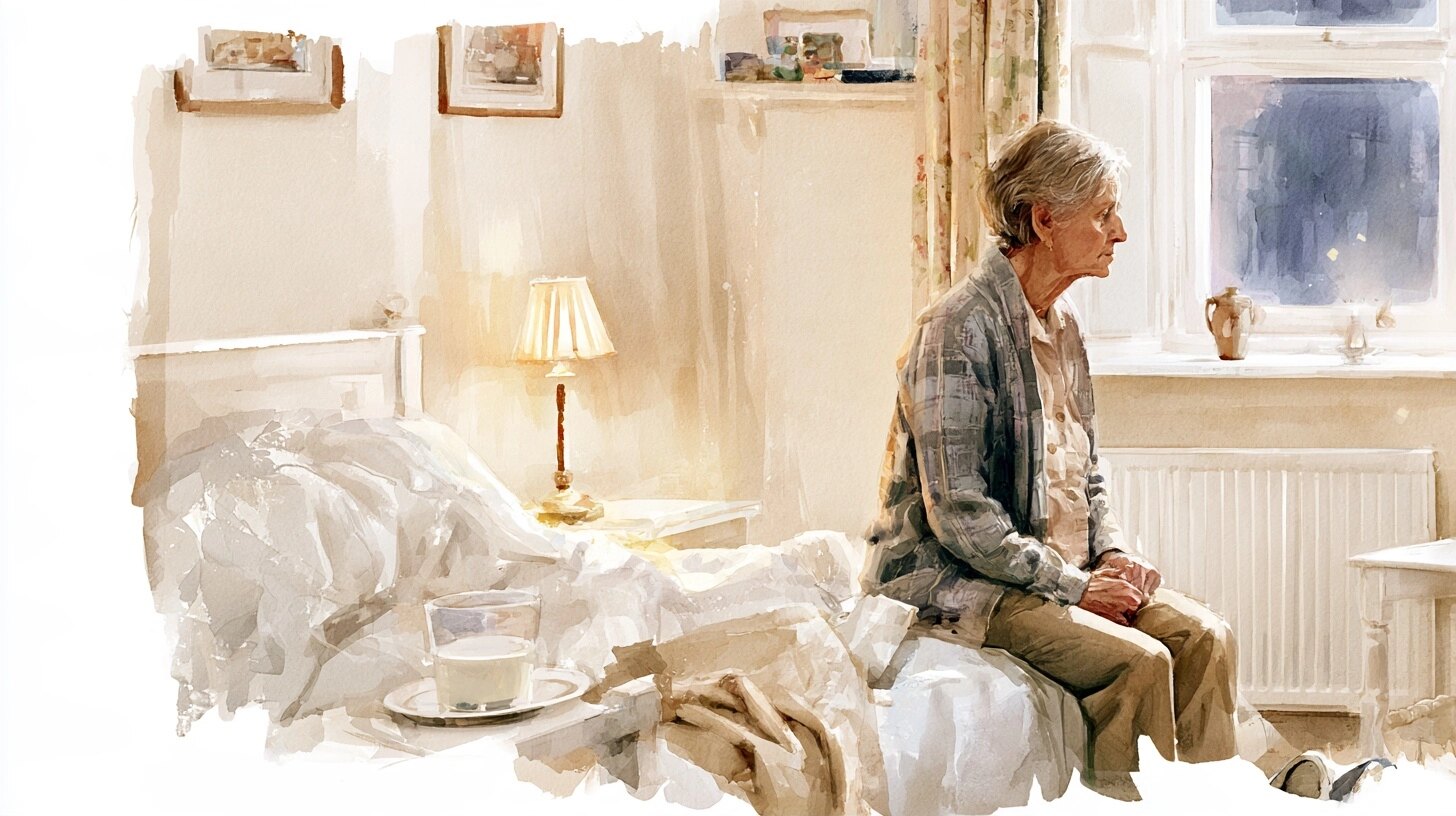
The short answer
- Lighter sleep is part of ageingAn NHS trust sleep guide says older people sleep more lightly and wake more often, and that sleep should still be refreshing.
- Most of what helps happens in the dayThe same getting-up time, daylight in the morning, staying active, and no caffeine after midday, as the NHS and NICE advise.
- The NHS is careful with sleeping tabletsNICE guidance for GPs advises against sleeping tablets for older people because of the risk of falls and confusion.
- Night help can make the nights saferIf your parent is up and unsteady at night, a carer can sleep in or stay awake. Nights on PrimeCarers start at £130.
This page is general information, not medical advice. Night rates are what carers on PrimeCarers charge with our fee included: £130 to £145 for a sleeping night and £150 to £160 for a waking night.
What changes with age
What normally changes with age, and what is worth raising with the GP
Some change in sleep is expected as people get older. The question to ask is whether your parent's sleep still leaves them rested, and whether anything has changed quickly.
| Usually part of getting older | Worth raising with the GP | |
|---|---|---|
| How deep the sleep is | Lighter sleep, with less deep sleep than when they were younger. | Sleep that never feels refreshing, with tiredness through the whole day. |
| Waking in the night | Waking a few times and going back to sleep. | Lying awake for long stretches most nights, or up several times to the toilet. |
| When they sleep | Going to bed earlier and waking earlier than they used to. | Waking very early, feeling low and unable to get back to sleep. |
| Sleep in the day | Dropping off in the chair now and then. | Sleepy all day even after a full night, or sleeping far more than before. |
| What happens in bed | Some tossing and turning on a bad night. | Loud snoring with pauses and gasps, or an urge to move the legs that stops them settling. |
| How quickly it changed | Slow change over years. | A sudden change. Sudden confusion needs medical help straight away. |
How deep the sleep is
- Usually part of getting older
- Lighter sleep, with less deep sleep than when they were younger.
- Worth raising with the GP
- Sleep that never feels refreshing, with tiredness through the whole day.
Waking in the night
- Usually part of getting older
- Waking a few times and going back to sleep.
- Worth raising with the GP
- Lying awake for long stretches most nights, or up several times to the toilet.
When they sleep
- Usually part of getting older
- Going to bed earlier and waking earlier than they used to.
- Worth raising with the GP
- Waking very early, feeling low and unable to get back to sleep.
Sleep in the day
- Usually part of getting older
- Dropping off in the chair now and then.
- Worth raising with the GP
- Sleepy all day even after a full night, or sleeping far more than before.
What happens in bed
- Usually part of getting older
- Some tossing and turning on a bad night.
- Worth raising with the GP
- Loud snoring with pauses and gasps, or an urge to move the legs that stops them settling.
How quickly it changed
- Usually part of getting older
- Slow change over years.
- Worth raising with the GP
- A sudden change. Sudden confusion needs medical help straight away.
From the NHS pages on insomnia, sleep apnoea, restless legs syndrome, depression and sudden confusion, NICE CKS on insomnia, and the sleeping problems guide from Cumbria, Northumberland, Tyne and Wear NHS Foundation Trust, September 2026.
The sleeping problems guide from Cumbria, Northumberland, Tyne and Wear NHS Foundation Trust explains that sleep in older people tends to be lighter, with more frequent waking, and that for a typical 70-year-old deep sleep is less than a tenth of the night. It says this is normal and nothing to worry about. The pattern moves too: it becomes more likely that somebody goes to bed sooner, wakes earlier, or drops off during the day. The guide sums it up as sleep that is shorter and more easily disturbed, but that should still be refreshing.
The NICE summary for GPs on normal sleep patterns says the number of times somebody wakes goes up with age and total sleep goes down. It adds that this may be part of ageing, but may also come from other health conditions, from taking several medicines, or from changes in lifestyle. A parent who sleeps a little less and wakes a little earlier, but gets through the day well, is probably getting the sleep they need. A parent who is exhausted, falling asleep over lunch or suddenly muddled needs someone to look for the reason. The elderly care guide covers the wider changes of later life.
Common causes
Common reasons an older person sleeps badly
Poor sleep in later life can have a cause that can be treated or eased. Each of these is named in NHS or NICE guidance, and more than one can be at work at once.
Pain
Joints, back, old injuries
Needing the toilet in the night
Getting up to pass urine
Medicines
Worth a review
Low mood, worry and grief
Easy to miss
Restless legs
Worse at night
Sleep apnoea
Snoring with pauses
Dozing in the day
The long afternoon
Other conditions matter too. The NICE summary on the causes of insomnia lists COPD, heart disease, stroke, Parkinson's disease, diabetes, long-term pain and tinnitus among the conditions that commonly come with poor sleep. If your parent lives with one of these, arthritis and care at home and the other guides in the health conditions section explain the help available. For low mood, the NHS sets out the symptoms of depression, and mental health in later life covers how to raise it and where support comes from, and helping someone who is lonely covers the long, empty days that can end in a doze in the chair.
The NHS pages on restless legs syndrome and sleep apnoea are worth reading if either sounds familiar. The sleep apnoea page says it can be hard for somebody to tell they have it, and that a person who has seen the symptoms can help by going to the GP with them.
A day built for sleep
The habits that help, set out as one day
Much of the NHS advice on sleep is about what happens in the day. The clock below puts it into a single ordinary day, with example times to move around your parent's own routine.
An example day, midnight at the top
- Night-time sleep
- Daylight and activity
- Evening meal
- Winding down
- A point to stop
Up at the same time, into the light (7am to 9.30am)
The same getting-up time every day, weekends and bad nights included. Curtains open straight away, and breakfast by a bright window or outside if the weather allows.
Active, and out of bed (10am to 4.30pm)
Something to get up for: a walk, the garden, the shops, a visitor. Staying awake through the afternoon keeps the tiredness for bedtime, so try not to doze in the chair.
Midday: Last tea or coffee with caffeine
The evening meal (5.30pm to 6.30pm)
Eaten well before bed, since the guidance says to avoid large meals in the two hours before bedtime. Alcohol in that window disturbs sleep later in the night.
8pm: Fewer drinks from here if they are up to the toilet
Winding down (9.30pm to 10.30pm)
Lights lower, the television and phone off, a book, the radio or a bath. The bedroom ready: dark, quiet and cool, with a clear, lit way to the toilet.
In bed, lights out (10.30pm to 7am)
Go to bed when sleepy rather than early to catch up. Waking in the night is normal. If still awake after about 20 minutes, get up and sit somewhere comfortable with a low light until sleepy again.
The habits on the clock come from the NHS page on insomnia, the Every Mind Matters page on how to fall asleep faster and sleep better, and the NICE guidance for GPs on sleep habits. Common to all of them is a regular getting-up time, the same every day, including after a bad night. The NICE guidance pairs it with more bright light in the morning.
The bedroom counts as well. The NHS says a room that is too hot or too cold, noise and an uncomfortable bed can all cause poor sleep, and Every Mind Matters suggests a room that is quiet, dark and cool. For an older person, dark has a limit: the way to the toilet needs a low light that can stay on. Tea, coffee and cola all contain caffeine, and NICE advises none after midday. It also advises no alcohol or large meals in the two hours before bed. Age UK has its own advice on sleeping better in later life.
Being active helps too. The NHS advises regular exercise, and NICE adds that vigorous exercise is best kept away from the hour before bed. For an older person that might be a walk, time in the garden or a trip to the shops, and exercise for older people has ideas pitched at different abilities. Cutting back on drinks in the evening should not mean drinking less overall. The NHS lists not eating and drinking enough as something that can make people feel lightheaded or faint, and elderly hydration explains how to keep drinks going through the day.
Sleeping tablets
Sleeping tablets, and why the NHS is careful with them in older people
When a parent is exhausted, a tablet can seem the obvious answer. NHS and NICE guidance is cautious about sleeping tablets for everybody, and more cautious still for older people.
| What the guidance says | For an older person | |
|---|---|---|
| Sleep habits | The NHS starts with changes to habits and the bedroom, and suggests seeing a GP if they have not helped. | The safest place to start, and the clock above sets them out. |
| CBT for insomnia | NICE says to offer cognitive behavioural therapy for insomnia (CBTi) first for long-term insomnia, in adults of any age. It can be face to face or digital. | Suitable at any age, with help from the family or a carer to use an app or get to sessions if needed. |
| Sleep aids from a pharmacy | The NHS says these may help for 1 to 2 weeks and should not be taken for longer. NICE advises GPs not to recommend them. | NICE warns that sedating antihistamines raise the risk of dangerous confusion and falls in older people. |
| Prescribed sleeping pills | The NHS says GPs rarely prescribe them. NICE says not routinely, only for short courses, and ideally for less than a week. | NICE advises GPs not to prescribe them to older people, and lists falls and fractures among the risks. |
Sleep habits
- What the guidance says
- The NHS starts with changes to habits and the bedroom, and suggests seeing a GP if they have not helped.
- For an older person
- The safest place to start, and the clock above sets them out.
CBT for insomnia
- What the guidance says
- NICE says to offer cognitive behavioural therapy for insomnia (CBTi) first for long-term insomnia, in adults of any age. It can be face to face or digital.
- For an older person
- Suitable at any age, with help from the family or a carer to use an app or get to sessions if needed.
Sleep aids from a pharmacy
- What the guidance says
- The NHS says these may help for 1 to 2 weeks and should not be taken for longer. NICE advises GPs not to recommend them.
- For an older person
- NICE warns that sedating antihistamines raise the risk of dangerous confusion and falls in older people.
Prescribed sleeping pills
- What the guidance says
- The NHS says GPs rarely prescribe them. NICE says not routinely, only for short courses, and ideally for less than a week.
- For an older person
- NICE advises GPs not to prescribe them to older people, and lists falls and fractures among the risks.
From the NHS pages on insomnia and zopiclone, and NICE CKS on managing insomnia and on z-drugs, September 2026. Talk to the GP or pharmacist before starting or stopping any medicine.
The NICE summary on managing insomnia advises GPs not to prescribe sleeping tablets (hypnotics) to older people. Its notes on the z-drugs, the group that includes zopiclone and zolpidem, say to avoid them in older people if possible because of a greater risk of side effects, including falls and fractures. Among the listed side effects are confusion, dizziness, drowsiness that carries into the next day, and unsteadiness and falls, particularly in older people.
This matters most at night. A person who wakes drowsy from a tablet and walks to the toilet in the dark is at more risk of falling. The NHS page on falls lists the side effects of some medicines as a cause and suggests asking a GP or pharmacist if you think a medicine is affecting your parent's balance.
If your parent already takes a sleeping tablet, do not stop it suddenly. The NHS page on zopiclone says stopping suddenly can cause withdrawal symptoms, and that the doctor will reduce the dose gradually. Ask the GP for a review instead. NICE also mentions a prolonged-release melatonin that GPs may consider for people over 55 with persistent insomnia, for a limited time. That is a decision for the GP. Medicines in later life covers medicine reviews more generally.
Seeing the GP
When to see the GP, and what to take with you
The NHS suggests seeing a GP when changing sleep habits has not helped, when trouble sleeping has gone on for months, or when it is affecting daily life. An appointment goes further with some preparation.
- 1
Bring the sleep diary
Two weeksBedtimes, waking times, naps, drinks and how rested your parent felt. It turns a general worry into a pattern the GP can use. - 2
List every medicine
Including shop-boughtPrescriptions, painkillers, sleep aids from the pharmacy and supplements, with the times they are taken. NICE asks GPs to look at medicines as a possible cause. - 3
Say what you have seen at night
You may be the witnessSnoring and pauses, restless legs, trips to the toilet, pain, confusion or wandering. NICE says an account from a family member can help the GP. - 4
Ask what happens next
Treatment or referralThe GP may treat a cause such as pain, low mood or the bladder, offer CBT for insomnia, or refer to a sleep clinic if another sleep disorder is suspected.
Go sooner for anything in the right-hand column of the first table, particularly signs of sleep apnoea, low mood, or being up many times in the night to pass urine. The NHS page on an enlarged prostate lists getting up to pee during the night as a symptom and says to see a GP about difficulty peeing or needing to pee more often. For sleep apnoea, the NHS says the GP may refer your parent to a sleep clinic, where tests are often done at home overnight.
If your parent feels that poor sleep is just age and does not want to go, how to get someone to accept care has ideas for the conversation. The NHS trust guide lists the National Sleep Helpline, run by The Sleep Charity, among organisations that can help.
Safety and night help
Night-time toilet trips, falls, and when night help makes sense
Broken sleep becomes a safety problem when your parent is up and unsteady in the dark, or confused at night. Several kinds of help are available, from an alarm to a carer who stays the night.
| What it does | When it fits | Cost | |
|---|---|---|---|
| Alarms and sensors | A pendant or a bed sensor that calls for help, or lights that come on when feet touch the floor. | Up once or twice, steady on their feet, and able to use an alarm. | Varies by provider. The council may help after an assessment. |
| Sleeping night (sleep-in) | A carer sleeps in a spare room and gets up when needed, for example to walk them to the toilet and back. | Up a few times, unsteady, or anxious alone at night. | £130 to £145 a night on PrimeCarers |
| Waking night | A carer stays awake all night, nearby and ready. | Up most of the night, confused and wandering, or needing turning or pad changes. | £150 to £160 a night on PrimeCarers |
Alarms and sensors
- What it does
- A pendant or a bed sensor that calls for help, or lights that come on when feet touch the floor.
- When it fits
- Up once or twice, steady on their feet, and able to use an alarm.
- Cost
- Varies by provider. The council may help after an assessment.
Sleeping night (sleep-in)
- What it does
- A carer sleeps in a spare room and gets up when needed, for example to walk them to the toilet and back.
- When it fits
- Up a few times, unsteady, or anxious alone at night.
- Cost
- £130 to £145 a night on PrimeCarers
Waking night
- What it does
- A carer stays awake all night, nearby and ready.
- When it fits
- Up most of the night, confused and wandering, or needing turning or pad changes.
- Cost
- £150 to £160 a night on PrimeCarers
PrimeCarers night rates include our fee. Agencies charge from £150 for a sleeping night and up to £240 for a waking night.
The trip from bed to toilet is made half awake, in the dark, perhaps drowsy from a medicine, so it needs to be safe. Night care for falls and toilet trips goes through making that route safe, item by item. Pendant alarms and sensors explains what the equipment does and where it stops, and managing incontinence covers pads, bottles and commodes. The NHS says anybody worried about falls can ask the council for a free care needs assessment, which can include changes to make the home safer.
A carer at night makes sense when the equipment is no longer enough: your parent is getting up unsteady several times a night, has fallen, is confused and wandering, or is frightened on their own. A sleeping night suits someone who is up a few times. A waking night suits somebody who is up most of the night or needs care through it. Waking night or sleeping night helps you choose, and overnight care explains how nights are arranged and what a carer does. If you are the one getting up every night, sleep deprivation and the case for a night carer looks at what that does to a family carer.
If your parent is up and unsafe at night, you can search for carers near you and compare their sleep-in and waking night rates. Every carer has had their identity and right to work checked, holds an accepted criminal-record check (Enhanced DBS issued within the last 2 years, DBS Update Service, Scottish PVG or Access NI), and has been interviewed online. Visits booked through PrimeCarers are covered by the carer insurance policy we arrange, within its terms (no clinical procedures). We do not check qualifications, training or references, so anything a carer says about experience with night care is their own account on their profile, for you to ask about. PrimeCarers is an introductory service, not an agency or a care provider. Carers are self-employed, and you agree the nights and the rate with them directly.
Questions
Questions families ask about sleep in older people
The NHS says adults need 7 to 9 hours. The NHS trust sleep guide says people over 65 usually need slightly less, though still around 7 to 8 hours, and that need varies from person to person. The better test is how your parent feels: waking refreshed and getting through the day without feeling tired means they are probably getting enough.
Dropping off now and then is common in later life. Sleeping most of the day, or being sleepy all day after a full night, is not something to put down to age. It can come from poor sleep at night, sleep apnoea, low mood or medicines, so mention it to the GP. If she has become drowsy or confused suddenly, get medical help straight away.
Waking earlier is a normal change with age. Waking very early and being unable to get back to sleep can also be a sign of depression, which the NHS lists among its symptoms, and the bladder, pain or an early bedtime can all play a part. If he is low, or tired all day, talk to the GP.
The NHS says GPs rarely prescribe sleeping pills, and the NICE guidance for GPs advises against prescribing them to older people because of the risk of falls, fractures and confusion. The GP is more likely to look for a cause, review medicines and offer CBT for insomnia. If your parent already takes one, ask for a review rather than stopping it suddenly.
The NHS says pharmacy sleep aids may help for 1 to 2 weeks and should not be taken for longer. NICE advises GPs not to recommend them, and warns that sedating antihistamines, which some of them contain, increase the risk of dangerous confusion and falls in older people. Ask the pharmacist or GP before your parent takes one.
The NHS page on incontinence suggests drinking less in the hours before bed for someone who gets up often in the night to pass urine, and NICE advises no caffeine after midday. That should not mean drinking less overall: move the drinks earlier in the day instead. If they are still up several times a night, see the GP, as there may be a medical cause.
When your parent is unsafe at night: up and unsteady, falling, confused or wandering, or frightened alone. A sleeping night, where the carer sleeps nearby and gets up when needed, costs £130 to £145 on PrimeCarers with our fee included. A waking night is £150 to £160. Overnight care explains both.