
What to look for
Six things to check on any shoe or slipper
NHS trusts that run falls and podiatry services publish footwear leaflets, and they agree on the same few features, whether the pair is for the house or for going out.
The same six things on a shoe or a slipper
Hold her shoe or slipper up beside the drawing and check each numbered part in turn, then turn it over and look at the sole.
A firm back that comes up round the heel
The back, which fitters call the heel counter, should be firm and come up round the heel. Avoid backless shoes and slippers.
Herefordshire and Worcestershire NHS trust
A strap, laces or a buckle
It holds the heel in the shoe, and can be loosened on days her feet are bigger.
Kent Community Health NHS trust
A low, broad heel
Wide at the base, not tapered. The limits differ a little, as the ruler shows.
Herefordshire and Worcestershire NHS trust
A thin sole with a good grip
Thin enough to feel the floor through, with a tread, and bending where her foot bends. Parkinson's UK advises against leather soles.
Age UK
Room for the toes
Long, wide and deep enough for the toes to move, with a rounded front.
Diabetes UK
A soft upper with no hard seams inside
Leather or a man-made equivalent that lets the foot breathe, with a plain front if she has bunions or bony lumps that could rub on a seam.
Kent Community Health NHS trust
How low is low: three limits for the heel
- No higher than 2.5 cm: Royal College of Podiatry, for people with diabetes
- No higher than 3 cm: Herefordshire and Worcestershire NHS trust
- No higher than 4 cm: Kent Community Health NHS trust
Measure at the back of the heel, from the floor to where the heel meets the shoe. If she has diabetes, buy to the Royal College of Podiatry limit.
The NHS falls prevention advice puts it in one line: wear shoes or slippers that fit well, do not slip off and have a good grip. The firm back and the fastening stop the foot coming out of the shoe, as it can from a backless mule on the stairs or a slipper with its back trodden flat. The low, broad heel gives a wider, steadier base to stand on than a narrow one. The thin sole lets her feel the floor under her, which Age UK says matters because a thick, cushioned sole can leave someone feeling unsteady, and the tread gives the grip.
Room for the toes and a soft upper are about comfort, which matters because a pair that pinches goes back in the cupboard and the old slippers come out again. If the falls service or GP has already looked at her falls, footwear will have been on their list, because NICE includes footwear and foot condition in the comprehensive falls assessment. When a parent keeps falling covers how to ask for that assessment.
Shoes in the house
She should wear something on her feet indoors, and a shoe if she will
Age UK's advice is to always wear shoes, sandals or slippers around the house and not to walk indoors in bare feet, socks or tights. Two NHS bodies go further and prefer a shoe to a slipper where she will wear one.
What she has on her feet at home, and where it sits
What the guidance warns against
Bare feet
Age UK says not to walk indoors in bare feet.
Age UK
Socks, tights or stockings on their own
Age UK and an NHS trust both list these as a slip risk.
Age UK
Non-slip socks on their own
One NHS trust lists them as unsafe, and a Scottish health board says the evidence for them is insufficient.
Rotherham, Doncaster and South Humber NHS trust
Backless mules and slip-on slippers
The foot can come out of them. NHS trusts say to avoid backless footwear.
Herefordshire and Worcestershire NHS trust
Old slippers, stretched or trodden down at the back
Age UK says loose or worn-out slippers may cause a trip.
Age UK
Thin, disposable foam slippers
One trust lists them as unsafe unless someone is very confident on their feet.
Rotherham, Doncaster and South Humber NHS trust
Fine if it fits, fastens and grips
A slipper built like a shoe
Closed at the back, with a strap and a firm sole that grips. Age UK asks for slippers that grip and fasten up.
Age UK
What two NHS bodies prefer
A well-fitting shoe with a non-slip sole, kept for the house
Two NHS bodies say a shoe is better than a slipper where possible.
NHS Greater Glasgow and Clyde
A sock, a pair of tights or a bare foot has little grip on a kitchen floor or a polished hall. A study of 1,371 people aged 65 and over in the United States, led by Dr Thomas Koepsell at the University of Washington, found that those who went shoeless had the highest risk of falling, and that trainers and canvas shoes were linked to the lowest.
Non-slip socks are handed out on some wards, but NHS Greater Glasgow and Clyde's guidance on them says there is insufficient evidence that they prevent falls, and the falls procedure at Rotherham, Doncaster and South Humber NHS trust lists socks on their own, including the non-slip kind, as unsafe. It also points out that some have grips on one side only, which stop working if the sock works loose.
A slipper built like a shoe can be fine. A shoe kept just for indoors gives her the support of a shoe without bringing the street into the house.
Swollen or painful feet
When her feet are swollen, painful or harder to control
Swelling, arthritis, Parkinson's or a new insole can each change what fits her, so a shoe that suited her two years ago may not suit her now.
Her feet or ankles swell, worse by the evening
The NHS advises wide, comfortable shoes with a low heel and a soft sole, and nothing tight. A strap or laces let the shoe open up as the day goes on.
NHS
Who to ask: An urgent GP appointment or NHS 111 if one foot or leg swells for no clear reason, the swelling is sudden, severe or painful, or she has diabetes. 999 if she is also short of breath or her chest feels tight.
Arthritis, bunions or painful joints
Age UK suggests trainers or well-cushioned shoes, as long as the soles are not so thick that she cannot feel the floor beneath her feet.
Age UK
Who to ask: The GP or a podiatrist.
Parkinson's, or a foot that drags
Parkinson's UK says laces, Velcro or a strap hold the foot better than a slip-on, and to avoid slippers and leather soles.
Parkinson's UK
Who to ask: The Parkinson's nurse, physiotherapist or a podiatrist.
She has insoles, orthotics or a brace
Take them to the shop and try shoes on with them in. The shoe has to be deep enough for both.
Herefordshire and Worcestershire NHS trust
Who to ask: Whoever made the insoles, before buying a new style.
Stiff hands, or she cannot bend down easily
Velcro is one of the secure fastenings NHS trusts list, and pressing a strap down is easier than tying laces with stiff fingers.
Rotherham, Doncaster and South Humber NHS trust
Who to ask: An occupational therapist, about aids for putting shoes on.
Swollen feet can push someone into the wrong slippers. When ordinary shoes stop fitting by the afternoon, it is natural to reach for whatever stretches, and a slipper that has stretched to fit a swollen foot is loose by the next morning. A shoe with a wide Velcro strap or laces can be loosened when the swelling is up and tightened again when it goes down, so it holds the foot either way. If the swelling itself is new, one-sided or getting worse, the cause matters more than the shoe, and swollen feet in an elderly person explains which kinds need a GP the same day.
Slippers sold for swollen feet, with deep, wide uppers and long straps, should be judged by the same six points as any other pair. Extra width does not make up for a soft, low back or a thin foam sole.
If she has diabetes
Shoes for an older person with diabetes: protecting feet she may not feel
Diabetes can damage the nerves in the feet. That brings a second risk on top of the fall: a stone in a shoe or a rub from a new slipper can make a wound she does not notice.
NHS Greater Glasgow and Clyde's footwear guidance adds that nerve damage can change how well a person feels their feet on the ground, which makes balance harder, so the falls advice above matters more, not less.
Diabetes UK suggests shoes that are wide fitting, with a deep and rounded toe area, flat or low heeled, and fastened with a lace or buckle so the foot does not slide about. The Royal College of Podiatry's leaflet for people with diabetes sets the heel at no more than 2.5 cm, the lowest of the limits on the ruler above, and says socks should not have bulky seams or elasticated tops. Wirral Community Health and Care NHS trust's leaflet for people at high risk says not to walk barefoot at all, because it can lead to skin damage the person might not feel.
Diabetes UK also says to check footwear inside and out before putting it on, so that nothing has fallen in and nothing sharp has gone through the sole, and to check the feet themselves every day, ideally before socks go on in the morning and before bed.
If her feet are at moderate or high risk, the NHS foot protection service may look at whether she needs special shoes or insoles, and foot care and eye screening with diabetes explains the yearly foot check and the risk levels.
The Royal College of Podiatry leaflet says to get advice within 24 hours if she has hurt a toe or foot, if a foot changes in colour, shape, temperature or swelling, if there is new pain nobody can explain, broken skin, or discharge or a smell from a wound. Contact her foot care team, the podiatry department or her GP, and if none of them is available, call NHS 111. The NHS also says to ask for an urgent GP appointment, or contact 111, if someone with diabetes has swollen feet, ankles or legs.
Getting the fit right
Take her to be measured, in the afternoon, and try both shoes
If you are buying for your mother, the fit matters as much as the features. A shoe with all six can still slip off if it is too big.
Buying the pair, from the shop to the first week
Go in the afternoon
Feet swell a little through the day, so morning shoes can be tight by teatime.
Kent Community Health NHS trust
Have both feet measured
Length and width, by someone trained to fit shoes. Her feet may have changed shape since she last bought a pair, so she tries on both shoes, not just one.
Royal College of Podiatry
Take her socks and insoles
The ones she wears every day.
Herefordshire and Worcestershire NHS trust
Walk in them, and wiggle the toes
A little finger's width past the longest toe, and the heel staying put as she walks.
Kent Community Health NHS trust
Wear them indoors first
Twenty to thirty minutes at a time, then look at her feet for red marks. Unworn outside, they can usually go back.
Diabetes UK
The Royal College of Podiatry says feet can change shape over time, so the size she has always bought may no longer be right, and that if possible the person should go to the shoe shop themselves rather than ask someone else to buy for them. A shop that measures width as well as length, and has wide or extra-deep fittings, is worth a special trip. If she cannot get to a shop, buy from somewhere that takes returns and have her wear the new pair only indoors at first, so it can go back if it rubs. Online, check the side photograph against the drawing of the six features, and look for a sole with a visible tread.
Podiatry and help at home
When to ask a podiatrist, and help with the shoes each morning
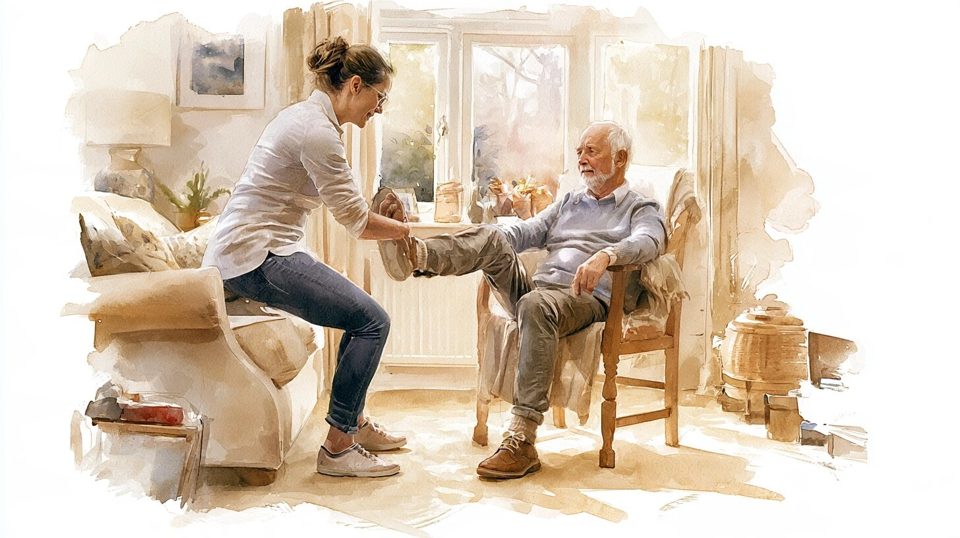
Some foot problems need more than the right shoe. For someone who has fallen, putting the shoes on can be as unsteady a moment as walking in them.
Age UK says that if a foot condition affects someone's health or mobility, they may be able to have routine podiatry on the NHS, and to ask the GP whether they are eligible. Ask about it if your mother has corns, hard skin, thick toenails or pain that makes her walk differently, if she has diabetes, or if she has insoles or a brace from years ago that may no longer fit. A podiatrist can also advise on shoes for her particular feet, and that advice comes first.
Bending down to fasten a strap or standing on one leg to pull on a shoe can tip someone off balance, and so can walking to the door in socks to find the shoes left there. Keep her indoor shoes where she sits to put them on, with a chair that has arms, and keep her slippers by the bed so she is not walking to the toilet at night in bare feet.
If she needs a hand at that point, a carer visiting in the morning can help her wash and dress, put on her socks and shoes and fasten them, and walk with her while she gets going. They can tell you when the slippers have stretched or the soles worn smooth, and if she has diabetes they can look at her feet as they help her dress and tell you or the GP about a red mark or a sore. A carer does not treat a foot problem or cut nails that need a podiatrist, and does not stand in for the falls service. The falls guide for families covers what to do if she does fall.
On PrimeCarers you look at carers near your mother, read their profiles, meet them first and agree the hours and routine with the carer you choose. Each carer has had their identity and right to work checked, an enhanced DBS check (or PVG in Scotland, Access NI in Northern Ireland) issued within the last 2 years, and an online interview. Carers are insured while they work. Experience of helping someone at risk of falling is the carer's own account on their profile, so ask about it when you meet.
Someone with her while she gets up and dressed
Tell us about your mother, the falls and the time of day she needs a hand. Carers near her who can help with washing, dressing and getting going apply, and you choose who to meet.
Carers on PrimeCarers charge £18 to £25 an hour with our fee included.
4.8 from 96 Google reviews2,000+ families helped
Questions
Questions families ask about shoes for an older parent
Age UK describes high-sided shoes with low heels, thin soles and a good grip as a great choice, and in the University of Washington study trainers and canvas shoes were linked with the lowest risk of a fall. Choose a pair with a strap or laces rather than a slip-on. If the balance problem is new or getting worse, ask the GP for a falls assessment as well, because a shoe will not fix the cause.
Sometimes. If her feet need shoes made to a prescription, for example because of diabetes or the shape of her feet, a podiatrist or orthotist can prescribe them, and the Royal College of Podiatry says those should be worn inside and outside the house. The way in is through the GP or the NHS podiatry service. For ordinary shoes, she buys her own.
Her own well-fitting shoes or closed slippers with a fastening, brought in by family if she went in without them. NHS Greater Glasgow and Clyde's guidance asks ward staff to contact the next of kin for suitable footwear. If her feet are swollen or dressed, pick a pair with Velcro that opens wide.
Let her choose the new pair, so they are hers, and look for one that is warm and soft inside but closed at the back with a strap and a firm sole. Put them where the old ones lived, by the bed or the chair. Tell her why in plain words: the old ones can come off on the stairs. Hearing the same from the GP or the falls service can help.