
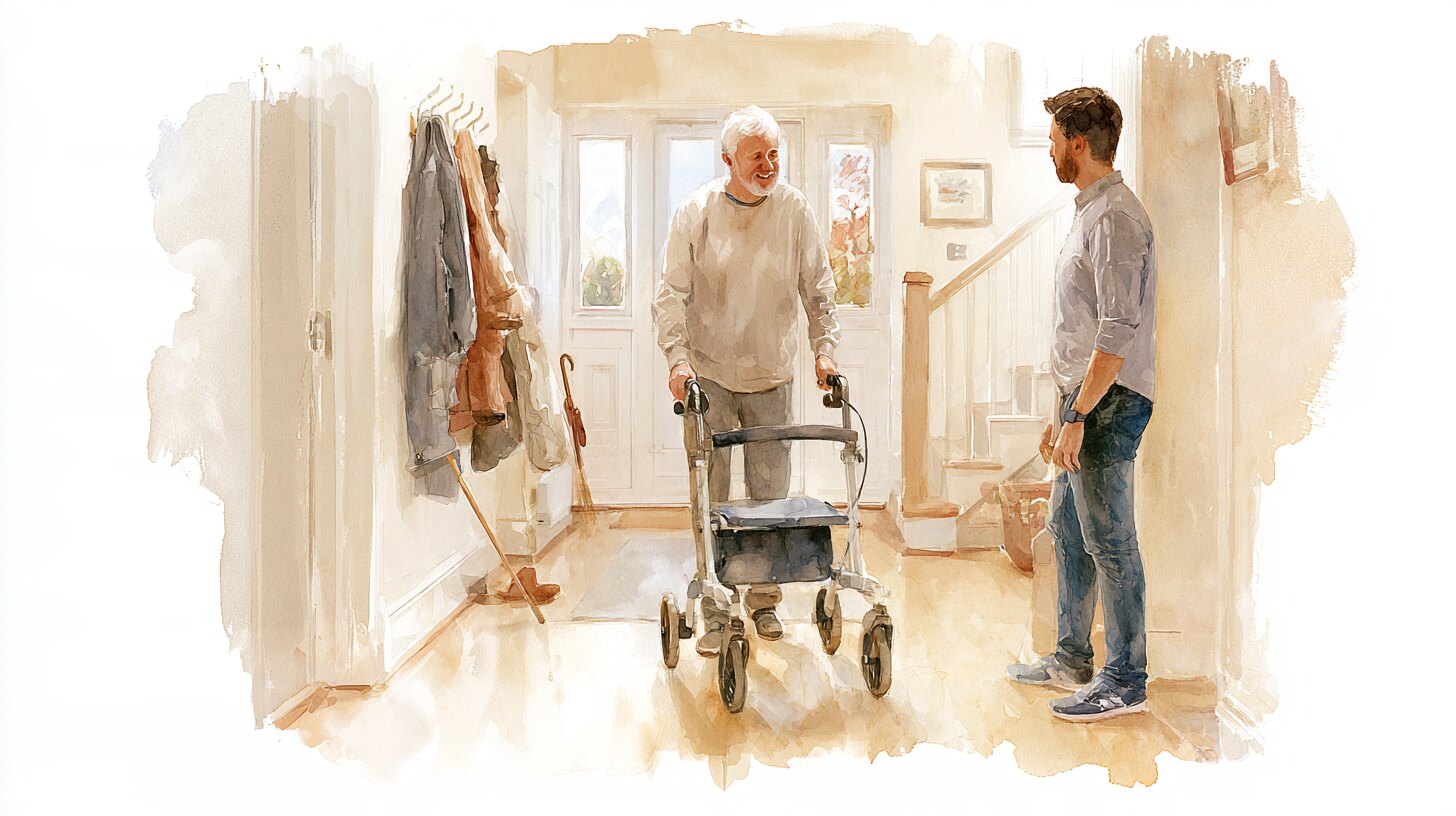
The short answer
- Have it measured before you buy itA physiotherapist or an occupational therapist watches somebody walk, picks the aid, sets the height and teaches the stairs. Asking costs nothing.
- Every aid trades steadiness for distanceA frame with no wheels is the steadiest thing there is and it barely leaves the house. A rollator will walk to the shops and rolls forward if the brakes are off.
- The stick goes in the hand opposite the weak legThe handle sits level with the crease of the wrist when the arm hangs down. Going upstairs the good leg leads, and coming down the stick goes first.
- The council and the NHS both lend equipmentAsk adult social services for a needs assessment, or ask a GP, physiotherapist or hospital staff about borrowing an aid.
PrimeCarers does not sell, supply or recommend equipment. This page is about choosing an aid, getting it fitted, and finding somebody to be alongside while your relative gets used to it.
Get it fitted first
Ask for a fitting before you buy anything
A walking aid changes how somebody stands, where their weight goes, and what they reach for when they are tired at the bottom of the stairs. The aid, the height and the hand all have to be right, and none of the three is obvious from a product photograph.
The person who settles it is a physiotherapist or an occupational therapist. They watch your relative walk, stand up out of a chair and turn round, and they choose from that rather than from a description over the phone. Guy's and St Thomas' falls guidance tells people to ask a physiotherapist what would suit them, and the NHS page on walking aids and wheelchairs says to ask for advice on the correct height and fit.
Pain in one hip, weakness down one side, poor balance and running out of stamina after fifty yards all look like unsteadiness from the kitchen doorway, and each points at a different aid. Parkinson's is the clearest case: Parkinson's UK states that the wrong walking aid can make freezing worse, which is why freezing and falls with Parkinson's is worth reading before anything is ordered.
What a fitting settles
- Whether the trouble is pain, weakness, balance or stamina, because each points at a different aid
- The height, measured against the wrist with the arm hanging down and shoes on
- Which hand a stick goes in, and whether one stick is enough
- How to stand up out of a chair with it, and how to take the stairs
- Whether the house needs two, one kept upstairs and one kept down
What buying it unmeasured leaves open
- An aid chosen from a photograph because it looked sturdy or folded small
- A frame still set to the height of whoever used it before
- A rollator bought for a garden with three steps down to it
- A stick carried in the air, which NHS physiotherapists warn is unsafe
- Nobody to ask when the rubber tip wears smooth or a handle works loose
If a fall has already happened, what to do after a fall comes first. The NICE guideline on falls in older people sets out what should follow one: a falls prevention exercise programme, and a home hazard assessment that NICE says an occupational therapist should carry out wherever possible.
What each aid trades
From a stick to a wheelchair, and what each one asks of you
Seven things sit behind the words walking aid, and they are not a ladder from worse to better. Each one steadies somebody more and lets them go less far, or the other way about. Reading that trade-off is most of the choice.
From a stick to a wheelchair, and what each one trades
Read down the list and the two bars swap over. The aids that hold somebody steadiest are the ones that keep them closest to home.
One walking stick
IndoorsOutdoorsSteadies
Gets you out
- It gives
- A point of balance on one side, and somewhere to put a little weight when a hip or knee hurts.
- It asks
- One free hand, and legs that can still carry most of the weight. It goes in the hand opposite the weaker leg.
Two sticks, or elbow crutches
IndoorsOutdoorsSteadies
Gets you out
- It gives
- Support on both sides at once, so weight can be kept off a painful or healing leg.
- It asks
- Both hands, a firm grip and arm strength. Elbow crutches take practice, and a physiotherapist teaches them.
A frame with no wheels
IndoorsSteadies
Gets you out
- It gives
- The steadiest base of any walking aid. All four feet are on the floor while the person steps.
- It asks
- Lifting the frame and placing it down for every single step, which is slow and tiring. It cannot go on stairs.
A wheeled walking frame
IndoorsSteadies
Gets you out
- It gives
- Almost the steadiness of the frame above, with no lifting: two wheels at the front, two feet at the back.
- It asks
- Flat floors and room to turn. South Tees Hospitals say wheeled frames are designed for indoor use.
A three-wheeled frame
IndoorsOutdoorsSteadies
Gets you out
- It gives
- Brakes, a narrower turn than a four-wheeled frame, and it folds for the car. There is no seat.
- It asks
- Enough hand strength to work the brakes, and care on kerbs. It is not for stairs.
A rollator with a seat
OutdoorsSteadies
Gets you out
- It gives
- Four wheels, brakes and a seat, so a longer walk can be broken into stages with a rest in between.
- It asks
- Hand strength for the brakes, because it rolls forward if it is leaned on. Not for stairs, and not to be sat on while moving.
A wheelchair for distance
OutdoorsSteadies
Not a walking aid
Gets you out
- It gives
- The hospital appointment, the garden centre and the family wedding, without the walk that would have ended them.
- It asks
- Somebody to push or the arm strength to self-propel, and a car boot that takes it. The NHS wheelchair service assesses and lends.
Two rows deserve saying out loud. A frame with no wheels is the steadiest walking aid made, and it asks somebody to lift it and set it down for every step, which is slow enough that people give up and hold the furniture instead. A rollator is the opposite. It will walk to the postbox and back, and it moves whether the person is ready or not, so it suits somebody with the hand strength for the brakes. South Tees Hospitals note that wheeled frames are designed for indoor use, which is why a house often ends up with two aids rather than one.
The condition usually narrows it before the therapist does. Weakness down one side changes which hand can hold anything, and transfers with one-sided weakness covers the getting up and sitting down. Somebody recovering from a hip fracture is usually sent home with a frame and moved down to sticks as the leg takes weight again, so the first aid is a stage rather than a verdict. With MS, the aid that suits a good morning may not suit a tired evening, which is why mobility aids for MS are planned around the bad days. With osteoarthritis in the hips, knees or feet, NICE suggests considering a walking aid such as a stick, and arthritis and care at home covers the rest of the house room by room.
Height, side and stairs
How the height is set, which hand it goes in, and the stairs
These are the things a physiotherapist teaches in ten minutes and a family is left to guess at when an aid arrives in a box. Knowing them lets you see whether what your relative does at home matches what they were shown.
- 1
Set the height against the wrist
Every aidStanding up straight with shoes on and arms hanging loose, the top of the handle should come level with the crease of the wrist, which is how Guy's and St Thomas' put it. Check every leg is on the same notch. - 2
Put a single stick in the opposite hand
SticksNHS Lanarkshire guidance is to hold the stick in the hand opposite the weak or painful leg, so the stick and that leg meet the ground together. Where the problem is balance rather than pain, the same guidance says use whichever hand is more comfortable. - 3
Move the aid, then the weaker leg, then the other
WalkingThe stick or frame goes forward about one step length, then the weaker leg comes level with it, then the stronger leg. With a frame, step into the middle and leave a gap at the front bar. - 4
Going up, the good leg leads
StairsUp: the good leg onto the step, then the affected leg to the same step, then the stick. Down: the stick onto the lower step first, then the affected leg, then the good leg. Hold the handrail with the free hand. Frames and rollators do not go on stairs at all. - 5
Stand up from the chair, never from the frame
ChairsPush up on the arms of the chair and take hold of the aid once you are standing. Pulling up on a frame tips it, and South Tees Hospitals say plainly not to stand holding the handles.
Brakes, seats and upkeep
What a rollator's seat is for, and the part that wears out
A rollator seat is for resting partway through a walk, with the brakes locked and the frame standing still. It is not a chair to be pushed in, and not somewhere to sit on a slope. The brakes and the rubber tips decide whether any of it is safe.
NHS Lanarkshire's guidance on the four-wheeled walker is worth following closely. Lock the brakes before sitting, hold the handles while lowering yourself, and push up on the handles to stand. Keep your fingers near the brakes while walking so the frame cannot run away downhill, and do not hang shopping bags from the handles, because the weight on the back tips it when the person lets go.
Before a walk, and once a month
0 of 9 ticked
Before you set off
Once a month
Where the aid does not go
If the worry underneath this is what happens when nobody is in the house, an aid is only part of the answer. Pendant alarms and sensors covers the rest, and the right equipment to aid the elderly covers the rails, raisers and bathroom equipment beside it.
How to get one
The council, the NHS, and buying it yourself
There are four ways an aid reaches the house, and they are less alternatives than a sequence. The two free ones are worth starting even if you end up buying something, because both put somebody in front of your relative.
| How to start it | Who looks at your relative | What it costs | Worth knowing | |
|---|---|---|---|---|
| A council needs assessment | Ring adult social services, or apply on the council website. | An occupational therapist, at home, walking round the house. | Free to ask for. Equipment and minor adaptations are not chargeable. | A minor adaptation is one costing £1,000 or less. Age UK warns waits for an OT can be long. |
| The NHS equipment loan | Ask the GP, a physiotherapist, an occupational therapist or the hospital ward. | The professional who refers, and the store that issues the aid. | Lent free, for as long as it is needed. | The store is run jointly by the NHS and the council, so either door leads to it. |
| Buying it privately | A mobility shop, a large pharmacy or an online retailer. | Nobody, unless you ask. Age UK says ask to be assessed face to face if you have any concerns. | You pay, and you own it. | Look for the BSI Kitemark, try it first, and check the returns policy. |
| VAT relief on what you buy | Tell the supplier before you order and ask whether the item qualifies. | You sign a written declaration, or somebody signs on your behalf. | Zero-rated on qualifying goods, so the VAT comes off the price. | GOV.UK says you do not qualify if you are elderly but not disabled. Sticks and frames are not named in the published list. |
A council needs assessment
- How to start it
- Ring adult social services, or apply on the council website.
- Who looks at your relative
- An occupational therapist, at home, walking round the house.
- What it costs
- Free to ask for. Equipment and minor adaptations are not chargeable.
- Worth knowing
- A minor adaptation is one costing £1,000 or less. Age UK warns waits for an OT can be long.
The NHS equipment loan
- How to start it
- Ask the GP, a physiotherapist, an occupational therapist or the hospital ward.
- Who looks at your relative
- The professional who refers, and the store that issues the aid.
- What it costs
- Lent free, for as long as it is needed.
- Worth knowing
- The store is run jointly by the NHS and the council, so either door leads to it.
Buying it privately
- How to start it
- A mobility shop, a large pharmacy or an online retailer.
- Who looks at your relative
- Nobody, unless you ask. Age UK says ask to be assessed face to face if you have any concerns.
- What it costs
- You pay, and you own it.
- Worth knowing
- Look for the BSI Kitemark, try it first, and check the returns policy.
VAT relief on what you buy
- How to start it
- Tell the supplier before you order and ask whether the item qualifies.
- Who looks at your relative
- You sign a written declaration, or somebody signs on your behalf.
- What it costs
- Zero-rated on qualifying goods, so the VAT comes off the price.
- Worth knowing
- GOV.UK says you do not qualify if you are elderly but not disabled. Sticks and frames are not named in the published list.
Sources: the NHS guide to walking aids and wheelchairs, NHS guidance on home adaptations, Age UK factsheet 42 (March 2026), and GOV.UK on VAT relief for disabled people.
The council route is the one families skip, and it is the one that brings an occupational therapist into the house. How to ask for a care needs assessment sets out what to say on the phone. If your relative is in hospital, or coming home on crutches after a knee replacement, raise the walking aid with the ward before discharge, and hospital discharge explained has the order things happen in. If they are over State Pension age and need help with personal care or supervision, Attendance Allowance is paid in cash and can be spent on equipment.
The first weeks
Getting used to it, and when a wheelchair is the kinder answer
The aid arrives at the right height, and then it has to become a habit in a house where the furniture has been doing the job for two years. That takes a few weeks, and it is the part nobody supervises.
Somebody alongside for the first walks
The first fortnight
Go back if it is not working
Not a failure
A wheelchair for distance is not a step down
Hospital, shops, family
If you want somebody alongside while your relative gets used to a new frame, you can search for carers near you and compare their rates and message the ones you like before committing to anything. Carers on PrimeCarers charge around £18 to £25 an hour with our fee included, against £28 to £35 an hour for an agency visit. Every carer has had an identity check, a right to work check and an accepted criminal-record check (Enhanced DBS issued within the last 2 years, DBS Update Service, Scottish PVG or Access NI), and has been interviewed online. Every visit booked through PrimeCarers is insured, by the carer's own policy or by cover we arrange where they do not hold one. We do not check qualifications or training, so ask a carer what experience they have of helping somebody walk with a frame.
People refuse aids because of what a stick says about them rather than what it does. Naming the thing they want to keep doing, the Sunday walk or the bus into town, usually goes further than talking about safety, and companionship visits built round that walk are a different booking from personal care.
For one long day away from home, such as a family wedding, a wheelchair can be borrowed or hired for the day while the frame stays at home. Hiring a wheelchair, scooter or commode for a wedding explains where to look and what to check before the day.
Questions
Questions families ask about walking aids
The top of the handle should be level with the crease of your wrist when you stand up straight in your shoes with your arm hanging by your side. Guy's and St Thomas' NHS Foundation Trust gives that measurement, and it is the same test for a frame. If you use two sticks, or any frame, check every leg is set to the same notch. A stick that is too tall pushes the shoulder up and gives less support when somebody leans on it.
In the hand opposite the weak or painful leg, so the stick and that leg meet the ground at the same moment. NHS Lanarkshire physiotherapy guidance says the same. Where the problem is balance rather than pain in one leg, that guidance says to hold the stick in whichever hand is more comfortable. It feels wrong for about a week, which is the usual reason people swap it back.
Yes. The NHS says you can borrow a walking frame, and some types of walking stick, and the people to ask are a GP, a physiotherapist, an occupational therapist or hospital staff. The local equipment store is run jointly by the NHS and the council, and equipment is lent for as long as it is needed. You can also ask adult social services for a needs assessment, which brings an occupational therapist to the house.
It depends what the person needs. A frame without wheels is steadier, because all four feet are on the floor while somebody steps, and it is meant for indoors. A rollator has four wheels, brakes and a seat and covers far more ground, but it moves whether or not the person is ready and needs hand strength for the brakes. Neither goes on stairs. A physiotherapist watching your relative walk is the person to settle it.
VAT relief exists for goods designed or adapted for disabled people, and you confirm in writing that you qualify. GOV.UK says you do not qualify if you are elderly but not disabled. Walking sticks and frames are not named in the published list of qualifying goods, so ask the supplier whether the item they are selling qualifies before you order. The separate five per cent rate for people aged 60 or over applies only to mobility aids supplied and installed in the home, such as grab rails and stair lifts.