
The short answer
- Freezing is a symptom, not a choiceThe feet stop while the person is awake and trying to move. Parkinson's UK describes it as feeling glued to the ground.
- Give one cue, and give it a momentA beat, a count, a line on the floor or a shift of weight onto one leg unlocks the step. Pulling an arm does the opposite.
- Four reasons a Parkinson's fall happensBalance that no longer corrects, steps that speed up and shrink, freezing, and blood pressure dropping on standing.
- Nobody is lifted off the floor by handKeep the person warm, help them up only if they can get up themselves, and ring 999 if they cannot.
Doses and timings belong to the Parkinson's nurse and the specialist. Nothing here is a reason to change medication at home.
What is happening
Why the feet stop when the person wants to go
Freezing of gait is a sudden inability to take the next step. Parkinson's UK describes the feeling as the feet being glued to the ground, says an episode can last a few seconds or thirty seconds or longer, and says more than half of people with Parkinson's may experience it. It starts in the same few places.
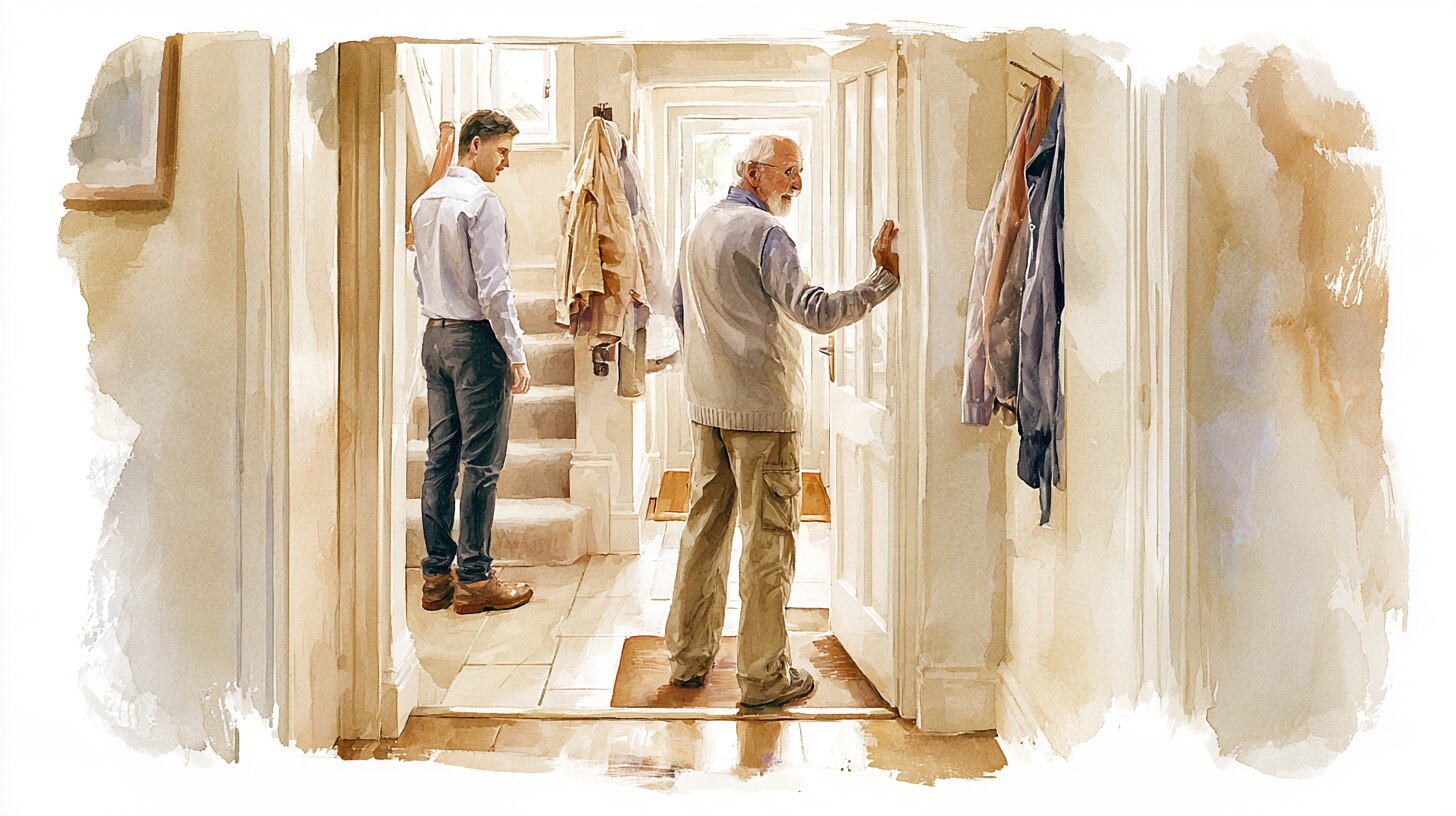
Doorways and thresholds
A narrow gap, and a change of floor
Turning round
At the sink, the bed, the armchair
The trip to the toilet
Especially in the night
Crowded or closed-in spaces
Shops, cafes, a full hallway
When somebody is hurrying them
Or asking a question mid-step
When a dose is wearing off
The hour before the next tablet
Freezing is not the same as an "off" period. In an off period the person is slow and stiff all over, while freezing takes one movement away and leaves the rest of them working. They overlap, because a freeze is more likely while the medication is wearing off, which is why medication on time, every time and 'off' periods and what helps sit next to this page. If freezes cluster at the same point in the dose cycle, write the times down for the Parkinson's nurse, whose decision it is, and the Parkinson's care guide sets out who does what.
What helps in the moment
The cues that get the feet moving again
A cue is a signal from outside that stands in for the start signal the brain is no longer producing: a beat, a line on the floor, a change of weight. One at a time works better than several, and the one that suits your relative may not suit somebody else, so try a few on a calm afternoon rather than in a crowded shop.
The order that works
- 1
Stop
Both of you stop walking. Nobody pulls and nobody talks over it.
- 2
Steady
Stand where they can see you, close enough to steady them if they sway.
- 3
One cue
Give a single cue, then be quiet. Two prompts at once is two tasks.
- 4
One big step
Ask for a long, deliberate first step rather than a shuffle, then keep the rhythm going.
Cues to try, one at a time
A beat to walk to
Say "left, right, left, right" out loud, hum a tune with a steady beat, or start a metronome app on your phone.
A beat from outside stands in for the timing signal the brain is no longer giving.
A countdown into the step
Say "one, two, three, step" or "ready, steady, go". Once they are moving, count the steps in tens.
It turns an open demand into one instruction with a clear start.
Something to step over
Lay strips of coloured tape across the floor at the trouble spots, about a step apart, or use a stick or laser that puts a line on the floor ahead of the feet.
Stepping over a target is easier than deciding to start walking.
A shift from one foot to the other
Ask them to move their weight onto one leg, or to rock gently from side to side, so the other foot comes free.
A foot cannot lift while it is still carrying the body.
Your foot, put down in front of theirs
Place your foot across the floor in front of theirs and ask them to step over it.
It makes an invisible task visible, and nobody has to pull anybody.
A long step rather than a shuffle
Ask for big steps, and say it out loud while they walk: "big steps", "walk tall".
Steps shrink before they stop, so asking for a long one asks for the opposite of the freeze.
What takes their balance away
- Pulling an arm or pushing them forward
- Hurrying them, or saying that you are late
- Asking a question while they are trying to start
- A walking aid bought without a physiotherapist looking at it first
A physiotherapist is the person to settle this with. NICE recommends Parkinson's-specific physiotherapy for people experiencing balance or motor function problems, at recommendation 1.7.3 of its guideline on Parkinson's disease in adults, and the referral can come from the GP or the Parkinson's nurse, as getting a Parkinson's physio and keeping the exercises going explains. Ask for the chosen cue to be written down in plain words, so the same one is used by you, the carer, and whoever is there on a difficult afternoon.
Parkinson's UK warns that the wrong walking aid can make freezing worse, so ask for advice before buying a frame, a stick or a laser attachment. A cue that works one week may stop working, and Parkinson's UK's page about freezing holds the fuller set to go back to.
Why these falls differ
Four reasons a fall happens, and what each one looks like
General falls advice starts with trip hazards. With Parkinson's the cause is more likely to be inside the person than on the floor, and naming it changes what you do next. More than one can be at work in the same fall.
| What it looks like | When it happens | What helps | |
|---|---|---|---|
| Balance that no longer corrects itself | A nudge, a reach or a turn takes them over, and the arms do not come out in time. | Turning, reaching up to a cupboard, being knocked in a busy room. | Parkinson's-specific physiotherapy, which NICE recommends for balance problems, and a walking aid chosen with advice. |
| Steps that speed up and shrink (festination) | The walk gets faster while the steps get shorter, the body running ahead of the feet, and they cannot stop. | On a slope, on the last few feet to a chair or the toilet, whenever there is a reason to hurry. | Stopping on purpose and starting again, long strides rather than a shuffle, and a rhythm to walk to. |
| Freezing | The feet stop and the top half of the body carries on, which is what turns a freeze into a fall. | Doorways, turns, thresholds, tight spaces, and while a dose is wearing off. | The cues above, and taking the doorway or the tight turn out of the route where the house allows it. |
| Blood pressure dropping on standing | Dizziness, blurred vision or fainting on getting up, which the NHS lists among the symptoms of Parkinson's. | Getting out of bed, standing after a meal, standing after sitting still a long while. | Sitting on the edge of the bed with the feet down for a few minutes, then standing slowly. Tell the GP, because the medicines can be part of it. |
Balance that no longer corrects itself
- What it looks like
- A nudge, a reach or a turn takes them over, and the arms do not come out in time.
- When it happens
- Turning, reaching up to a cupboard, being knocked in a busy room.
- What helps
- Parkinson's-specific physiotherapy, which NICE recommends for balance problems, and a walking aid chosen with advice.
Steps that speed up and shrink (festination)
- What it looks like
- The walk gets faster while the steps get shorter, the body running ahead of the feet, and they cannot stop.
- When it happens
- On a slope, on the last few feet to a chair or the toilet, whenever there is a reason to hurry.
- What helps
- Stopping on purpose and starting again, long strides rather than a shuffle, and a rhythm to walk to.
Freezing
- What it looks like
- The feet stop and the top half of the body carries on, which is what turns a freeze into a fall.
- When it happens
- Doorways, turns, thresholds, tight spaces, and while a dose is wearing off.
- What helps
- The cues above, and taking the doorway or the tight turn out of the route where the house allows it.
Blood pressure dropping on standing
- What it looks like
- Dizziness, blurred vision or fainting on getting up, which the NHS lists among the symptoms of Parkinson's.
- When it happens
- Getting out of bed, standing after a meal, standing after sitting still a long while.
- What helps
- Sitting on the edge of the bed with the feet down for a few minutes, then standing slowly. Tell the GP, because the medicines can be part of it.
Sources: the NHS on the symptoms of Parkinson's disease, Parkinson's UK on falls and dizziness, and NICE guideline NG71.
That last row is the one families are least ready for. NICE guideline NG71 says that when somebody with Parkinson's develops orthostatic hypotension, the medical name for that drop, their existing medicines should be reviewed for a possible cause, and it lists dopaminergics alongside blood pressure tablets, anticholinergics and antidepressants. The tablets that keep a person moving can be part of why they feel faint when they stand. That belongs to the Parkinson's nurse or the GP, and it is not solved at home by skipping a dose: the same guideline says Parkinson's medicines should not be withdrawn abruptly. Parkinson's UK on falls and dizziness covers the other causes.
Everything true of any older person falling is still true here. How to deal with elderly falls covers the general ground, and mobility and falls care the help that brings the number down.
When they are on the floor
What to do when somebody is down, and why not to lift them
This is the part worth reading before it happens, because there is no time to look it up afterwards. The NHS advice is short: keep the person comfortable and warm, help them up only if they are able to get up themselves, and do not try to lift them yourself.
- 1
Get down to them, and leave them where they are
The first minuteKneel beside them and say their name. NHS inform advises taking a few minutes to check for pain and injury, because the pain of an injury can take a while to be felt. - 2
Decide whether this is a 999 call
Straight awayThe NHS says to call 999 if the person may have injured their head, back, neck or hip, or if they cannot get up. Bleeding, a limb that looks wrong, or anticoagulant medicine mean ringing now. - 3
Keep them warm while you wait
Every timeA blanket or a coat over them, legs and feet included. NHS inform notes that lying in one position too long leaves people stiff and sore, damages the skin and can leave them dehydrated, so help them shift gently now and then. - 4
If they are not hurt, let them get themselves up
In stages, at their paceThe NHS route is to roll onto the side, push up onto hands and knees, crawl to something heavy such as an armchair, bring one foot forward and stand slowly holding on. Your job is to hold the chair still. - 5
Do not lift them by hand, however light they are
No exceptionsLifting somebody off the floor by hand risks a second injury to them and a back injury to you, and it can fail halfway with both of you down. If they cannot get up, ring 999 or 111 and let the call handler decide. - 6
Tell the GP and the Parkinson's nurse afterwards
Within a day or twoParkinson's UK says that after a fall somebody with Parkinson's should always see their GP, even when they do not seem hurt, because the GP can look into why it happened.
If the fall ended at the hospital, after a fall and a trip to A&E covers what to put in place before your relative comes home. If you are the one helping them up from chairs day to day, moving elderly parents safely covers the handling, and the NHS page on falls is a short read worth keeping open. If your relative is alone for part of the day, ask the occupational therapist about alarms and fall detectors too.
The home, and the hours
The changes worth making, and being there when it happens
Two things bring freezes and falls down at home. The first is taking the trigger points out of the routes your relative walks most. The second is having somebody in the house at the times of day it goes wrong, which is different from hovering over them all day.
A walk round the house, and a fortnight of notes
0 of 9 ticked
Doorways, floors and routes
The bathroom, the chair and the bed
Knowing when it happens
That last line is where the care decision comes from. Standing beside somebody all day is not a plan, and it is not what most people can pay for. Buy the hours the notes point at: the morning while the first dose comes on, the bathroom trip after lunch, the hour before bed.
When you are ready to look at people, search for carers near you and compare what hours they can cover. PrimeCarers is an introductory service: you choose the carer and agree the visits and the rate with them directly. Before a profile appears, a carer's identity and right to work are checked, an accepted criminal-record check (Enhanced DBS issued within the last 2 years, DBS Update Service, Scottish PVG or Access NI) is confirmed, and the carer is interviewed online. Every visit booked through PrimeCarers is insured, by the carer's own policy or by cover we arrange where they do not hold one. What a carer says about their Parkinson's experience is their own account on their profile, so ask on the phone which cue they use and how they keep to a medication timetable. Whether a carer can give medication covers the tablets.
Questions
Questions families ask about freezing and falls
Not on its own. Freezing is a recognised symptom of Parkinson's, and Parkinson's UK says more than half of people with Parkinson's may experience it. What matters is whether it is new, whether it keeps landing at the same point in the dose cycle, and whether it has caused a fall. Write down when it happens and take that to the Parkinson's nurse.
Say very little. Stand where she can see you, stay calm, and wait a few seconds. Then give one cue and stop talking: "one, two, three, step", or a steady beat she can walk to. Parkinson's UK suggests shifting her weight onto one leg so the other foot comes free, and the Parkinson's Foundation suggests putting your foot down in front of hers to step over. Do not pull her arm and do not hurry her.
Ask the physiotherapist before you buy anything. A laser that puts a line on the floor to step over is one of the visual cues Parkinson's UK describes, and strips of coloured tape across the floor do the same job for the price of a roll of tape. Parkinson's UK also warns that the wrong walking aid can make freezing worse.
Yes. Parkinson's UK says that after a fall somebody with Parkinson's should always see their GP, even when they do not seem hurt, because the GP can look into the reasons behind it. If he hit his head, takes blood-thinning medicine, or the pain is getting worse rather than better, that is a 111 or 999 call.
No, and it is not something to ask for. Lifting somebody off the floor by hand is unsafe for both people, and the NHS advice is not to try it. What a carer who is there can do is everything else: keep him warm, check him for injury, ring 999 if he is hurt or cannot get up, talk him through getting himself up in stages if he is not, and write down what happened.
Keep notes for a fortnight on every freeze and every fall: the time, the place, and how long since the last tablet. The hours the pattern points at are the hours to cover. Visits are agreed directly with the carer, so they can move as the pattern moves, and the notice period in the client contract is 48 hours for hourly care. Visits are usually an hour or more, at £18 to £25 an hour.