
The short answer
- The therapists decide how each move is doneA physiotherapist and an occupational therapist set the method, the equipment and the number of people. Nothing here replaces that assessment, and no family should be taught a lift by a web page.
- The move is planned around the stronger sideThe stronger leg takes the weight and the stronger hand pushes or holds on. Where the chair stands and which way the turn goes are part of the plan.
- The weak arm is not used to pull somebodyThe muscles that hold that shoulder in place have been weakened, and the joint can be pulled partly out of its socket. Hands belong on the trunk, or on a handling belt.
- Ring the therapy team before you struggle onNew pain, a near miss, or a morning that now takes two of you are reasons to ask for a review rather than reasons to try harder.
Figures on this page are what families pay carers on PrimeCarers, £18 to £25 an hour with our fee included, against £28 to £35 an hour at an agency.
What one-sided weakness changes
Why a transfer after a stroke is planned around the stronger side
The Stroke Association puts weakness on one side of the body at about 8 in 10 people after a stroke. Weakness on one side is called hemiparesis, and paralysis on one side is called hemiplegia. Four separate things can be affected, and a transfer has to account for all of them.
A leg that will not hold the weight
Standing and turning
An arm and hand that cannot push
Holding on, pushing up
The muscles around the middle
Staying upright once they are up
Feeling, vision and attention
Not noticing one side
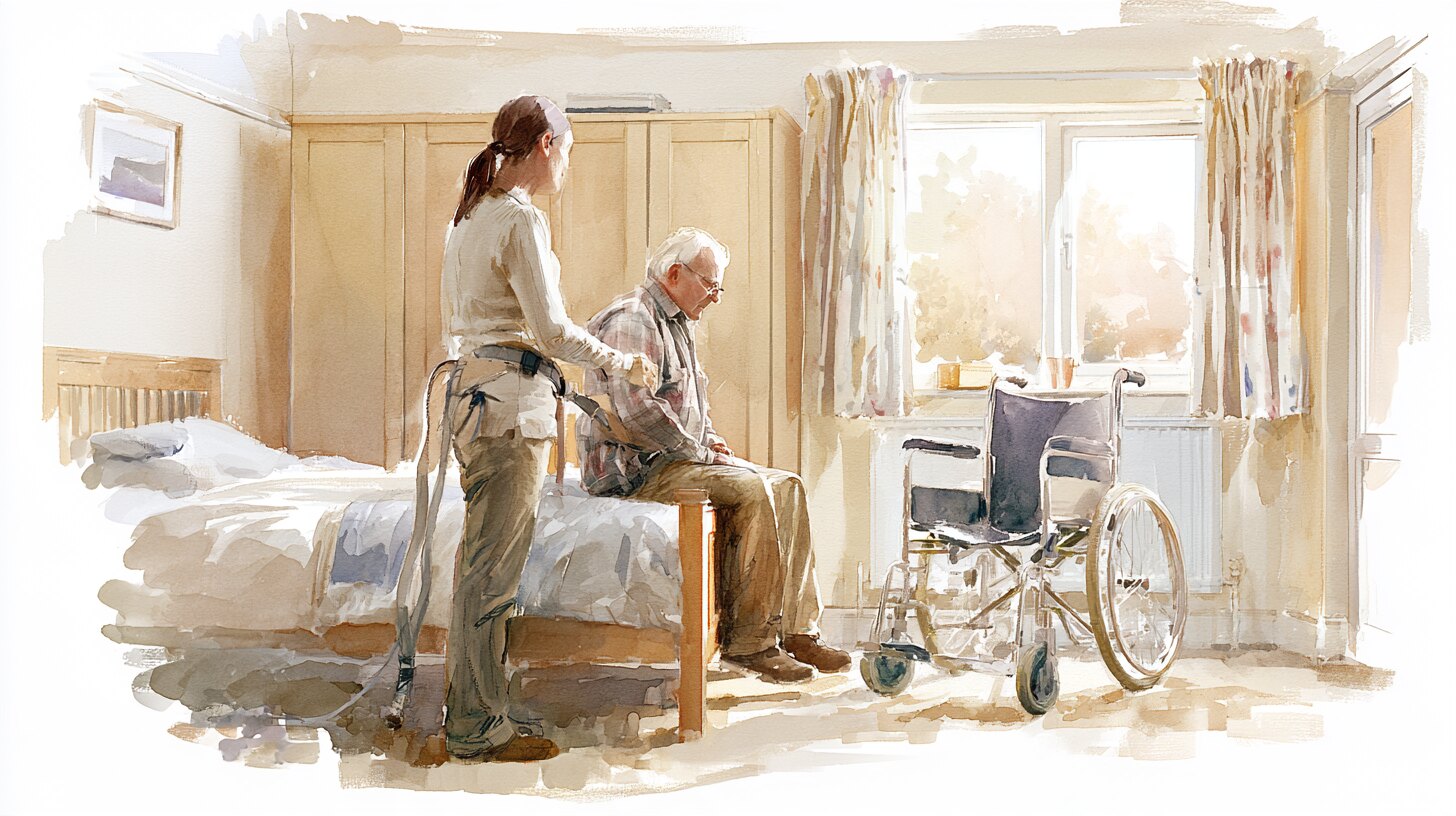
That is why therapists work towards the stronger side. The stronger leg can hold the weight while the other follows, and the stronger hand can reach a rail. So the chair is placed on a particular side of the bed, the turn goes a particular way, and the grab rail goes up where that hand can find it. None of it should be rearranged because the room looks tidier the other way. The physiotherapist advises on seating and positioning, and will show your family or a carer how to help with getting in and out of bed.
If your relative has only just come home, the first weeks home after a stroke covers what else lands that month, and rehab at home after a stroke explains how the daily practice fits around it. Where speech or understanding have been affected, read aphasia and communication after a stroke as well, because a transfer depends on the person knowing what is about to happen and being able to say stop. The Stroke Association explains muscle weakness after a stroke in more detail.
The shoulder on the weak side
Why nobody pulls on the weak arm
Shoulder pain is common after a stroke and it usually happens on the affected side. One cause is subluxation, a partial dislocation: the muscles that normally hold the joint in place have been weakened, and the weight of the arm can pull and stretch the soft tissues. An arm in that state cannot be used as a handle.
What careful handling looks like
- The arm supported the way the therapist set it up, on pillows or foam supports if that is what they provided
- Hands on the trunk or hips, or on a handling belt the therapist has fitted and shown you
- Everybody who helps told how that shoulder is handled, including visitors and any new carer
- The arm kept where it cannot catch behind the person or hang down during a move
- New shoulder pain reported to the GP or the stroke team, because the cause can be assessed and treated
What damages a weak shoulder
- Pulling on the weak hand or forearm to bring somebody forward in a chair
- Lifting under both armpits, which puts the whole weight through a shoulder that cannot hold it
- Taking hold of that arm to stop a fall
- Moving the arm further than the therapist has said it can go, or faster
- A sling, strap or support nobody has prescribed and nobody is reviewing
NICE recommends that people after a stroke, and their families and carers, are given information on how to prevent pain or trauma to the shoulder where there is a risk of it. If nobody has had that conversation with you, ask for it. The Stroke Association page on shoulder pain after stroke is clear that a therapist should make sure anyone handling the arm knows how to do it with care and without straining the joint, and that correct positioning helps prevent the shoulder blade and upper arm bone moving apart.
Bed, chair, toilet and car
The four transfers a week is built around
Almost every move your relative makes is one of four. Each has its own difficulty, its own equipment and its own question for the therapist. What follows is what good practice looks like and what to ask to be shown, not a method to copy.
Bed to chair
First thing, and again at bedtimeRolling onto one side, bringing the legs over the edge of the bed, sitting up, then standing or sliding across to a chair or wheelchair beside the bed.
Where the room allows, the chair is placed on the stronger side, so the stronger hand has something to push against and the stronger leg takes the weight as the person comes up.
- Bed lever
- Profiling bed
- Slide sheet
- Transfer board
- Handling belt
Ask the physiotherapist to show you which side the chair should stand on, what height the bed needs to be, and what the weak arm should be doing while the person moves.
Chair to standing
Several times a dayComing forward to the front of the seat with the feet drawn back, then standing, turning a few degrees and sitting down on the other surface.
The stronger arm reaches for the arm of the chair or the rail. The turn is usually made towards the stronger side, because that is the leg that can hold the weight while the other one follows.
- Chair raisers
- Riser recliner chair
- Handling belt
- Turntable
Ask whether the chair is the right height. A seat that is too low is one of the ordinary reasons a stand needs two people when it did not need to.
Chair to toilet or commode
Often in a hurryThe same stand and turn as any other transfer, but in the smallest room in the house, with clothing to manage and usually not much warning.
A grab rail is fitted where the stronger hand can reach it from the approach the therapist has chosen, which is why the rail goes up after somebody has watched the trip rather than before.
- Raised toilet seat
- Grab rail
- Toilet frame
- Commode
- Perching stool
Ask the occupational therapist to watch a real trip to the toilet, not a demonstration in the living room. Speed, clothing and the doorway are what make this one different.
Getting into a car
Every appointmentSitting sideways onto the seat with both feet still outside, then bringing the legs round one at a time. The seat height, the door opening and the kerb decide how hard it is.
The car is parked so the person approaches the seat from their stronger side where that is possible, and a turntable or swivel cushion takes the twisting out of the second half of the move.
- Turntable or swivel cushion
- Transfer board
- Handling belt
Ask the occupational therapist to try it with your own car on your own drive. A transfer that works in the hospital car park can fail on a sloping driveway.
What a therapist prescribes
The equipment an occupational therapist puts in, and how it arrives
Most of what makes a transfer safe after a stroke is small, cheap and specific to one person. These are the items families see most often, described as the Health and Safety Executive describes them.
A handling belt
Something to hold that is not an arm
A transfer board, sometimes a banana board
Sitting across, rather than standing
A turntable
Taking the twist out of a turn
A bed lever or support rail
Getting up and out of bed
A perching stool
Sitting without going all the way down
Get the assessment before you buy any of it. NICE recommends assessing people after a stroke for their equipment needs, and checking whether their family or carers need training to use it, with the assessment done by an appropriately qualified professional. The route is a council needs assessment, free to ask for and not dependent on income. An occupational therapist visits, watches the transfers and works out what is needed, and the NHS social care guide says that equipment or a change to the home costing less than £1,000 must be provided free of charge where the assessment finds it is needed. The care needs assessment explains how to ask, and the right equipment to aid the elderly goes through the smaller items room by room.
The HSE guidance on moving and handling equipment lists what each item is for. Hoists, slings and the two-carer question are a subject of their own, and transfers, hoists and when a visit needs two carers covers them, including the checks before every hoist use and how a Disabled Facilities Grant works for building work such as a ceiling track.
When one person is not enough
No weight through the legs at all, and the signs it has stopped being a one-person job
Some strokes leave a person unable to put any weight through their legs. At that point the move is no longer a stand and a turn, and it cannot be made safe by trying harder.
Has any of this been true in the last month?
0 of 9 ticked
Your relative
The move itself
You
Any of these is a reason to ring the community stroke team, the occupational therapist or adult social care and ask for the moving and handling plan to be looked at again. A review may change the equipment, the method or the number of people, and one new piece of equipment can turn two handlers back into one. If you are the person doing most of the helping, you can ask the council for a carer's assessment in your own right.
If the answer is that you need somebody else in the house for the transfers, search for carers near you and compare their rates, and ask each one what transfers they are confident doing and what equipment they have worked with. Carers on PrimeCarers are self-employed and set their own rates, typically £18 to £25 an hour with our fee included, against £28 to £35 at an agency. We are an introductory service rather than a care provider. We check identity, right to work and an accepted criminal-record check (Enhanced DBS issued within the last 2 years, DBS Update Service, Scottish PVG or Access NI) and interview every carer online, and how every carer is checked sets out what that covers. The profile shows the skills and experience the carer lists in their own words, which are for you to check with them, and references from past employers and families can appear on it alongside reviews from PrimeCarers bookings; we do not verify them, so follow up the ones that matter to you. A self-employed carer decides for themselves what they are competent to take on.
Where the hardest transfers are the night-time trips to the toilet, night care for falls and toilet trips covers what a waking night carer does. Where your relative is now hoisted, live-in care for someone who is bedbound or hoisted works through the week and the cost, and what an hour of care costs sets the arrangements side by side.
Questions
Questions families ask about transfers after a stroke
Towards her stronger side, in most cases, because that is the leg that can take the weight and the hand that can push or hold a rail. It is not a rule to apply on your own, though. The physiotherapist who has assessed her decides the direction, the seat height and where the chair stands, and writes it into her moving and handling plan. Ask them to show you on the bed and chair she uses.
No. Lifting under the armpits puts his whole weight through a shoulder whose muscles the stroke has weakened, and that joint can be pulled partly out of its socket. It is also the kind of handling that injures the person doing it. If getting him up needs a lift, it needs equipment and an assessment instead, and the therapy team can arrange both.
A curved transfer board. A transfer board is a smooth board bridging two surfaces so somebody can slide across sitting down rather than standing up, and the curved version reaches around a wheelchair wheel or into a car. An occupational therapist assesses whether one suits your relative, provides it and shows you both how it is used.
Do not try to hold them up. The Health and Safety Executive points out that trying to prevent a fall is the natural reaction, that it has injured both the helper and the person being helped, and that a helper standing in the right position may allow a controlled slide instead. Guide them down to the floor, make them comfortable, then decide how to get them up. Ring 999 if they have hit their head or are in pain.
Through an occupational therapist, after an assessment. Ask your relative's council for a needs assessment, which is free and does not depend on income, or ask the GP or the stroke team to refer them. The NHS social care guide says equipment or a change to the home costing less than £1,000 must be provided free of charge where the assessment finds it is needed. You can buy equipment yourself, but get it assessed first.
Not by itself. A live-in carer is one person in the house, so a transfer the plan says needs two handlers still needs somebody else to come in for it. What live-in care changes is the nights and the hours between visits. Transfers, hoists and when a visit needs two carers goes through the two-carer question and what a second carer adds to the cost.