
The short answer
- An assessment decides how a transfer is doneA moving and handling plan names the equipment, the technique and the number of handlers, and it is written before anybody tries it.
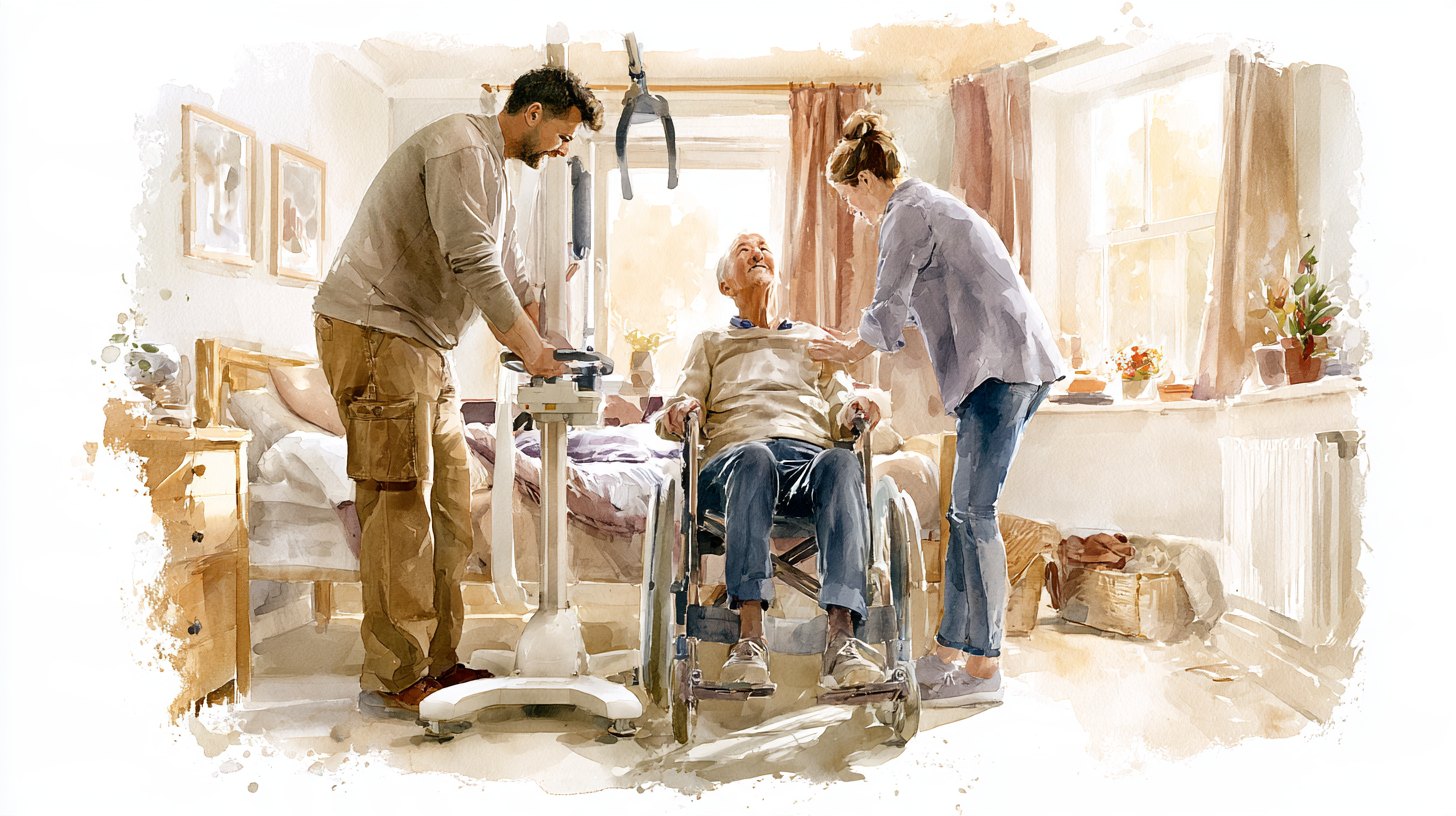
- A hoist transfer often needs two peopleHSE guidance is that a hoist can be worked by one person, but in many cases assessment shows two are needed: one on the hoist, one steadying and reassuring.
- The equipment does the liftingSlide sheets, turning discs, standing aids and hoists are what make a transfer safe, and most of it comes free from the council.
- Two carers for an hour costs two hourly ratesOne carer on PrimeCarers is £18 to £25 an hour with our fee included. Two carers for the same hour is £36 to £50.
Figures on this page are what families pay carers on PrimeCarers, £18 to £25 an hour with our fee included, against £28 to £35 an hour at an agency.
Five ways a transfer is done
From a steadying hand to a hoist, and where your relative sits
A transfer is any move between two surfaces: bed to chair, chair to commode, wheelchair to bath. There are five broad ways of doing one, and they differ in what the person can still do, what equipment carries the weight, and how many people have to be in the room.
Standing up with something solid to hold
Nobody hands onCan take their own weight and manage the movement, but needs something to push or pull against.
- Grab rail
- Bed lever
- Chair raisers
- Riser recliner chair
The rails and the height of the furniture do the work. A carer stays close and watches rather than holding on to anyone.
Getting up with prompting and someone close by
One carer, hands freeCan still do the movement, but loses the order of it, or loses confidence halfway and sits back down.
- Nothing beyond furniture at the right height
Talking somebody through a movement they can still do themselves keeps the strength and the confidence they have left.
Moving with a steadying hand and a small aid
One carer trained in that aidCan take some of their own weight and follow instructions, but cannot turn in bed or cross a gap safely alone.
- Slide sheet
- Turning disc
- Transfer board
- Walking frame
The aid moves the person and the carer guides and steadies. Dragging somebody up the bed by hand, or pulling them up under the arms, is the kind of handling the regulations tell employers to design out.
A standing aid or a stand-aid hoist
One or two, as the handling plan saysCan put some weight through their legs and grip with their hands, but cannot get up from a chair or a bed unaided.
- Standing and turning frame
- Stand-aid hoist with its own sling
A standing aid only suits somebody who can hold on and bear some weight. Who decides that is the professional who assessed the transfer, and it is written down before the first use.
A full hoist and a sling
Usually two trained peopleCannot put weight through their legs, cannot hold a sitting position safely, or has to be lifted from the floor.
- Mobile or ceiling track hoist
- Full body sling, sized for the person
- Slide sheets
HSE guidance says that although a hoist can be operated by one person, in many cases the assessment shows two handlers are needed: one to work the hoist and one to steady the person and reassure them.
If you are not sure which of these describes your relative, do not guess. Ask the district nurse, the physiotherapist or the occupational therapist who has seen them, or ask adult social care for an assessment. What personal care covers day to day starts from that plan. Where a stroke has left one side weak, transfers with one-sided weakness covers how each move is planned around the stronger side. If a fall is the reason you are reading this, what to do after an elderly person falls deals with the fall itself, and lifting somebody off the floor is its own kind of transfer with its own equipment.
When two people are needed
When one carer is not enough for a transfer
Care arranged with two carers for the same visit is sometimes called double-handed care. It is not a judgement about a carer's strength. It is about what the equipment needs, what the person can hold and control, and what happens if a move goes wrong halfway through.
A mobile hoist is being used
The most common reason
The person cannot hold a position
No weight through the legs, no grip
The move is unpredictable
Pain, distress, sudden resistance
The space or the weight demands it
Bathrooms, stairs, bariatric care
The number of handlers belongs in the moving and handling plan and is written there before the first transfer. It is not for a family to decide at the bedside, and it does not change because one carer turned up instead of two. A carer asked to do a two-person transfer alone is being asked to do what the assessment said was unsafe.
If the worst moments are at night, getting to the toilet, night care for falls and toilet trips covers what a waking night carer does. If skin damage from sitting or lying in one position is part of the picture, pressure sores explains repositioning and what to watch for.
The equipment and who pays
How to get a hoist, a bed or a slide sheet, and what it costs
Almost all of the equipment on this page comes through the council rather than out of your own pocket, and the route starts with an assessment that is free to ask for.
- 1
Ask adult social care for a needs assessment
Free, and anyone can askRing the adult social care number at your relative’s council, or ask online. The NHS is clear that a needs assessment is free and does not depend on income. Say plainly that getting out of bed, or into the bath, has become unsafe. - 2
An occupational therapist visits and writes the plan
Weeks, sometimes longerWhere equipment is needed the assessment is usually done by an occupational therapist, who watches the transfers, measures the space and sets out the equipment, the technique and the number of handlers. Age UK notes that waits can be long, and that the council still has to meet eligible needs while you wait. - 3
Equipment is loaned, delivered and fitted
Free for aids and minor adaptationsCommunity equipment and minor adaptations cannot be charged for, and the charging regulations define a minor adaptation as one costing £1,000 or less. Complex items such as mobile hoists and profiling beds are always delivered and fitted, and stay the council’s responsibility. - 4
Bigger building work goes through a grant
Up to £30,000 in EnglandA ceiling track hoist, a level access shower or a downstairs bedroom is building work rather than equipment, and that is what a Disabled Facilities Grant is for. It is means tested, the maximum mandatory grant in England is £30,000, and the council must decide within 6 months.
If your relative has just come out of hospital, ask whether reablement applies before you pay for anything. Short-term rehabilitation from the council, known as intermediate care or reablement, is free for up to 6 weeks, and it often includes the equipment and the practice that turn a two-person transfer back into a one-person one. Local authority funding explains the assessment and the means test that follows it, the right equipment to aid the elderly goes through the smaller items room by room, and walk-in baths covers the bathroom decision.
You can buy any of this privately and skip the wait, including the bariatric equipment a person with a high body weight may need. Get the assessment anyway before you do: the wrong sling or the wrong type of hoist is one of the main reasons hoisting goes wrong, and a bought hoist that does not suit your relative is expensive and unusable. Age UK publish advice on equipment and adaptations, and their factsheet on disability equipment and home adaptations sets out the charging rules.
What goes wrong with a hoist
The mistakes that cause hoist accidents, and the checks that prevent them
The Health and Safety Executive publishes a guide to hoisting people that lists what goes wrong and why. Falls during hoisting have caused serious injuries, and in a small number of cases they have been fatal. Almost every cause on the list is a checking failure.
What safe practice looks like
- The sling named in the plan, sized for that person and checked against the hoist it hangs from
- A look at the hoist and the sling before every use, to the manufacturer’s instructions
- Servicing and thorough examination in date, where the carer can see it
- The floor clear and the chair or bed ready before the person leaves the ground
- Somebody with them, talking to them, the whole time they are in the sling
- The transfer stopped and lowered to a safe position if anything feels wrong
What causes accidents
- Using whichever sling is lying over the hoist, or one borrowed from somebody else
- Mixing a loop sling with a clip spreader bar, so the attachment is not secure
- A toileting sling used for a general transfer, when it supports very little of the body
- Carrying somebody any distance in a mobile hoist, or over a threshold or a rug
- Leaving somebody hanging in a sling while the carer fetches something
- Anybody using a hoist they have not been trained on, including a family member
Equipment that lifts people has to be thoroughly examined by a competent person at least every 6 months under the Lifting Operations and Lifting Equipment Regulations 1998, or to a written scheme drawn up by a competent person. If the hoist came from the council, that examination is arranged for you, and it is worth knowing when it was last done. The full list of causes and checks is in the HSE information sheet Getting to grips with hoisting people, and the HSE guidance on managing moving and handling risks covers the assessment.
What one carer and two cost
What a second carer adds to the bill
Two carers for the same hour means two hourly rates, because two self-employed people are each being paid for their time. These are the figures on PrimeCarers, with our fee included.
| One carer | Two carers | One carer, agency | |
|---|---|---|---|
| One hour | £18 to £25 | £36 to £50 | £28 to £35 |
| Two visits a day, 14 hours a week | £252 to £350 | £504 to £700 | £392 to £490 |
| Three visits a day, 21 hours a week | £378 to £525 | £756 to £1,050 | £588 to £735 |
One hour
- One carer
- £18 to £25
- Two carers
- £36 to £50
- One carer, agency
- £28 to £35
Two visits a day, 14 hours a week
- One carer
- £252 to £350
- Two carers
- £504 to £700
- One carer, agency
- £392 to £490
Three visits a day, 21 hours a week
- One carer
- £378 to £525
- Two carers
- £756 to £1,050
- One carer, agency
- £588 to £735
Weekly figures are the hourly range multiplied out, and the second carer is charged at their own rate. Bank holidays are charged at one and a half times the carer’s rate and Christmas Day at twice, under the client contract. If the council has assessed your relative as needing two carers and is funding the package, these are not the figures you will pay.
Not every visit in the week needs two people. One shape worth asking about is two carers for the morning transfer out of bed and the evening transfer back into it, with one carer for the meals and company in between, because those visits do not involve the hoist. Splitting the week that way is a conversation with the carers rather than a change of package.
Arranging it safely
What to check with a carer before the first transfer
PrimeCarers is an introductory service, so these checks are yours to make with the carer rather than ours. We verify identity, right to work and an accepted criminal-record check (Enhanced DBS issued within the last 2 years, DBS Update Service, Scottish PVG or Access NI), and we interview every carer online. Training and experience sit on the carer's profile and in the conversation you have with them.
Before a carer does a transfer for the first time
0 of 7 ticked
The plan
The carer
The house
When you are ready, search for carers near you and read what each one lists about the transfers they have done. Profiles carry rates, availability, reviews from other families and the carer's own account of their experience, and how every carer is checked sets out what we verify before a profile appears. Ending an arrangement takes 48 hours' notice for hourly care under the client contract. Settling in with a personal carer covers the first few weeks.
Questions
Questions families ask about transfers and hoists
Sometimes, and it depends on the person and the hoist rather than on the carer. HSE guidance is that although hoists can be operated by one person, in many cases the assessment shows two handlers are needed: one to work the hoist and one to keep the person in a safe position and reassure them. What decides it is your relative's own moving and handling plan.
No, and please do not try it. The second person in a two-handler transfer needs the same training in that equipment as the first. If money is the reason you are asking, ask the council for a reassessment and whether different equipment would make the transfer a one-person job. An occupational therapist decides that.
The council, in most cases. Community equipment and minor adaptations cannot be charged for, and a minor adaptation is one costing £1,000 or less. A mobile hoist or a profiling bed is loaned to your relative, delivered and fitted, and stays the council's responsibility. Building work such as a ceiling track hoist goes through a Disabled Facilities Grant instead, which is means tested and capped at £30,000 in England.
Equipment used at work to lift people must be thoroughly examined by a competent person at least every 6 months under the Lifting Operations and Lifting Equipment Regulations 1998, or in line with a written scheme of examination drawn up by a competent person. That is on top of the manufacturer's servicing and the checks a carer makes before each use.
Yes, and councils review these arrangements. A published survey of English councils with adult social care responsibilities recorded more than 12,000 reviews of double-handed home care packages in a year, usually led by a local authority occupational therapist. In many of those councils the arrangement stayed at least partly in place after most reviews, so a review is a question rather than a foregone conclusion.
Not on its own. A live-in carer is one person in the house, so a transfer the plan says needs two handlers still needs a second person to come in for it. Live-in care covers the nights and the gaps between visits, and it can be paired with a second carer booked for the morning and evening transfers.
The equipment, before the discharge date if you can. Ask the ward for the moving and handling assessment and check that community occupational therapy and the equipment store have it, because a hoist has to be delivered and fitted and a bed may have to come downstairs. What to arrange before discharge day is the fuller checklist.