
The short answer
- An occupational therapist assesses firstThe council arranges a free assessment. The therapist watches how your relative moves, looks at the rooms, and says what equipment is needed and how each move should be done.
- Every piece of equipment has a safe working loadBeds, hoists, slings, commodes and wheelchairs are each rated for a maximum weight. The therapist checks your relative is within it before anybody uses them.
- The risk assessment decides on two carersWhether a visit needs a second person is set in the moving and handling plan. It is not a judgement about your relative, and it is not a family preference.
- Two carers means two carers’ ratesEach carer charges their own rate. One carer on PrimeCarers is £18 to £25 an hour with our fee included, so two for the same hour is £36 to £50.
Figures on this page are what carers on PrimeCarers charge, £18 to £25 an hour with our fee included, against £28 to £35 an hour at an agency. Every visit has a one-hour minimum.
A note on words before anything else. Equipment built for people with a high body weight is called bariatric equipment, and you will hear that word from therapists and suppliers. It describes the equipment and the way it is rated. Your relative is a person who needs help with personal care, in the same way as anybody else, and the rest of this page is written with that in mind.
The therapist’s assessment
Start with an occupational therapist's assessment
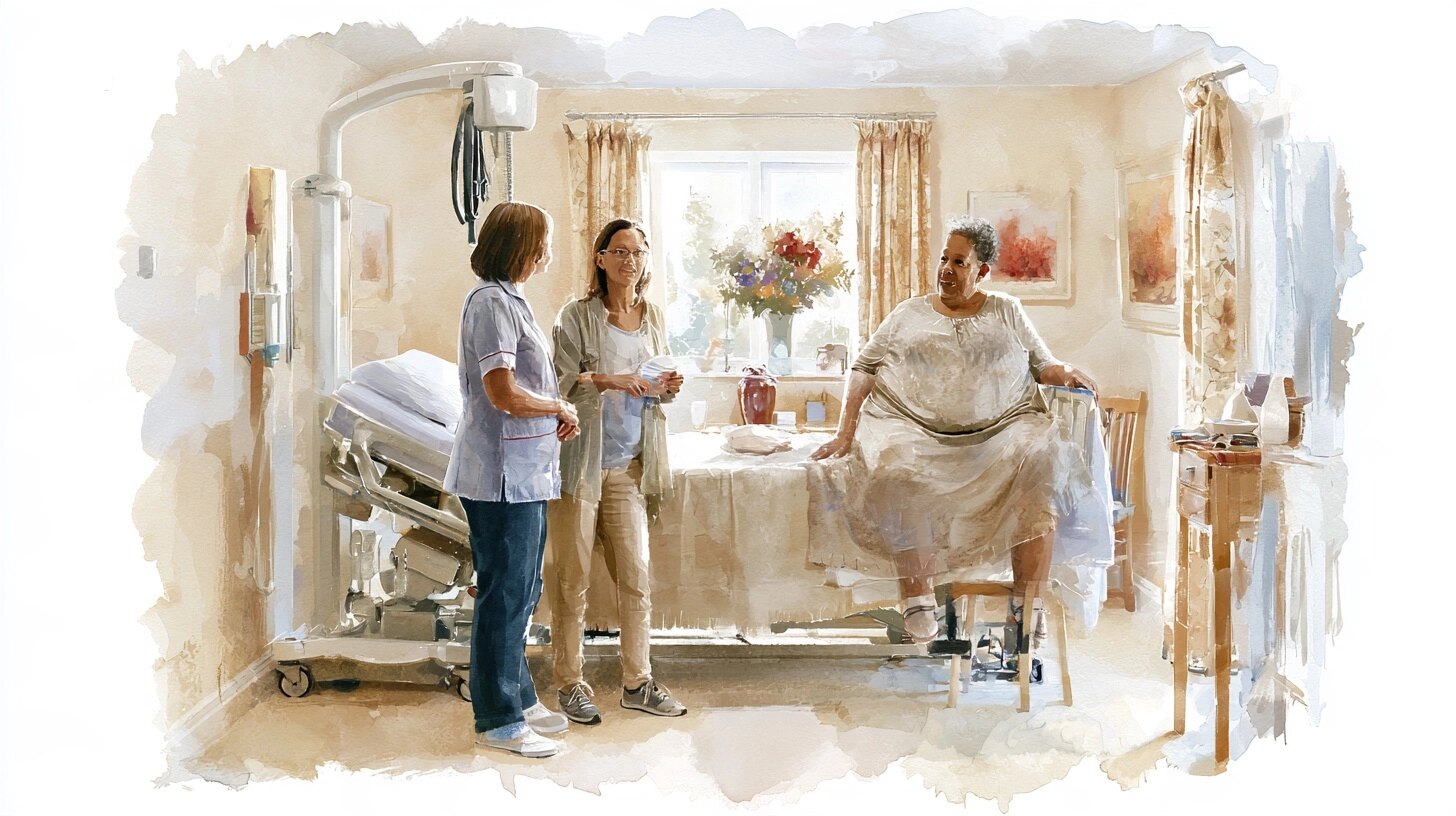
Before anybody buys a bed or books a second carer, ask for an assessment. It is free, the council arranges it, and it produces the two things everything else depends on: a list of equipment rated for your relative, and a written plan for how each move is done.
- 1
Ask the council for a needs assessment
Free to ask forRing adult social care at your relative’s local council, or apply online. The NHS is clear that a needs assessment is free. Say plainly what has become hard, such as getting out of bed, getting to the toilet or getting in the shower, and that you are worried about equipment and handling. - 2
An occupational therapist visits at home
Usually at least an hourThe NHS describes an occupational therapist visiting at home, asking questions and walking round with your relative to see what they struggle with. Mention everything that is difficult, including the small things, and mention anything that has already broken or felt unsafe. - 3
Equipment is matched to your relative and the rooms
Part of the same visitEquipment is chosen against your relative’s weight and their shape, including the width of the hips and the space they need to sit and turn. The rooms matter too: doorways, the space either side of the bed, and whether a hoist can move across the floor. - 4
A moving and handling plan is written
Before the first transferThe plan names the equipment, the sling and how it attaches, the technique for each move and the number of people needed. Ask for a copy. Anybody who helps your relative, paid or family, should work from it.
On the NHS social care pages, the council's own professional or an occupational therapist visits you at home to see what you need, and the NHS page on home adaptations describes what happens during the visit. The council's side of the process, and the means test that follows if the council is asked to pay for care, is explained in the care needs assessment and local authority funding.
If your relative is in hospital, the assessment and the equipment should be in place before they come home. Ask the ward who is doing the moving and handling assessment and whether the community equipment service has the order, because a bed may need to come downstairs, which the options when stairs get hard covers, and a hoist has to be delivered and fitted. What to arrange before discharge day is the checklist for that week.
Equipment, room by room
Equipment rated for your relative's weight, room by room
Every piece of equipment that carries a person has a safe working load: the most weight it is designed to take. The therapist's job is to choose equipment whose safe working load covers your relative, and to check that before it is used. This is what that looks like through the house.
| Where | What may be needed | What is checked first | Where it comes from |
|---|---|---|---|
| The bedroom |
| The safe working load of the bed covers your relative, the mattress and anything else on it. There is room either side of the bed for two carers and a hoist to work. | Community equipment service after an assessment. For the mattress, ask the GP or district nurse for a pressure ulcer risk assessment. |
| Getting in and out of bed or a chair |
| Your relative’s weight is below the safe working load of both the hoist and the sling, which are rated separately. The sling fits the hoist it hangs from. | Community equipment service, delivered and fitted. A ceiling track hoist is building work and goes through a Disabled Facilities Grant. |
| The bathroom and toilet |
| Each item has its own safe working load, and the seat is wide enough to sit on without pressing on the frame. The toilet and its fixings can take the load. | Community equipment service. Equipment and small adaptations under £1,000 each are free if your relative is assessed as needing them. |
| The living room |
| The seat is wide and deep enough, and high enough to stand from. Your relative’s own chair can be outgrown in weight or width, so the therapist looks at it as well. | Community equipment service after assessment, or bought privately once the therapist has said what to look for. |
| Getting out of the house |
| The chair is rated for your relative and fits their hips and legs. The route out of the house and the doorways are wide enough for it. | The NHS wheelchair service, after a referral from a GP, physiotherapist, occupational therapist or hospital staff. Some areas let you refer yourself. |
The bedroom
What may be needed
- A bed rated for their weight, which may be an electric profiling bed
- A pressure-relieving mattress that suits the bed
- Slide sheets for moving up the bed and turning
What is checked first
The safe working load of the bed covers your relative, the mattress and anything else on it. There is room either side of the bed for two carers and a hoist to work.
Where it comes from
Community equipment service after an assessment. For the mattress, ask the GP or district nurse for a pressure ulcer risk assessment.
Getting in and out of bed or a chair
What may be needed
- A mobile or ceiling hoist
- A sling in the right size and type
- A stand aid, if your relative can take some weight through their legs
What is checked first
Your relative’s weight is below the safe working load of both the hoist and the sling, which are rated separately. The sling fits the hoist it hangs from.
Where it comes from
Community equipment service, delivered and fitted. A ceiling track hoist is building work and goes through a Disabled Facilities Grant.
The bathroom and toilet
What may be needed
- A commode
- A shower chair or perching stool
- A toilet frame or raised seat, and grab rails
What is checked first
Each item has its own safe working load, and the seat is wide enough to sit on without pressing on the frame. The toilet and its fixings can take the load.
Where it comes from
Community equipment service. Equipment and small adaptations under £1,000 each are free if your relative is assessed as needing them.
The living room
What may be needed
- An armchair or specialist seat rated for their weight
- Chair raisers, so standing up is easier
What is checked first
The seat is wide and deep enough, and high enough to stand from. Your relative’s own chair can be outgrown in weight or width, so the therapist looks at it as well.
Where it comes from
Community equipment service after assessment, or bought privately once the therapist has said what to look for.
Getting out of the house
What may be needed
- A wider wheelchair, rated for their weight
- A cushion that spreads pressure
What is checked first
The chair is rated for your relative and fits their hips and legs. The route out of the house and the doorways are wide enough for it.
Where it comes from
The NHS wheelchair service, after a referral from a GP, physiotherapist, occupational therapist or hospital staff. Some areas let you refer yourself.
The safe working load is marked on lifting equipment by law. The Lifting Operations and Lifting Equipment Regulations 1998 require machinery and accessories for lifting to be clearly marked with it, which covers a hoist and its sling. The Health and Safety Executive's guide Getting to grips with hoisting people asks for a check that the person's weight does not exceed the safe working load of both the hoist and the sling, because they are rated separately and the lower figure is the one that counts. An NHS trust's specialised equipment guidance applies the same rule to beds, chairs, hoists and slings alike.
Two practical things follow. The first is that the check only works against a current weight, so if your relative's weight changes, or they have been unwell, ask for the equipment to be looked at again. The second is that equipment which lifts people must be thoroughly examined by a competent person at least every 6 months. If it came from the council, that is arranged for you; it is worth knowing the date.
Transfers, hoists and two carers covers the five ways a transfer is done and the hoisting mistakes to avoid, which apply to anybody who is hoisted. For a wheelchair, the NHS page on walking aids and wheelchairs explains how a GP, physiotherapist, occupational therapist or hospital staff refer your relative to the local wheelchair service. The right equipment to aid the elderly goes through the smaller items.
When two carers are needed
Why two carers may be needed, and who decides
A visit with two carers is sometimes called double-handed care. Whether your relative needs it depends on the moves in the plan, the equipment and the room, rather than on anybody's weight alone, and it is decided in the assessment.
A hoist is part of the plan
One person works it, one supports
The handling has been assessed as needing it
The plan says so in writing
Washing and turning in bed
Holding a position safely
The room makes a move harder
Space, doorways, the bathroom
The Health and Safety Executive's guidance on managing moving and handling risks in health and social care is the source for both of the first two cards. The number of carers is written into the moving and handling plan before the first visit. It is not a matter of what the family would prefer, or of what one carer feels able to try on the day. If the plan says two, a visit with one carer should not include that move. If you think the plan is wrong in either direction, ask the team who wrote it to look again. The therapist can look at whether different equipment or a change to the room would alter what a move needs, in either direction.
Under the client contract you agree to give carers full and accurate information in advance about mobility and handling requirements, and to tell them promptly when things change. So share the handling plan with any carer before their first visit. If a carer is unwell and offers a substitute, the contract lets you object on reasonable grounds, and a substitute who has not used your relative's hoist is a reasonable concern to raise.
Skin, pressure and continence
Care for skin folds, pressure areas and continence, done with dignity
The personal care itself is ordinary work: washing, drying, checking skin, changing pads. For a larger person some of it takes longer and needs more care, and it should be done calmly and in private, at your relative's pace.
What a carer looks after during a personal care visit
0 of 7 ticked
Skin folds
Pressure areas
Continence
NICE's briefing on intertrigo describes it as a common inflammatory skin condition caused by moisture, heat and friction from skin-to-skin contact. That is why the drying matters as much as the washing. If a fold is sore, weeping or smells, ask the pharmacist or GP rather than trying products one after another.
The NHS lists swollen, sweaty or broken skin and difficulty moving among the things that make pressure ulcers more likely, and says a person cared for at home can ask a GP for a pressure ulcer risk assessment so a plan can be made. Pressure sores explains what to look for, when to call the district nurse, and how mattresses and cushions are arranged.
For continence, the NHS says a GP can refer your relative to the local continence service, and in some areas you can refer yourself. Managing incontinence covers pads, products and the day-to-day routine.
Privacy and the right carer
Shame, privacy, and choosing a carer who is matter-of-fact and kind
Being helped to wash is hard for anybody at first. For someone who has felt judged about their size, letting a stranger see them undressed can be the hardest part of all. The right carer makes it feel like ordinary care, because that is what it is.
What helps
- A carer who explains each step before doing it, and keeps your relative covered except for the part being washed
- Equipment ready and checked before the visit starts, so nobody is struggling with it while your relative waits
- The same carers each week where possible, so your relative is not explaining their body to somebody new
- Asking your relative whether they would prefer a woman or a man for intimate care
- Talking about weight only when it matters for equipment, and in plain, neutral words
What to avoid
- Comments, jokes or sighs about size, even meant kindly
- Talking about your relative over their head, or about them to the other carer
- A carer who seems uneasy with the equipment or the task and lets it show
- Rushing, which makes the visit feel like a problem to be got through
- Assuming your relative is embarrassed rather than asking what they would like
When you talk to carers, you are listening for two things. The first is experience: how they have helped somebody with a high body weight before, what equipment they used, and how they worked with a second carer. The second is manner. A good answer is calm and practical, and does not dwell on your relative's size. If a carer talks about your relative with any hint of judgement before they have even met, choose somebody else.
Ask your relative what they want before anybody arrives. They may want a woman or a man for washing and the toilet, and asking for a male or female carer for intimate care explains how to set that on the search and what to confirm. If you have been doing the washing yourself and it is time to hand it over, handing intimate care to a professional covers how to do that gently.
What it costs
What one carer and two carers cost, and what to ask them
Carers on PrimeCarers are self-employed and set their own rates. When a visit needs two carers, you are paying two people for their time, and each charges their own rate.
| One carer | Two carers | |
|---|---|---|
| One hour | £18 to £25 | £36 to £50 |
| An hour each morning and evening, 14 hours a week | £252 to £350 | £504 to £700 |
One hour
- One carer
- £18 to £25
- Two carers
- £36 to £50
An hour each morning and evening, 14 hours a week
- One carer
- £252 to £350
- Two carers
- £504 to £700
Figures use the range carers on PrimeCarers charge, £18 to £25 an hour with our fee included, multiplied out; each carer charges their own rate, so your total depends on the two you choose. Agencies charge £28 to £35 an hour for one carer. Bank holidays are one and a half times the carer’s rate and Christmas Day twice, under the client contract.
Not every visit in the week has to have two carers. If the hoist is only used to get up in the morning and into bed at night, a lunch visit for a meal and company may only need one. Two carers for an hour each morning and evening, with one carer for an hour at lunch, comes to £630 to £875 a week. Whether that works depends on what the plan says about each move, so check with the therapist before you book it that way. If the council has assessed your relative as needing care and is paying for some or all of it, the figures above are not what you will pay; local authority funding explains how the council's share is worked out, and what an hour of care costs sets hourly care against the other arrangements.
What to ask each carer before you bookSection titled What%20to%20ask%20each%20carer%20before%20you%20book
PrimeCarers checks every carer's identity and right to work, confirms an accepted criminal-record check (Enhanced DBS issued within the last 2 years, DBS Update Service, Scottish PVG or Access NI), and interviews every carer online. We do not check qualifications, training or references, so moving and handling experience is something you ask about and the carer describes on their own profile. Visits booked through PrimeCarers are covered by the carer insurance policy we arrange, within its terms (no clinical procedures).
- What moving and handling training have you had, and when was it last refreshed?
- Have you used this type of hoist and sling, and bariatric equipment in general?
- Have you worked as one of two carers before, and who led the transfers?
- Would you read the handling plan and walk through each move with us before the first visit?
When you are ready, search for carers near you and compare their rates, then ask each one about their experience with bariatric moving and handling before you book two for the same visit. Settling in with a personal carer covers the first weeks. Ending an hourly arrangement takes 48 hours' notice under the client contract.
Questions
Questions families ask about personal care for a larger person
The moving and handling assessment, usually carried out by an occupational therapist. It looks at each move, the equipment and the room, and the number of carers is written into the plan. It is not something the family or a single carer decides on the day. If you think the plan is wrong, ask the team who wrote it to review it.
The most weight a piece of equipment is designed to carry. Beds, hoists, slings, commodes, chairs and wheelchairs each have one. Lifting equipment must be clearly marked with it by law, and HSE guidance is to check that the person's weight is below the safe working load of both the hoist and the sling before they are used.
If your relative is assessed as needing it, equipment and small adaptations costing less than £1,000 each are provided free, according to the NHS. Larger items such as hoists and profiling beds are usually loaned through the community equipment service. Building work, such as a ceiling track hoist or a level access shower, goes through a Disabled Facilities Grant, which is means tested.
Please do not do this unless the therapist who wrote the plan has trained you on that equipment and agreed to it. The second person in a two-carer move needs the same training as the first, and if you were hurt during a transfer, your relative would lose your help as well. If cost is the problem, ask for a review of the plan and whether different equipment would make a move safe for one carer.
We do not check training or qualifications. We check identity, right to work and an accepted criminal-record check (Enhanced DBS issued within the last 2 years, DBS Update Service, Scottish PVG or Access NI), and interview every carer online. Carers describe their own training and experience on their profiles, and you should ask each one directly about moving and handling a larger person and the equipment your relative uses.
Talk about the equipment rather than their body. The bed, the hoist and the chair each have a weight limit, and the therapist needs a current weight to choose ones that are safe. Put that way, it is a practical question, and your relative can decide how they would like to be weighed and who is in the room.