
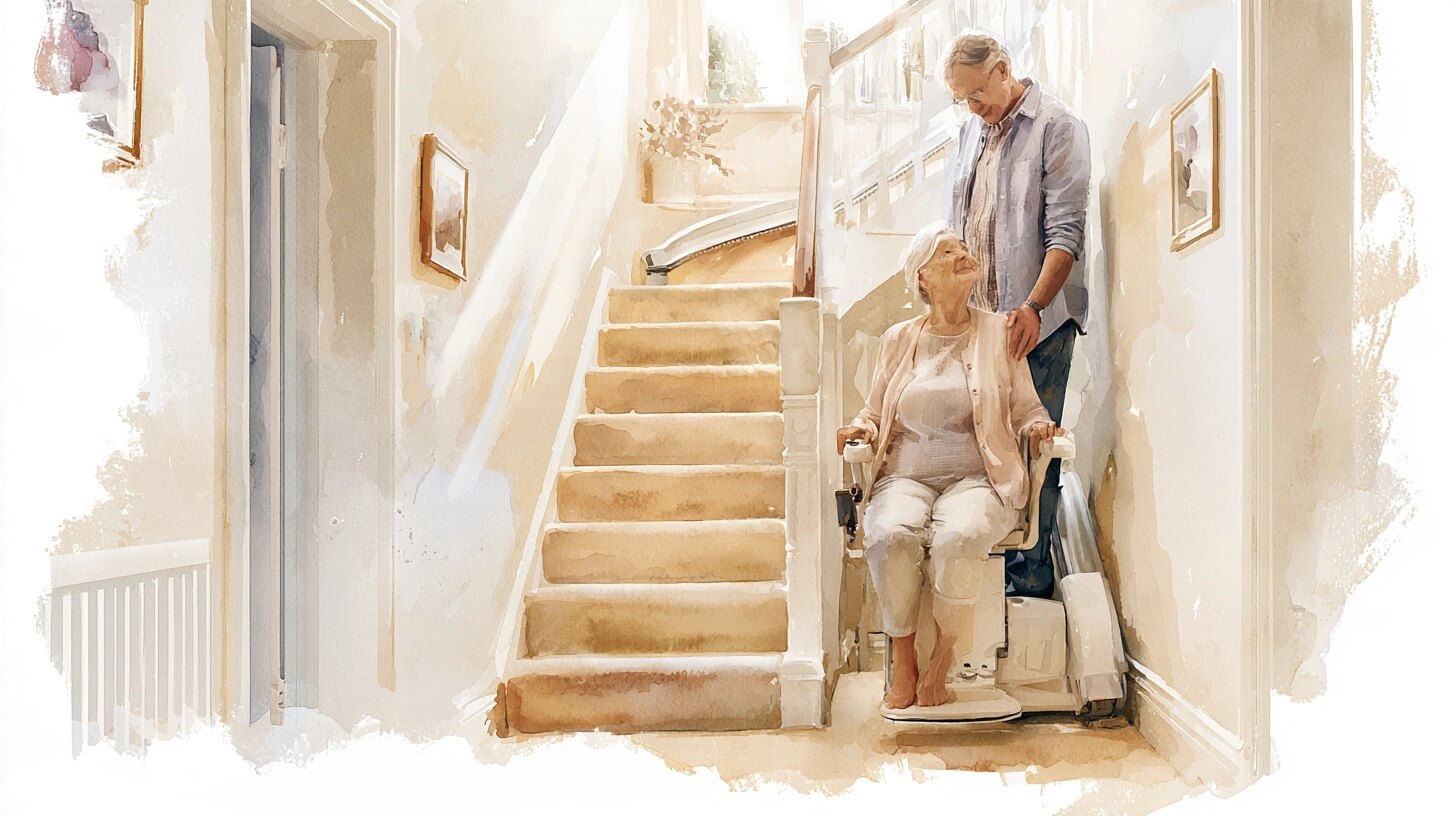
The short answer
- Ask for an occupational therapist firstRing the council's adult social services, or ask the GP. The assessment is free to ask for, and it tells you which option is safe before you spend anything.
- Start with the smallest change that worksA second rail and good lighting may be enough for somebody who can still climb. A stairlift or a lift only helps if they can get on and off safely.
- Small jobs are free, bigger ones have a grantAdaptations costing £1,000 or less should be paid for by the council. A stairlift can come under a means-tested Disabled Facilities Grant.
- A bed downstairs is a real optionIt can be the right answer, or a stopgap while other work is done. Plan for washing, the toilet and privacy before the bed is moved.
PrimeCarers does not sell, fit or arrange equipment or adaptations. We introduce families to self-employed carers, and this guide explains the choices so you can talk them through with the occupational therapist and your relative.
Signs of risk
Signs the stairs have become a risk
The changes can be small at first, such as a slower climb or a hand on the wall where there used to be none. The NHS says to see a GP if somebody has had a fall or is worried about their balance or mobility, and these are the signs worth taking to that appointment.
Has any of this happened in the last few months?
0 of 10 ticked
On the stairs
Around the house
What they do
The NHS page on falls lists the common causes: weaker muscles, conditions that affect balance such as arthritis, stroke and Parkinson's, low blood pressure, the side effects of medicines, eyesight or hearing problems, and dementia. Ask the GP for a falls assessment and a medicines review at the same time as you ask about the stairs. NHS inform's guide to hazards at home covers clutter, lighting and night-time trips, and Guy's and St Thomas' falls advice says not to leave rugs or mats at the top or bottom of the stairs.
If your relative has stopped going upstairs and there is no clear physical reason, read fear of falling before you decide anything. Doing less can make the legs weaker, and a stairlift will not fix that on its own. Climbing stairs is also good exercise for people who can still manage it safely, which is climbing stairs good for older people explains. The mobility and falls care guide covers why older people fall more widely.
The five options
Five ways to deal with the stairs, from a second rail to moving home
Each option solves a different problem. A rail helps somebody who can still climb, and a stairlift or a lift carries somebody who cannot. Living downstairs or moving takes the stairs out of the day altogether. The table puts all five side by side.
1. A second banister and better lighting
A rail on the other side of the stairs, so both hands have something to hold, and light switches or sensor lights at the top and bottom.
- Who assesses
- A council occupational therapist, who decides the height and where the rail is fixed.
- Who can pay
- The council, as a minor adaptation, when it costs £1,000 or less. Bulbs and plug-in night lights you can buy yourself.
- What to watch for
- It helps somebody who can still climb. It does nothing for breathlessness, pain or dizziness on the stairs.
2. A stairlift
A seat or perch on a rail fixed to the stairs. A straight rail suits a straight flight; a curved rail is built to follow bends and landings.
- Who assesses
- A council occupational therapist first, then the supplier surveys the stairs.
- Who can pay
- A Disabled Facilities Grant, which is means tested. Bought privately, it can be VAT free for a qualifying disabled person.
- What to watch for
- They still need to get on and off safely at both ends. A curved rail costs more than a straight one. Ask about servicing and repairs before you sign.
3. A through-floor lift
A small lift car that travels through a hole cut in the ceiling, from a downstairs room to a bedroom above.
- Who assesses
- A council occupational therapist, then a surveyor or the supplier, because it is building work.
- Who can pay
- A Disabled Facilities Grant, if the council agrees it is necessary and practical for the house. VAT relief can apply.
- What to watch for
- It needs space in both rooms and alterations to the house. Some models take a wheelchair, so nobody has to transfer.
4. Living downstairs
A bed in the living or dining room, with a commode, a downstairs toilet or, as a larger project, a ground-floor bedroom and bathroom.
- Who assesses
- A council or hospital occupational therapist, who can arrange a commode and other equipment on loan.
- Who can pay
- Loaned equipment is free. A downstairs bedroom extension, or better access to a toilet or shower, can come under a Disabled Facilities Grant.
- What to watch for
- Privacy, washing and visitors in the one room they have to live in. It can be a stopgap while something else is arranged.
5. Moving home
A bungalow, a ground-floor flat, or housing built for older people, where there are no stairs to manage.
- Who assesses
- Your relative, with the family. The council housing team, and an adviser for the money.
- Who can pay
- Usually your relative, from the sale or their own means. Ask the council whether it offers any help with a move.
- What to watch for
- Leaving neighbours, friends and a home they know. It is their decision to make, and it takes time to arrange.
Ordered roughly from the smallest change to the home to the largest. Grants and VAT relief each have their own conditions; the occupational therapist and the council decide what applies.
A second banister and better lightingSection titled A%20second%20banister%20and%20better%20lighting
For somebody who can still climb but has started to hold the wall, a rail on the other side of the stairs gives both hands something to hold. The NHS guide to home adaptations gives a banister on the stairs as one of its examples. Lighting matters as much as the rail. Living Made Easy, the equipment information service that grew out of the Disabled Living Foundation, suggests a light switch at the top and bottom of the stairs, and plug-in night lights on the landing cost little. An occupational therapist can have a rail fitted by the council.
A stairliftSection titled A%20stairlift
A stairlift is a seat, or a perch for somebody who can stand but not climb, on a rail fixed to the stairs. Living Made Easy explains that straight rails are significantly cheaper than curved ones, that most stairlifts run on batteries so they still work in a power cut, and that a staircase needs to be about 740mm wide. It recommends an inspection every six months and a service every year. Reconditioned stairlifts are sold by authorised dealers with a warranty, and some suppliers rent them by the month. We give no prices here, because they depend on the staircase and the supplier and no government or consumer body publishes a figure we could check.
A stairlift only moves your relative between floors. They still have to walk to it, sit down, fasten the belt, and stand up safely at the top, which may be on a narrow landing. That is what the occupational therapist will watch for. If they cannot do those steps safely, a stairlift can add a risk rather than take one away.
A through-floor liftSection titled A%20through-floor%20lift
A through-floor lift is a small lift car that rises through an opening cut in the ceiling, usually from a living room into a bedroom above. Living Made Easy says it needs more space than a stairlift on both floors and involves alteration work to the house, and that a wheelchair user can travel in some models without having to transfer out of the chair.
Living downstairsSection titled Living%20downstairs
If the house has room, your relative can move their bed downstairs and use a commode or a downstairs toilet. It can be the lasting answer or a stopgap while a stairlift is fitted, and the next section covers it on its own.
Moving homeSection titled Moving%20home
A bungalow, a ground-floor flat or housing built for older people removes the stairs altogether. It is also the largest change, because it means leaving a home and neighbours they know. Age UK's housing options guides describe the kinds of housing available. The decision is your relative's to make, and if money from a sale will also pay for care, speak to a regulated financial adviser first, because PrimeCarers cannot give financial advice.
Living downstairs
Moving a bed downstairs: the toilet, washing, privacy and dignity
A bed in the front room solves the stairs in an afternoon, and it can make a big difference after a hospital stay. It also turns the front room into a bedroom as well as a sitting room. These are the things to plan before the bed is carried down.
The bed and where it goes
Ask before you buy
The toilet
A commode or a downstairs toilet
Washing
Plan it before the move
Privacy
Their room, not a corridor
Nights
Light and a way to call
The rest of the family
A shared house changes too
Moving the bedroom downstairs can feel like a loss, even to somebody who agrees it is safer. The bedroom upstairs may be where they have slept for decades, and a bed in the living room can feel like being on show. Ask your relative what matters most to them: which room, which side of the bed, where their things go, and who comes in. Privacy and dignity for older people covers the wider principles, and bathing and toileting an elderly parent covers the practical side of a commode and a strip wash.
Loaned equipment comes through the council or the NHS community equipment service after an assessment. North Bristol NHS Trust, as one example, lists commodes, perching stools, toileting equipment and bed raisers among the items it lends without charge. Ask what your area can provide.
If your relative is coming home from hospital unable to manage the stairs, raise it with the ward team before the discharge date, because equipment has to be delivered and a bed may need moving. Leaving hospital: what to arrange has the fuller list. If the stairs are part of a recovery, a physiotherapist may be working towards getting your relative back upstairs, and physio at home explains how that works.
Assessment and money
Get an occupational therapy assessment first, then work out who pays
An occupational therapist looks at how your relative moves around the house and what they are trying to do, then recommends the equipment and changes that would help. Asking for an assessment costs nothing, and it is the route into free equipment and the grant for bigger work.
- 1
Ask the council for an assessment
TodayRing adult social services at your relative's council, or apply online, and ask for an assessment for equipment or home adaptations. A GP, a hospital ward or a district nurse can also refer them. Say it is about the stairs and describe what you have seen. - 2
An occupational therapist visits
At homeThey watch your relative on the stairs, getting in and out of bed and using the toilet, and ask what has become hard. They recommend what would help, in order of priority. - 3
Small items are fitted or loaned
Free to your relativeRails, lighting changes and other minor adaptations costing £1,000 or less should be paid for by the council, whatever your relative's savings. Equipment such as a commode is loaned. - 4
Bigger work goes through a grant
Means testedA stairlift, a through-floor lift or a downstairs bedroom can come under a Disabled Facilities Grant, worth up to £30,000 in England. The council must decide within 6 months, and work started before approval may not be paid for.
You can contact the council yourself, by phone or online, so you do not have to wait for the GP. GOV.UK's needs assessment page finds your relative's council, and if day-to-day tasks as well as the stairs have become hard, ask for a care needs assessment at the same time. If you are told to wait, ask what you can safely do in the meantime, and whether a private occupational therapist's report would be accepted.
The legal basis for the free small items is the charging regulations, which say an adaptation is minor if it costs £1,000 or less, and the NHS guide says the council should pay for each one. The Disabled Facilities Grant is set out in full in our guide to home adaptations that reduce the need for care, including the means test and how to apply, so we will not repeat it here. GOV.UK lists a stairlift and an extension for a downstairs bedroom among the things the grant can pay for, and says a grant will not affect any benefits your relative gets.
Walking aids and how to choose explains how an aid is fitted and why the stairs may need a second one, and pendant alarms and sensors covers what to have in place in case of a fall.
Carers and nights
What a carer can and cannot do on the stairs, and help at night
A carer can make a downstairs arrangement work, and can be there when your relative uses the stairs or the stairlift. There are also things no carer should do, and it helps to know them before the first visit.
What a carer can help with
- Being there while your relative uses the stairs or the stairlift, in the way the occupational therapist or physiotherapist has advised
- Carrying the washing, the tray and the bags, so your relative has both hands for the rails
- Getting up, washing and dressing in the morning, and getting ready for bed at night
- Emptying and cleaning the commode, changing the bed and keeping the downstairs room tidy and private
- Checking the lights, the alarm and the walking aids at each visit
- Noticing when the stairs or the transfers are getting harder, and telling the family
What a carer should not do
- Carrying your relative up or down the stairs, or taking their weight on the stairs
- Lifting somebody off the floor after a fall without the right equipment
- A transfer that has been assessed as needing a hoist or two people, done alone or without the equipment
- Using a hoist or a stair climber they have not been shown how to use for your relative
- Deciding which equipment your relative needs, which is the occupational therapist's job
Moving and handling is about equipment and technique, not strength. If your relative needs help to stand or to move between the bed, a chair and a commode, the occupational therapist or physiotherapist decides how it is done and with what, and transfers, hoists and two carers explains when a hoist or a second person is needed, and personal care for a larger person covers equipment rated for a higher body weight. PrimeCarers does not check carers' training or qualifications, so ask each carer about their experience with transfers and equipment yourself, and ask the occupational therapist to show them how your relative's equipment is used.
For a family who have moved a parent's bed downstairs and need help mornings and evenings, an hour at the start of the day and an hour at the end is a sensible place to start. Carers on PrimeCarers charge £18 to £25 an hour with our fee included, so two one-hour visits a day, seven days a week, at the typical £20 comes to £280 a week. Agencies charge £28 to £35 an hour, and what an hour of care costs sets the two side by side. When you are ready, you can search for carers near you and compare their rates. Every carer's identity, right to work and accepted criminal-record check (Enhanced DBS issued within the last 2 years, DBS Update Service, Scottish PVG or Access NI) are checked, and they are interviewed online, before they appear. Separately, every visit booked through PrimeCarers is insured, by the carer's own policy or by cover PrimeCarers arranges where they do not hold one.
Questions
Questions families ask about the stairs
Possibly. Ask the council's adult social services for an occupational therapy assessment. If the occupational therapist recommends a stairlift, it can come under a Disabled Facilities Grant, which is means tested and worth up to £30,000 in England. Do not start work before the council approves the grant, or it may not be paid. Home adaptations explains the grant in full.
It can be. Living Made Easy says reconditioned stairlifts are available from authorised dealers with a warranty, and that some suppliers rent them by the month, which can suit somebody whose needs are likely to change. Whatever you choose, ask about servicing, repairs and what happens if it breaks down.
Not if your relative qualifies. GOV.UK says a person who is disabled or has a long-term illness is not charged VAT on stair lifts and other products designed for a disability, or on installing them. They confirm it in writing to the supplier. Somebody who is older but not disabled does not qualify.
A carer can be with him while he uses the stairs or a stairlift, in the way his occupational therapist or physiotherapist has advised, and carry things so his hands are free. A carer should not carry him or take his weight on the stairs. If he cannot manage the stairs with somebody alongside, that is a reason to look at a stairlift or living downstairs. Transfers, hoists and two carers explains what needs equipment.
It can be the safest way home if she cannot manage the stairs yet. Talk to the ward and the occupational therapist before the discharge date, so a commode and any other equipment arrive in time. Treat it as something to review, because some people get back upstairs with physiotherapy.
GOV.UK says the council must give a decision within 6 months of the application, and there is usually an occupational therapy assessment before that. A second rail, a commode or a bed downstairs can make the house safer in the meantime.