
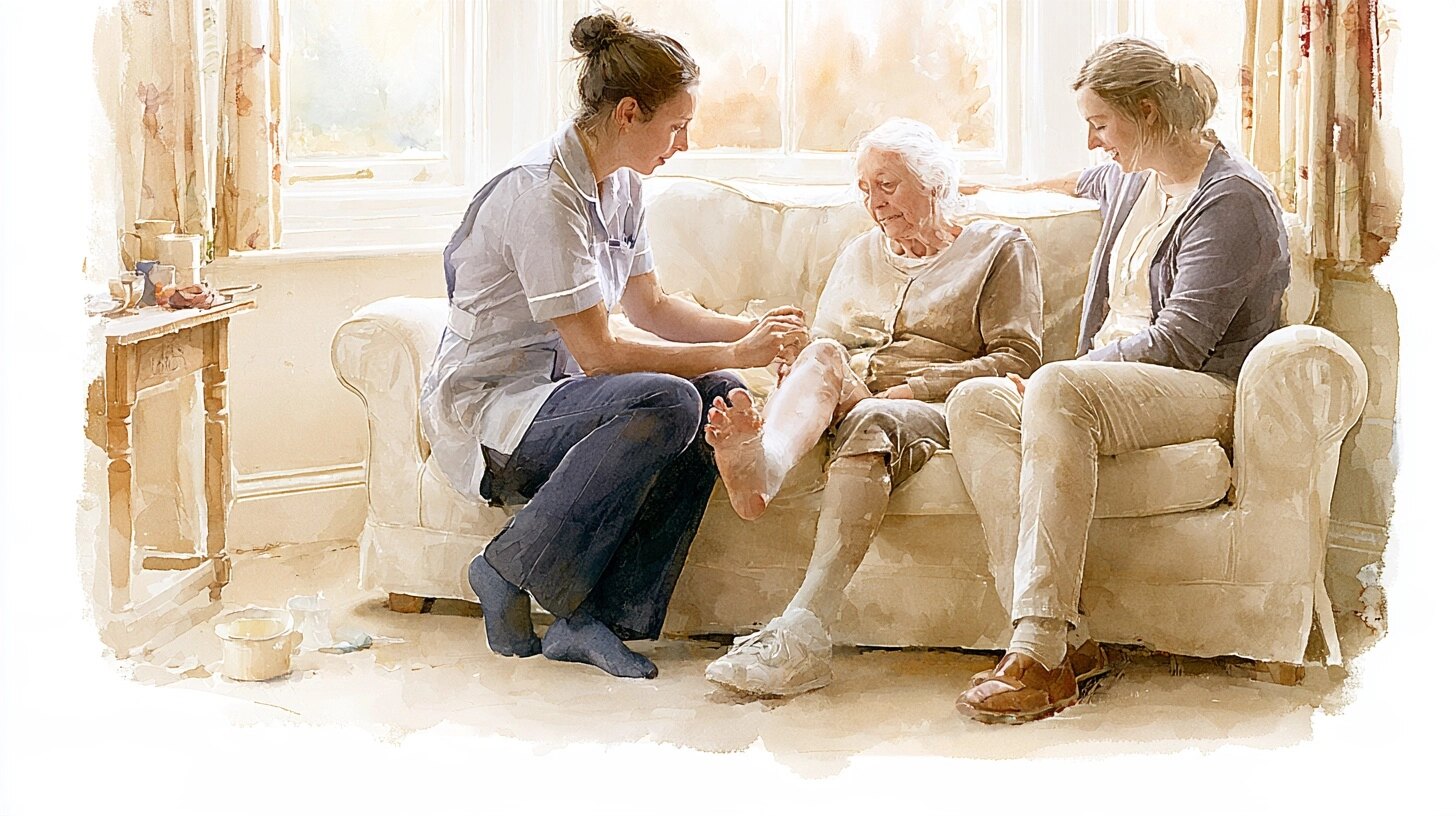
The short answer
- Keeping the wound clean and watching it is for anyoneA family member or a carer can keep the dressing dry, help with washing within the discharge advice, look at the wound every day and ring when it changes.
- The dressing itself belongs to a nurseChanging a dressing, removing clips or stitches, packing a wound, drains, negative pressure therapy and pressure sores are nursing tasks, unless a nurse has formally handed one over and trained the person doing it.
- Ask for the nurse's name and date before leaving the wardThe nursing may come from the district nurses, the practice nurse at the GP surgery or the ward itself. If nobody has come when they should have, ring the GP surgery.
- Sudden confusion and signs of sepsis mean 999Spreading redness, heat, pus, a bad smell or a wound opening need a call the same day. Sudden confusion or the signs of sepsis need 999.
Carers on PrimeCarers charge £18 to £25 an hour with our fee included, typically about £20, against £28 to £35 an hour through an agency. This is a care page, not medical advice, and it describes England.
Carer or nurse
What a family or a carer can do for the wound, and what belongs to a nurse
Most of what a healing wound needs from the people around it is ordinary care: keeping it clean and dry, keeping the person comfortable, and noticing when something changes. The dressing itself and anything done to the wound is nursing, and it stays with a nurse unless a nurse decides otherwise.
Anyone in the house can do this
A family member, a friend or a carer
Keep the dressing clean and dry
Leave it where the nurse put it. Help your relative keep clothing, bedding and pets away from it.
Help with washing and showering as the discharge advice allows
Follow the written advice about when a shower is allowed and keep the wound out of a bath until the team says otherwise.
Look at the dressing and the skin around it every day
Look without lifting anything, so that a change is noticed on the day it starts.
Notice how your relative is in themselves
Their temperature, whether they are eating and drinking, and whether they are thinking as clearly as usual.
Report anything that has changed
To the district or practice nurse, the ward, the GP or 111, and write down what you saw and when.
Keep them comfortable
Pain relief taken on time as prescribed, a good position in the chair or bed, food, fluids and a little movement.
A nurse does this
Unless a nurse has formally delegated the task and trained the person doing it
Changing a dressing
NICE asks for an aseptic non-touch technique when a surgical dressing is changed or removed, which is a clinical skill.
Removing clips or stitches
A nurse takes them out, at the GP surgery or at home, on a date the ward gives you.
Packing a wound that has been left open
Some wounds are left to heal from the bottom up and are packed with dressing material by the nurse.
Looking after a drain
A tube and bottle that takes fluid away from the wound. Emptying, measuring and removing it are nursing jobs.
Negative pressure wound therapy
A small pump attached to a sealed dressing. The nurse sets it up and changes it.
Anything to do with a pressure sore
Assessing it, dressing it and ordering the mattress or cushion belong to the district nursing team.
When a nurse hands a task over
A registered nurse can delegate a task such as a simple dressing change to a named carer. That means the nurse has assessed your relative, decided it is safe for them, taught the carer on their own wound and watched them do it, and has written it into the care plan. A family member offering to show the carer how is not delegation, and nor is a course certificate.
The line is there to protect the wound. A surgical wound is a break in the skin, and the UK Health Security Agency's patient leaflet on monitoring surgical wounds for infection tells patients not to remove the dressing or touch the wound or a wound drain, because germs on fingers can pass into it. NICE's guideline on preventing surgical site infection, NG125, asks for an aseptic non-touch technique whenever a surgical dressing is changed or removed. That is a way of working that nurses are trained in, and it is why lifting a dressing to have a look is not something to do between visits, however well meant. The hospital discharge and post-operative care guide covers the rest of the weeks after an operation.
There is one exception worth knowing about. Some discharge advice tells the patient they may take a simple dressing off themselves after a few days. If the written advice says that, follow it exactly as written. If it says nothing, or you are not sure, ask the ward or the nurse before anybody touches it.
A carer can be trained to do a particular wound task for your relative, but only through formal delegation by a registered nurse, with the training, the sign-off and the care plan that go with it. Who can train a carer to do a healthcare task sets out how that works and who stays accountable. Pressure sores are the clearest case where the nurse leads. A carer helps prevent them by helping your relative change position and by looking at their skin, and preventing pressure sores at home, and when to call the district nurse covers the rest.
Who does the nursing
Who looks after the wound once your relative is home
The nursing for a surgical wound can come from one of three places, and it depends on the operation, the hospital and whether your relative can get out of the house. The discharge letter or the ward should tell you which applies.
| Who they usually see | What they do for a wound | How to reach them | |
|---|---|---|---|
| District nurses | People who cannot get to the GP surgery, whether that is for a few weeks after an operation or for longer | Wound checks and dressings at home, removing clips or stitches, pressure sores, and ordering pressure relieving equipment | A referral from the ward or the GP. Some teams also take calls from relatives. Ask the GP surgery for the number |
| The practice nurse | People who can get to their GP surgery | Wound checks, dressing changes and taking out stitches or clips, in an appointment at the surgery | Book with the GP surgery, and say what the discharge letter asks for and on what date |
| The ward or the surgical team | Anyone they have operated on, particularly in the first days and for specialist wounds | A wound clinic appointment, a phone check, or advice on a problem with the wound after discharge | The number on the discharge letter. Some hospitals run a wound helpline or ask for photographs |
District nurses
- Who they usually see
- People who cannot get to the GP surgery, whether that is for a few weeks after an operation or for longer
- What they do for a wound
- Wound checks and dressings at home, removing clips or stitches, pressure sores, and ordering pressure relieving equipment
- How to reach them
- A referral from the ward or the GP. Some teams also take calls from relatives. Ask the GP surgery for the number
The practice nurse
- Who they usually see
- People who can get to their GP surgery
- What they do for a wound
- Wound checks, dressing changes and taking out stitches or clips, in an appointment at the surgery
- How to reach them
- Book with the GP surgery, and say what the discharge letter asks for and on what date
The ward or the surgical team
- Who they usually see
- Anyone they have operated on, particularly in the first days and for specialist wounds
- What they do for a wound
- A wound clinic appointment, a phone check, or advice on a problem with the wound after discharge
- How to reach them
- The number on the discharge letter. Some hospitals run a wound helpline or ask for photographs
Services and names differ from one area to another. The district nursing service in Somerset, for example, lists post-operative patients among those it sees and takes referrals from GPs, hospitals, relatives and patients themselves.
Before your relative leaves the ward, ask three things and write the answers down. Who will look at the wound, and where. When the first check is, and when the clips or stitches come out. The NHS page on recovering from a knee replacement says a nurse will take out stitches or clips after about 10 days, and other operations have their own timings. A heart bypass can leave a wound on the leg, where a vein was taken, as well as the one down the chest, and recovery at home after heart surgery covers looking after both. The third question is what number to ring if the wound worries you, in the day and at night. NICE asks hospitals to give patients and carers information on how to recognise a surgical site infection and who to contact if they are concerned, so it is fair to ask for that in writing. What to arrange before discharge day covers the rest of the list.
If getting to the surgery would be difficult, say so while your relative is still on the ward. A person who can manage a car journey on a good day may not manage it on day eight, sore and tired, and it is easier to set up a district nurse visit before discharge than after.
If nobody has come
How to get a nurse to visit, and what to do when nobody has been
Referrals get lost, dates move and letters arrive late. If the nurse was expected and has not come, or nobody told you anything about the wound at all, these steps work in this order.
- 1
Read the discharge letter again
FirstLook for the words district nurse, practice nurse, wound check or clip removal, a date, and a phone number. Photograph it so every carer who visits can see it too. - 2
Ring the ward in the first few days
Days 1 to 3Ask whether a district nursing referral was made, which team it went to and when the first visit is booked. If it was never made, ask the ward to make it now. - 3
Ring the GP surgery
The same daySay your relative has come home after an operation with a wound that needs nursing and that nobody has been. Ask for the district nursing team, or for a practice nurse appointment if they can get to the surgery. - 4
Keep a short note of the wound
Every dayThe date, what the dressing looked like from the outside, their temperature if you have a thermometer, and how they seemed. It gives the nurse something to work from when they arrive. - 5
Use 111 when the surgery is closed
Evenings and weekendsIf the wound looks worse and you cannot reach anyone, contact 111 by phone or at 111.nhs.uk. Do not wait for the nurse if you see the signs further down this page.
NICE's guideline on moving between hospital and home says a GP or community-based nurse should phone or visit people at risk of readmission 24 to 72 hours after their discharge. If your relative is older and frail, or lives alone, it is reasonable to mention that when you ring, along with any frailty score the hospital gave them. Avoiding readmission after a hospital stay covers the wider first weeks, including what else sends people back into hospital.
Signs of infection
The signs of a wound infection, and when to ring 999 instead
Some redness, swelling and soreness around a new wound is part of healing. The UKHSA leaflet says a surgical wound infection can develop at any time from two to three days after the operation until the wound has healed, usually two to three weeks later. These are the signs to act on, in three levels.
Same day
Contact the nurse, the GP or 111 the same day
- Redness around the wound that is spreading or getting worse rather than settling. The NHS notes that redness can be harder to see on brown or black skin, so heat, swelling and pain matter as much
- The wound or the skin around it feeling hot, or more swollen than it was
- Pus, or green or yellow fluid, coming from the wound, or a bad smell
- The wound opening or gaping
- A high temperature, or feeling hot, cold or shivery
- Feeling generally unwell, or more pain than yesterday instead of less
If you have a number for the nurse or the ward, use it. Otherwise ask for an urgent GP appointment or contact 111.
Source: nhs.uk pages on recovery after gallbladder removal, hip replacement and gastrectomy; the UKHSA leaflet on monitoring surgical wounds; Guy’s and St Thomas’ and the Royal Orthopaedic Hospital.
999 or A&E
Sudden confusion in an older person
- Not making sense or not knowing where they are, when yesterday they were themselves
- The NHS lists infections among the causes of sudden confusion and says urinary tract infections are a common cause in older people, so a new muddle can point to an infection somewhere in the body
The NHS says to go to A&E or call 999 if someone suddenly becomes confused.
Source: nhs.uk, sudden confusion.
999
Signs of sepsis: call 999
- Confusion, slurred speech, or not making sense
- Blue, pale, grey or blotchy skin, lips or tongue
- Breathing very fast, or difficulty breathing
- A very high or very low temperature, feeling hot or cold to the touch, or uncontrollable shivering
- A rash that does not fade when you press it
- Passing no urine all day, or very little in the last 18 hours
Call 999 or go to A&E. The NHS says not to drive yourself to A&E; ask someone to drive you or call for an ambulance.
Source: nhs.uk, sepsis.
A carer or a family member who sees your relative every day is often the first to notice, because they see the same dressing and the same person at the same time each day. Look at the skin around the dressing, notice any smell when you are close, and ask how the pain compares with yesterday. Tell the nurse on the day you notice a change, even a small one. The NHS says a wound infection after an operation is usually treated with antibiotics, and the nurse or GP can only start that once they know.
For an older person, the sign that matters most can be the one furthest from the wound. The NHS says to go to A&E or call 999 if someone suddenly becomes confused, and lists infection among the causes. A parent who was themselves yesterday and today is muddled, restless or not making sense needs help now, and it is not something to put down to the anaesthetic or tiredness. UTIs and sudden confusion in older people explains why an infection can show itself this way.
Sepsis is the reason not to wait with any of this. It is a life-threatening reaction to an infection, and its signs in an older person are not always the ones a family expects. The NHS page on sepsis lists the signs above as reasons to call 999 or go to A&E, and says not to drive to A&E. If you are worried a wound infection is turning into something more serious, ring 999 and say so.
Slow healing
Why some wounds heal more slowly, and what helps
Some people heal more slowly than others, and a slow wound is not always a sign that anything has gone wrong. A few things are known to hold healing back, and the nurse will want to hear about them.
Diabetes
Tell the nurse and the GP
Smoking
Ask about help to stop
Eating and drinking too little
Something a carer helps with
Pressure, moisture and lying still
Watch the skin elsewhere too
None of this changes who does what. A slow wound, like a worrying one, goes to the nurse. What the people around your relative can do is help with the things on these cards: meals and drinks, moving a little, keeping skin clean and dry, and passing on what they notice. If your relative has diabetes, what diabetes is and how it affects the body covers the background, and the NHS quit smoking pages set out the free support.
Help at home
Where a carer fits while the wound heals, and what it costs
A carer does not replace the nurse. What they can do is be there every day while the wound heals, help with washing and meals in a way that keeps the dressing dry, and notice early if the wound or the person changes.
Washing within the discharge advice
Watching and reporting
Meals, drinks and comfort
Getting to the nurse
Carers on PrimeCarers charge £18 to £25 an hour with our fee included, typically about £20, against £28 to £35 an hour through an agency. If the nights are the worry, a sleeping night starts at £130, and short-term night care after a hospital discharge covers that. Hourly care after a hospital stay sets out how a short run of visits usually looks, and caring for someone at home after surgery covers the other parts of recovery. If you need somebody there while the wound heals and to notice if it changes, you can search for carers near you and compare their rates.
PrimeCarers introduces families and self-employed carers to each other. We do not provide or manage care, and we do not check nursing registration, qualifications or training. Every carer has an identity check, a right to work check and an accepted criminal-record check (Enhanced DBS issued within the last 2 years, DBS Update Service, Scottish PVG or Access NI), and is interviewed online before their profile appears. Their insurance covers them while they work, separately from those checks. What a carer says about their experience of wound care is their own account on their profile, and it is worth asking about when you speak to them. A carer's experience does not make them your relative's nurse: a wound task is only theirs to do if a nurse has delegated it to them. Our pricing explains how the rate and our fee work.
If your relative goes back into hospital with the wound, tell the carer as soon as you can. The contract between a client and a carer says a visit cancelled by the client is payable in full, with unplanned hospitalisation, illness, or a reason the carer agrees as the exceptions. Notice on hourly care is 48 hours, and PrimeCarers charges nothing itself to cancel.
Questions
Questions families ask about wound care at home
Not as a matter of course. Changing a surgical dressing is a nursing task, and NICE asks for an aseptic non-touch technique when it is done. A registered nurse can delegate a particular dressing to a named carer after assessing your relative and training the carer on their wound, and that should be written into the care plan. Without that, a carer keeps the dressing clean and dry, watches it and tells the nurse when it needs attention. How delegation works.
Only if the ward or the nurse has told you to and shown you how, or the written discharge advice says the dressing can come off at a certain point. Otherwise leave it for the nurse. If it is wet through, soaked or has come off, ring the nurse or the ward and ask what to do in the meantime.
Redness that spreads or gets worse, the wound feeling hot or more swollen, pus or green or yellow fluid, a bad smell, the wound opening, a high temperature, or feeling generally unwell. Contact the nurse, the GP or 111 the same day. Sudden confusion, or signs of sepsis such as blue, pale or blotchy skin, fast breathing or slurred speech, mean calling 999.
A nurse, either the practice nurse at the GP surgery or a district nurse at home if your relative cannot get out. The ward should give you the date before discharge. Dissolvable stitches do not need taking out. If the date passes and nobody has been in touch, ring the GP surgery.
The usual route is a referral from the ward before discharge or from the GP afterwards. If one was expected and nobody has come, ring the ward to check it was sent, then ring the GP surgery and ask for the district nursing team. Say that your relative has a surgical wound and cannot get to the surgery.
The NHS says you can usually shower 48 hours after surgery unless you have been advised not to, and that the wound should not go under water, as in a bath, until it has fully healed or a doctor says it is safe. Follow the written advice from the ward, which may be different for your relative's operation.