
The short answer
- Home ventilation is usually a mask worn at nightNon-invasive ventilation pushes air in through a mask over the nose or the nose and mouth. Ventilation through a tracheostomy tube in the neck is less common and needs far more support.
- The home ventilation team is the number to ringThey choose the machine and mask, set it, teach the family and review it at clinic. Keep their number by the bed, and ask what happens out of hours.
- Plan for a power cut before the first oneTell your electricity supplier and join its Priority Services Register. Ask the team whether your relative needs a battery or a spare machine.
- A carer handles the mask only once the team has signed them offEverything around the person is ordinary care. Putting the mask on and taking it off, or any other ventilator task, is for a carer the team has trained for your relative.
Every clinical statement on this page comes from NICE, the NHS website, an NHS trust home ventilation leaflet or the MND Association, and each is linked where it is made. This page describes England.
NIV and invasive ventilation
Two kinds of home ventilation, and which one your relative is likely to have
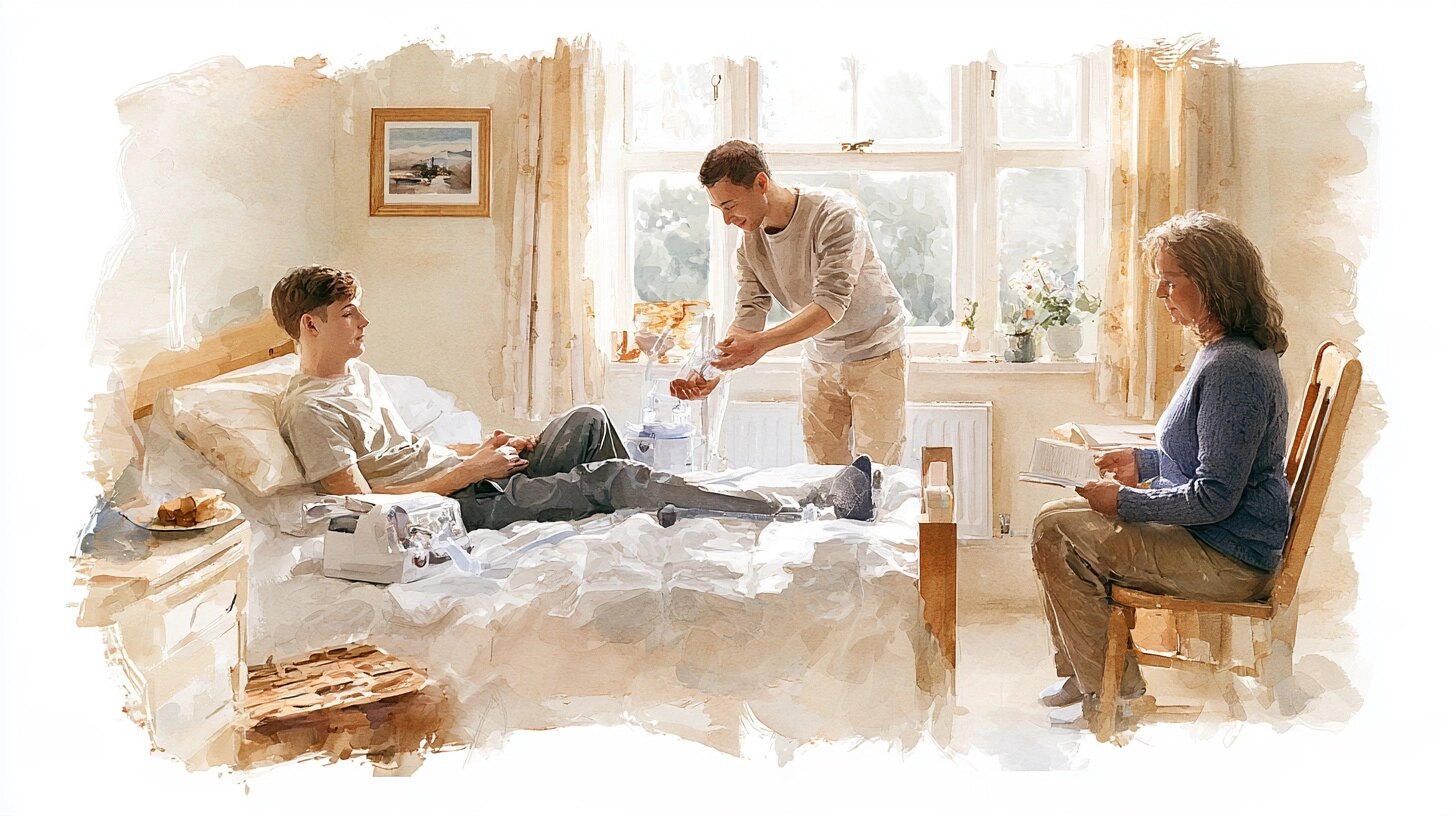
A ventilator at home does not mean an intensive care bed in the front room. Home ventilation is usually a machine beside the bed, a length of tubing and a mask. Knowing which of the two kinds your relative has tells you most of what to expect.
| Non-invasive ventilation (NIV) | Invasive ventilation | |
|---|---|---|
| How the air gets in | Through a mask over the nose, or the nose and mouth, held on by straps around the head. Some people use nasal pillows that sit just inside the nostrils. | Through a tracheostomy, a tube passed into the windpipe through an opening in the front of the neck. It needs an operation. |
| When it is used | Usually at night at first. Some people come to need it during the day as well, and some all the time. | May be needed for much of the day or all of it, and the person may not be able to breathe without it. |
| What it asks of the household | Fitting the mask, keeping it clean, watching the skin under it, and a plan for power cuts. | Tracheostomy care, suction and an emergency plan, with somebody trained close by. |
How the air gets in
- Non-invasive ventilation (NIV)
- Through a mask over the nose, or the nose and mouth, held on by straps around the head. Some people use nasal pillows that sit just inside the nostrils.
- Invasive ventilation
- Through a tracheostomy, a tube passed into the windpipe through an opening in the front of the neck. It needs an operation.
When it is used
- Non-invasive ventilation (NIV)
- Usually at night at first. Some people come to need it during the day as well, and some all the time.
- Invasive ventilation
- May be needed for much of the day or all of it, and the person may not be able to breathe without it.
What it asks of the household
- Non-invasive ventilation (NIV)
- Fitting the mask, keeping it clean, watching the skin under it, and a plan for power cuts.
- Invasive ventilation
- Tracheostomy care, suction and an emergency plan, with somebody trained close by.
Sources: the MND Association information sheet on ventilation, and the home ventilation leaflets from Hull University Teaching Hospitals NHS Trust. The team looking after your relative will tell you exactly what they have and why.
The MND Association's information sheet on ventilation describes both kinds plainly. NIV boosts the flow of ordinary air into the lungs through a mask, and it is the most common form of ventilation for people with motor neurone disease. Ventilation through a tracheostomy, which some teams call invasive ventilation, sends air through a tube into the windpipe. The Hull home ventilation leaflet for carers adds that NIV is not the same as CPAP, the machine many people use for sleep apnoea.
People come to need NIV for different reasons. When the muscles used for breathing weaken, or breathing becomes shallow during sleep, carbon dioxide can build up in the blood, and the Hull leaflet lists daytime tiredness, disturbed sleep, a lack of energy and morning headaches among the signs. NICE guideline NG42 recommends NIV for people with motor neurone disease whose breathing is affected, and care at home with MND covers where it sits in the wider picture. The NHS lists a machine to help with breathing among the treatments for muscular dystrophy where the condition affects the lungs. NICE guideline NG115 on COPD asks for some people with COPD to be referred to a specialist centre to be considered for long-term NIV, and COPD and oxygen at home covers the rest of that condition. North Tees and Hartlepool's NIV leaflet notes that the lungs may struggle when somebody is overweight, and that for some of these people the team considers a machine to use every night at home. This is sometimes called obesity hypoventilation.
If your relative has a tracheostomy, tracheostomy care at home covers the tube, suction and the emergency plan, and you should read it first. The rest of this page is written mainly for the mask.
The home ventilation team
The home ventilation team sets it up, teaches you and stays the number to ring
NIV at home is started and looked after by a specialist NHS respiratory team. Trusts call it different things, such as the home ventilation service, the NIV team or the respiratory ventilation service, but the job is the same. Here is who does what once the machine is in the house.
- Sets it or is in charge of it
- Does it day to day
- Backs it up, or is the one to ring
| The job | The family | A carer, once signed off | Home ventilation team | GP | Electricity supplier |
|---|---|---|---|---|---|
| Choosing the machine, the mask and the settings | Backs it up, or is the one to ring: Tells the team how nights are going and what your relative finds hard | Never changes a setting | Sets it or is in charge of it: Fits the mask, sets the machine and reviews both at clinic | No usual part | No usual part |
| Putting the mask on at night and taking it off | Does it day to day: Shown how by the team before starting | Does it day to day: Only after the team has trained them and signed them off for your relative | Sets it or is in charge of it: Teaches it, and runs training for carers where the service offers it | No usual part | No usual part |
| Cleaning the mask, straps and tubing | Does it day to day: As the leaflet from your team says | Does it day to day: As the team has shown them and the care plan says | Sets it or is in charge of it: Explains how often and with what | No usual part | No usual part |
| Watching the skin under the mask and a dry mouth | Does it day to day: Looks for soreness on the bridge of the nose | Does it day to day: Notices soreness and tells the family, and the team if the plan says so | Sets it or is in charge of it: Refits or changes the mask, and can add a humidifier | Backs it up, or is the one to ring: For a stuffy nose that does not settle | No usual part |
| Spare masks, filters and servicing the machine | Does it day to day: Keeps the spares and knows who supplied the machine | Backs it up, or is the one to ring: Can say when a mask or strap is wearing out | Sets it or is in charge of it: Arranges servicing, or tells you who does | No usual part | No usual part |
| Power, batteries and power cuts | Does it day to day: Joins the Priority Services Register and keeps batteries charged | Does it day to day: Follows the written plan for a power cut | Sets it or is in charge of it: Decides whether a battery or a spare machine is needed | No usual part | Backs it up, or is the one to ring: Warns of planned cuts where it can, and gives priority support in an emergency |
| An alarm, or breathing that is worse | Does it day to day: Rings the team for a fault, and 999 in an emergency | Does it day to day: Rings the number in the care plan, and 999 in an emergency | Sets it or is in charge of it: The number for the machine, in the hours the service is open | Backs it up, or is the one to ring: Or 111, when breathing is worse but it is not an emergency | No usual part |
| Going into hospital | Does it day to day: Sends the ventilator and the leaflet with your relative | Backs it up, or is the one to ring: Makes sure the ventilator goes too if the family is not there | Backs it up, or is the one to ring: Asks to be told, so they can advise the ward | Backs it up, or is the one to ring: NICE asks for the GP to be told your relative uses NIV | No usual part |
Choosing the machine, the mask and the settings
- The family
- Backs it up, or is the one to ring: Tells the team how nights are going and what your relative finds hard
- A carer, once signed off
- Never changes a setting
- Home ventilation team
- Sets it or is in charge of it: Fits the mask, sets the machine and reviews both at clinic
Putting the mask on at night and taking it off
- The family
- Does it day to day: Shown how by the team before starting
- A carer, once signed off
- Does it day to day: Only after the team has trained them and signed them off for your relative
- Home ventilation team
- Sets it or is in charge of it: Teaches it, and runs training for carers where the service offers it
Cleaning the mask, straps and tubing
- The family
- Does it day to day: As the leaflet from your team says
- A carer, once signed off
- Does it day to day: As the team has shown them and the care plan says
- Home ventilation team
- Sets it or is in charge of it: Explains how often and with what
Watching the skin under the mask and a dry mouth
- The family
- Does it day to day: Looks for soreness on the bridge of the nose
- A carer, once signed off
- Does it day to day: Notices soreness and tells the family, and the team if the plan says so
- Home ventilation team
- Sets it or is in charge of it: Refits or changes the mask, and can add a humidifier
- GP
- Backs it up, or is the one to ring: For a stuffy nose that does not settle
Spare masks, filters and servicing the machine
- The family
- Does it day to day: Keeps the spares and knows who supplied the machine
- A carer, once signed off
- Backs it up, or is the one to ring: Can say when a mask or strap is wearing out
- Home ventilation team
- Sets it or is in charge of it: Arranges servicing, or tells you who does
Power, batteries and power cuts
- The family
- Does it day to day: Joins the Priority Services Register and keeps batteries charged
- A carer, once signed off
- Does it day to day: Follows the written plan for a power cut
- Home ventilation team
- Sets it or is in charge of it: Decides whether a battery or a spare machine is needed
- Electricity supplier
- Backs it up, or is the one to ring: Warns of planned cuts where it can, and gives priority support in an emergency
An alarm, or breathing that is worse
- The family
- Does it day to day: Rings the team for a fault, and 999 in an emergency
- A carer, once signed off
- Does it day to day: Rings the number in the care plan, and 999 in an emergency
- Home ventilation team
- Sets it or is in charge of it: The number for the machine, in the hours the service is open
- GP
- Backs it up, or is the one to ring: Or 111, when breathing is worse but it is not an emergency
Going into hospital
- The family
- Does it day to day: Sends the ventilator and the leaflet with your relative
- A carer, once signed off
- Backs it up, or is the one to ring: Makes sure the ventilator goes too if the family is not there
- Home ventilation team
- Backs it up, or is the one to ring: Asks to be told, so they can advise the ward
- GP
- Backs it up, or is the one to ring: NICE asks for the GP to be told your relative uses NIV
PrimeCarers does not check a carer’s training or clinical skills, and does not introduce nurses. The carer column applies only once the home ventilation team has trained that carer and signed them off for your relative.
Drawn from NICE guideline NG42, the MND Association, NIV leaflets from the Hull, Kent Community Health and Worcestershire NHS trusts, and Ofgem. Services differ by area, so your relative’s own care plan comes first.
NICE sets out what should happen before NIV starts for somebody with motor neurone disease. The guideline is written for that condition, but its list makes a useful set of questions whatever the reason for the machine. The team assesses the risks with the person and the family, including a ventilator failing, the power supply and battery back-up, and whether carers are available. Then it prepares a care plan, and the family should be offered a copy. NICE says it should cover the reviews, how the machine is maintained, round-the-clock emergency clinical and technical support, and training for the person, the family and carers. It also asks for families and carers to be assessed on whether they are able and willing to help with the ventilation, and on what training they need.
NICE also says NIV is usually started at night after the person has had time to get used to it during the day, and that the hours are built up as needed. The MND Association adds that the mask and settings are usually adjusted at an outpatient clinic, and that some machines can be adjusted remotely by the team.
Equipment and power cuts
The machine, the masks, and a plan for when the power goes off
The equipment itself is simple to live with. The part that is easy to overlook until it happens is electricity, because the machine runs on it. A short plan made in the first week saves a frightening night later.
Before the first power cut
0 of 8 ticked
The electricity supplier
The machine
The plan
Ofgem's page on the Priority Services Register lists the help that comes with it. They include priority support in an emergency, advance notice of scheduled power cuts wherever possible, and the chance to name a family member or carer to receive the supplier's messages.
The MND Association says being prepared for power cuts is essential for anybody who depends on their ventilator for more than 14 hours a day, and that some suppliers or care teams may be able to help with a back-up generator for longer cuts. Whether your relative is at that point is for the team to say. If they use NIV for a few hours at night, the plan can be short. If they use it most of the day, it needs to be written down and every carer needs to have read it.
The mask, alarms and worse breathing
What you are likely to notice, and who to ring about it
Somebody in the family may be the first to see that something is not right: a red mark on the nose, a dry mouth in the morning, an alarm at two o'clock. The leaflets from NHS home ventilation teams say what each of these usually means and who deals with it.
| What the leaflets say it usually means | Who to ring | |
|---|---|---|
| A sore or red nose, or marks on the face | Hull says sores on the face and nose come from a mask that is too tight. Kent says soreness on the bridge of the nose means the mask is too tight at the top or a poor fit, and can get worse. | Kent says to contact the NIV nurse and not wait for the next appointment. The mask may need refitting or replacing. |
| Air blowing into the eyes, or sore eyes | Air leaking from the mask. Hull says not to carry on with air blowing into the eyes. | The team, if repositioning the mask the way they taught you does not stop it. |
| A dry mouth or throat | Kent calls this very common, particularly with a mask that covers the mouth. Hull suggests plenty to drink through the day, and Kent a glass of water by the bed. | The team, if it carries on. Hull and Kent both say a humidifier or other filters may help. |
| An alarm on the machine | The team's leaflet lists what each alarm on your relative's machine means. Hull's includes a leak, a loss of mains power and a system failure. | The home ventilation team for a fault with the machine. The electricity supplier for a power cut. |
| Breathing that is worse, or your relative seems more unwell | It may be the illness rather than the machine, so it needs a clinician to look at it. | Worcestershire says to call the GP, 111 or 999. Call 999 at once for the signs in the box below. |
A sore or red nose, or marks on the face
- What the leaflets say it usually means
- Hull says sores on the face and nose come from a mask that is too tight. Kent says soreness on the bridge of the nose means the mask is too tight at the top or a poor fit, and can get worse.
- Who to ring
- Kent says to contact the NIV nurse and not wait for the next appointment. The mask may need refitting or replacing.
Air blowing into the eyes, or sore eyes
- What the leaflets say it usually means
- Air leaking from the mask. Hull says not to carry on with air blowing into the eyes.
- Who to ring
- The team, if repositioning the mask the way they taught you does not stop it.
A dry mouth or throat
- What the leaflets say it usually means
- Kent calls this very common, particularly with a mask that covers the mouth. Hull suggests plenty to drink through the day, and Kent a glass of water by the bed.
- Who to ring
- The team, if it carries on. Hull and Kent both say a humidifier or other filters may help.
An alarm on the machine
- What the leaflets say it usually means
- The team's leaflet lists what each alarm on your relative's machine means. Hull's includes a leak, a loss of mains power and a system failure.
- Who to ring
- The home ventilation team for a fault with the machine. The electricity supplier for a power cut.
Breathing that is worse, or your relative seems more unwell
- What the leaflets say it usually means
- It may be the illness rather than the machine, so it needs a clinician to look at it.
- Who to ring
- Worcestershire says to call the GP, 111 or 999. Call 999 at once for the signs in the box below.
Sources: the NIV leaflets from Hull University Teaching Hospitals, Kent Community Health and Worcestershire Acute Hospitals NHS trusts, and the MND Association information sheet on ventilation. Your relative's own leaflet and care plan come first where they differ.
The Kent Community Health NIV leaflet says the mask should fit firmly but not too tightly, and that a small leak at the bottom is common and does not affect how well the machine works. How to fit the mask and answer each alarm is taught by the team on your relative's own machine, and you and any carer follow that teaching.
Two things help if your relative goes into hospital. Hull and Kent both say to take the ventilator with them, and Hull asks the family to let the home ventilation team know, because some ward staff are less familiar with the equipment. NICE asks for the GP and the emergency services to be told that somebody with motor neurone disease uses NIV, so ask the team whether that has been done.
You can get the free printable PDF to keep with this guide.
Nights and paid carers
Whether someone needs to be awake at night, and what a paid carer can do
Whether somebody has to sit up all night depends on your relative, and it is the team's decision rather than yours or ours. What a paid carer can do follows from the same decision.
NICE asks the team to provide night-time help and training where somebody cannot use the equipment on their own, including removing or replacing the mask in an emergency. The MND Association says the health and social care team can assess whether somebody needs to be in the house to respond quickly, and that some ventilators have built-in alarms for when a person cannot call out. A person who can take their own mask off and use the machine alone may need nobody awake. A person who cannot take the mask off themselves may need somebody close by all night. Ask the team which describes your relative, and to write it in the care plan.
If the answer is somebody awake, waking night or sleeping night explains the difference between a carer asleep in the house and one awake beside the bed. If the ventilation has reached most of the day, how many carers a 24-hour team takes sets out the rota shapes, and the MND Association says that at that stage a care package usually includes trained care workers even with strong family support.
What any carer can do
- Washing, dressing, meals and drinks through the day, which also helps with a dry mouth
- Company, and help with the routine at bedtime and in the morning
- Noticing a sore nose, a new cough, more sleepiness or a morning headache, and telling the family
- Keeping the area round the bed clear and the plan and phone numbers where they can be seen
- Ringing the number in the care plan, or 999 in an emergency
Only once the team has trained and signed them off
- Putting the mask on at night and taking it off
- Cleaning or reassembling the mask and tubing
- Answering an alarm by doing anything more than ringing for help
- Using a cough assist machine or suction, where your relative has one
- Adjusting the straps, in the way the team has shown them
A carer can take on the mask and the other ventilator tasks only once your relative's specialist team has trained them and signed them off for your relative. Delegated healthcare tasks explains how that hand-over works and who stays answerable afterwards. The sign-off is for one named carer and one person, so a second carer or a stand-in needs their own. The client contract lets a carer send a substitute, and lets you object on reasonable grounds, which include whether the substitute can meet the agreed care needs.
When you are building night support around the machine, you can search for carers near you and compare their rates, and ask each one about their experience with NIV or other breathing support. What a carer writes on their profile is their own account. PrimeCarers checks a carer's identity and right to work, an accepted criminal-record check (Enhanced DBS issued within the last 2 years, DBS Update Service, Scottish PVG or Access NI), and holds an online interview. We do not check qualifications, training or clinical skills, and we do not introduce nurses, so any experience a carer describes is for you to ask about and for the home ventilation team to assess. Every visit booked through PrimeCarers is insured, by the carer's own policy or by cover PrimeCarers arranges where they do not hold one. Ask the insurer in writing whether that cover extends to a ventilator task the team has delegated. Whether part of the day needs a nurse instead is covered in nurse-led or carer-led complex care.
Questions
Questions families ask about a ventilator at home
Yes, once your relative's home ventilation team has trained that carer and signed them off for your relative. Hull's carers' leaflet says carers can be shown how to fit the mask and start the ventilator. Until the team has done that, the carer helps with everything around the machine and rings for help if something is wrong. Delegated healthcare tasks explains the sign-off.
Not always. It depends on whether your relative can use the machine and take the mask off on their own. NICE asks the team to arrange night-time help where somebody cannot, and the MND Association says the team can assess whether somebody needs to be in the house to respond quickly. Ask the team and have the answer written into the care plan.
Follow what the team taught you for that alarm, and ring the home ventilation team about a fault with the machine. Hull's leaflet says most people are safe to manage overnight and contact the team on the next working day, but that depends on how much your relative relies on the machine, so ask the team in advance. If your relative is struggling to breathe, call 999.
Join your supplier's Priority Services Register and tell them your relative uses a ventilator. Ofgem says the register gives priority support in an emergency and advance notice of scheduled power cuts wherever possible. It does not keep the power on, so ask the team whether your relative needs a battery or a spare machine as well.
No. PrimeCarers introduces families to self-employed carers. We do not check qualifications, training or clinical skills, and we do not introduce nurses, so we cannot say a carer is trained in ventilation. You can search carers near you and ask about their experience, and your relative's home ventilation team decides whether to train and sign off the carer you choose.