
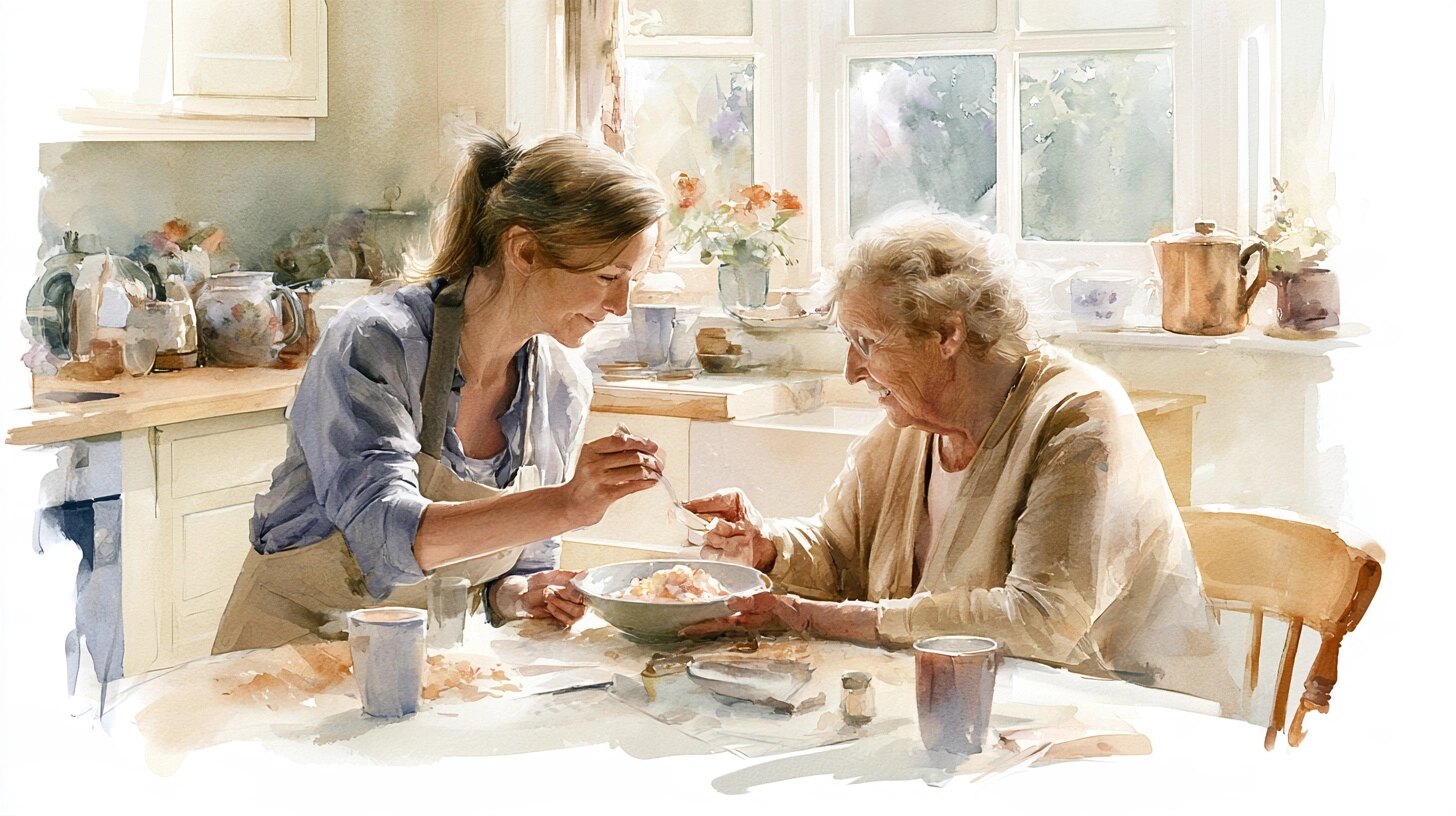
This page is part of PrimeCarers' guide to dementia care. It covers what dementia itself does to eating as it moves into its later stages. For eating well in older age more generally, the elderly nutrition guide is the better place to start.
The short answer
- Most mealtime problems have a cause you can work withForgetting a meal, not recognising food, struggling with cutlery and holding food in the mouth each point to something that can be changed or checked.
- Small, plain changes at the table helpFinger food, a plate that contrasts with the food, eating together, smaller meals more often, a calm room, and plenty of time.
- Tell the GP about coughing, choking or a wet voice after drinkingA speech and language therapist assesses swallowing and sets any change to food or drink texture. That is not something for a family to guess at.
- NICE advises against routine tube feeding in severe dementiaThe decision about feeding in the later stages is made with the clinical team, and ideally with your relative's own earlier wishes in front of everyone.
Checked against NICE guideline NG97, the NHS, the Alzheimer's Society and the Royal College of Physicians, September 2026. Prices are what carers on PrimeCarers charge, with our fee included.
What changes
What dementia does to eating in the later stages
The Alzheimer's Society describes people with dementia forgetting they have eaten, struggling to recognise the food and drink in front of them, having trouble picking up or gripping cutlery or a glass, and holding food in their mouth. As the illness goes on, swallowing difficulties become more common as well. The table below sets out each change, what can lie behind it, and what to do.
Knowing it is a meal
The memory and the recognition of food, rather than the body.
What you see
Saying they have already eaten, or asking when lunch is an hour after it
What can lie behind it
Forgetting a meal they have just had, or worrying about when the next one is coming
What to do
Keep to set mealtimes, sit down to eat with them, and leave a snack in sight between meals
What you see
Looking at a full plate and not starting
What can lie behind it
Not recognising what is in front of them as food, or not being sure what to do with it
What to do
Put one thing on the plate at a time, name it, and take the first mouthful yourself so they can copy you
What you see
Leaving food that is hard to see, such as mashed potato on a white plate
What can lie behind it
Changes in how they see, so the food does not stand out from the crockery or the table
What to do
A plain plate in a colour that contrasts with the food and with the tablecloth
Getting food from the plate
Coordination and grip, which change as the illness goes on.
What you see
Pushing food around, or giving up with the knife and fork
What can lie behind it
Difficulty picking up or gripping cutlery or a glass, or no longer knowing how to use them
What to do
Finger food they can pick up, and help loading the fork without taking the whole meal over
What you see
Getting up and walking away halfway through
What can lie behind it
Restlessness, or a meal that has gone on longer than their attention can hold
What to do
Food they can carry, such as a sandwich cut small, and a second go at the table later rather than insisting now
In the mouth
The group where a dentist, a pharmacist or the GP can often find a cause.
What you see
Holding food in the mouth or the cheek, or chewing for a long time without swallowing
What can lie behind it
Forgetting to swallow, a texture that is hard to manage, or discomfort they cannot describe
What to do
Gentle prompts to swallow, an empty mouth before the next spoonful, and a check for pain. Tell the GP if it keeps happening
What you see
Turning the head away, pushing the spoon off, or keeping the mouth shut
What can lie behind it
A sore mouth, dentures that no longer fit, constipation, low mood, or not being hungry
What to do
Stop, try again later, and ask the dentist or the GP to look for a cause. If they keep refusing food, speak to the GP or a pharmacist
Swallowing
Report these to the GP. The speech and language therapist decides what changes, not the family.
What you see
Coughing or choking while eating or drinking
What can lie behind it
Food or drink going down the wrong way, towards the lungs rather than the stomach
What to do
Ask the GP for a referral to a speech and language therapist, and write down when it happens and with what
What you see
A gurgly or wet-sounding voice after a drink
What can lie behind it
One of the signs the NHS lists for a swallowing problem, alongside coughing and choking
What to do
Stop and let them clear their throat, then tell the GP. Do not start thickening drinks yourself
What you see
Chest infections that keep coming back, or weight going down
What can lie behind it
Food, drink or saliva getting into the lungs over time, or not enough going in
What to do
Tell the GP the whole pattern, including the coughing at meals, rather than treating each infection on its own
Drawn from the Alzheimer’s Society, the NHS, NICE guideline NG97 and the Royal College of Physicians. One change can have more than one cause, and a person can manage well one day and struggle the next.
These changes do not arrive on a timetable, and someone can eat a full breakfast and then refuse lunch. The seven stages of dementia explains how the illness tends to progress, and eating difficulties sit mainly in the later stages it describes.
Refusing food deserves a second look before anyone decides it is the dementia. The Alzheimer's Society notes that a person may turn down food and drink because of physical difficulties such as problems with chewing and swallowing, or constipation, and that refusing food or holding it in the mouth can be how they communicate a need they cannot put into words. A sore mouth or dentures that no longer fit are worth ruling out, and daily mouth care and when to call a dentist covers both. If the refusals keep going, the charity's advice is to speak to a pharmacist or the GP.
Weight loss is the other thing to keep an eye on. The Royal College of Physicians says that in the later stages more than two thirds of people living with dementia are likely to be at risk of malnutrition, and that slowing the decline with adapted eating and drinking is still a positive outcome. What happens when an older person does not eat enough covers the signs, and a GP can weigh your relative and refer to a dietitian.
What helps at the table
Plain changes that make a meal easier
Nothing here needs equipment or a prescription. Each change takes away one of the things that makes a meal hard for somebody whose memory, eyesight and coordination are all under strain, and several can be tried at the next meal.
Finger food
For a knife and fork that no longer work
A plate that stands out
Contrast between food, plate and table
Eating together
Somebody to copy
Small amounts, more often
Instead of three large meals
A calm room
Television off, one conversation
Time
Longer than you expect
Making the home dementia-friendly covers lighting and contrast around the kitchen and dining table, and explains why patterned tablecloths and busy crockery work against a person with dementia.
Drinks need the same thought, because a person who has forgotten to eat may have forgotten to drink too. How to get an older person to drink more has practical ideas. If a speech and language therapist has set a thickness for drinks, those ideas apply only within it.
Swallowing and the therapist
When swallowing changes, a speech and language therapist decides what happens next
Difficulty swallowing is called dysphagia. The Alzheimer's Society says that people with swallowing problems are at risk of choking, and of food or saliva going down the windpipe and causing an infection in the lungs, which is called aspiration pneumonia. The NHS lists coughing or choking when eating or drinking, food coming back up, a feeling of food stuck in the throat, and a gurgly, wet-sounding voice among the signs.
- 1
Write down what you see
This weekNote when the coughing happens, with what food or drink, and whether their voice sounds wet afterwards. Note any chest infections and whether their clothes are getting looser. - 2
Ask the GP for a referral
Soon, and urgently if it is getting worseThe NHS advises contacting the GP urgently, or NHS 111, if someone has difficulty swallowing, coughs while eating or keeps getting chest infections. NICE tells clinicians to consider involving a speech and language therapist when there are concerns about a person's safety when eating and drinking. Ask for that referral by name. - 3
The therapist assesses the swallow
The assessmentA speech and language therapist watches your relative eat and drink and works out which textures they can manage safely. They may also advise on sitting position, pace, the size of each mouthful and the level of help at meals. - 4
They set the texture, in writing
The plan everyone followsChanges can include softer or blended food and thickened drinks. The therapist may use the IDDSI framework, which numbers drink thickness from 0 to 4 and food textures from 3 to 7. Keep the written plan in the kitchen. - 5
Ask for a review when things change
Swallowing is not fixedThe Royal College of Physicians notes that swallowing ability and preferences fluctuate. If your relative is coughing more on the current plan, or managing better, go back to the GP or the therapist rather than adjusting it yourself.
The reason a family should not guess at textures is that the right one depends on how this particular person's swallow works, and only an assessment shows that. The Royal College of Physicians says carers may need training and support to make sure they follow the guidance on consistency and texture correctly. Ask the therapist to show you how to make up a thickened drink, and use the IDDSI levels explained in plain words to read the numbers on the plan.
Tablets are part of the same conversation. The Royal College of Physicians notes that medicines may need to be prescribed in other forms when swallowing changes, which the doctor arranges with the pharmacist. So if tablets have become hard to swallow, ask the GP or pharmacist rather than crushing them or opening capsules yourself.
You can get the free printable PDF to keep with this guide.
Tube feeding and hand feeding
The decisions about feeding in advanced dementia
As dementia reaches its most advanced stage, eating and swallowing can become difficult enough that the family is asked about the options. What follows is what the guidance says, not a view on what to choose: the decision is made with the clinical team, and it depends on your relative and what they would have wanted.
| What it involves | What the guidance says | What to weigh | |
|---|---|---|---|
| Tube feeding | Liquid food given through a tube passed through the nose into the stomach, or through a tube placed into the stomach through the abdomen (a PEG tube). | NICE NG97 says not to routinely use tube feeding in people living with severe dementia, unless it is for a condition that could be reversed. NICE's decision aid says studies found no good evidence that people lived longer or were better nourished with it. | NICE lists discomfort, sores, distress at a tube the person does not understand, the risk of it being pulled out, and a hospital stay to fit a PEG tube. Some studies found a higher risk of chest infections. |
| Careful hand feeding | Continuing to offer food and drink by mouth, slowly and in the textures the therapist set, for comfort and enjoyment. It is sometimes called comfort feeding. | The Royal College of Physicians calls this eating and drinking with acknowledged risks. It says the decision must be documented, with clear guidance for carers on how to help the person eat. | The risk of choking or chest infection does not go away, and the plan accepts that openly. The person keeps the taste of food they like, and the company of a meal. |
| Mouth care alone | When someone can no longer take much at all, keeping the lips and mouth moist and clean, with sips if they can still swallow. | NICE's decision aid suggests offering food and drink the person likes so they can enjoy the taste, moistening their lips, and sips of water or juice if they can still swallow. | This belongs to the most advanced stage of the illness, and a palliative care team can guide it. |
Tube feeding
- What it involves
- Liquid food given through a tube passed through the nose into the stomach, or through a tube placed into the stomach through the abdomen (a PEG tube).
- What the guidance says
- NICE NG97 says not to routinely use tube feeding in people living with severe dementia, unless it is for a condition that could be reversed. NICE's decision aid says studies found no good evidence that people lived longer or were better nourished with it.
- What to weigh
- NICE lists discomfort, sores, distress at a tube the person does not understand, the risk of it being pulled out, and a hospital stay to fit a PEG tube. Some studies found a higher risk of chest infections.
Careful hand feeding
- What it involves
- Continuing to offer food and drink by mouth, slowly and in the textures the therapist set, for comfort and enjoyment. It is sometimes called comfort feeding.
- What the guidance says
- The Royal College of Physicians calls this eating and drinking with acknowledged risks. It says the decision must be documented, with clear guidance for carers on how to help the person eat.
- What to weigh
- The risk of choking or chest infection does not go away, and the plan accepts that openly. The person keeps the taste of food they like, and the company of a meal.
Mouth care alone
- What it involves
- When someone can no longer take much at all, keeping the lips and mouth moist and clean, with sips if they can still swallow.
- What the guidance says
- NICE's decision aid suggests offering food and drink the person likes so they can enjoy the taste, moistening their lips, and sips of water or juice if they can still swallow.
- What to weigh
- This belongs to the most advanced stage of the illness, and a palliative care team can guide it.
Sources: NICE guideline NG97 recommendation 1.10.8 and its patient decision aid on enteral tube feeding; Royal College of Physicians, Supporting people who have eating and drinking difficulties, 2021.
NICE is careful in its wording. Tube feeding can still be tried, its decision aid says, where the reason for the eating or swallowing problem is treatable and the person is expected to eat and drink normally again afterwards. What the guidance advises against is using a tube as the routine answer to eating difficulties that come from the dementia itself. The NICE decision aid on tube feeding in severe dementia is two pages long and written for families, and it is worth asking the team to go through it with you.
Who makes the decisionSection titled Who%20makes%20the%20decision
If your relative can still understand and weigh the choice, it is theirs. If they cannot, the clinical team decides in their best interests under the Mental Capacity Act, and the Royal College of Physicians says a decision to continue eating and drinking with acknowledged risks can be made that way. The family's part is to say what your relative valued and what they said when they could. Mental capacity and how it is assessed explains the process.
Two documents change the picture if they exist. An advance decision can refuse artificial nutrition and hydration, which includes tube feeding, but the Mental Capacity Act Code of Practice says it cannot refuse basic care, which includes the offer of food and water by mouth. Advance decisions and advance statements explains how to make one and when it applies. A lasting power of attorney for health and welfare can give an attorney the power to make decisions about life-sustaining treatment, if your relative chose to give it. Lasting power of attorney and dementia covers what to check. If neither exists and your relative can still talk about what they would want, have that conversation early.
Palliative care for dementia explains care for comfort in the later stages, and who is in the team.
A carer at mealtimes
What a carer does at mealtimes, and what it costs
Help at meals is mostly time. A carer who sits through a slow lunch and knows the plan the therapist set takes a daily weight off the family, and is there to notice a change.
What to agree with a carer before the first meal
0 of 9 ticked
The plan
The meal itself
What to report
Telling the carer all of this is part of the arrangement. The client contract asks the client to give full and accurate information, in advance and as things change, about known risks that affect the care, naming cognitive impairment among them. The contract also says a carer should not take on work they feel unqualified to do, and should say so. A carer who has never supported someone on a texture plan may reasonably say no, which is better than finding out at a meal.
Lunch is a natural first visit to book. The standard visits and what each covers explains the lunch call, and an hour is the shortest visit on PrimeCarers unless a carer offers shorter ones. If your relative needs somebody at every meal and through the night, live-in care for dementia puts one carer in the house who knows the plan and is there for all of it.
If you need somebody with the patience to sit through a meal, you can search for carers near you and compare their rates and dementia experience. Every carer has an online interview before they appear, and their identity, right to work and accepted criminal-record check (Enhanced DBS issued within the last 2 years, DBS Update Service, Scottish PVG or Access NI) are checked. Carers are self-employed and insured while they work. PrimeCarers does not check qualifications, training or references. Experience with dementia or swallowing plans is the carer's own account on their profile, so ask them about the meals they have helped with before.
Questions
Questions families ask about eating and swallowing
There can be several reasons at once. She may have forgotten she has not eaten, not recognise the food, find cutlery hard to use, or have a sore mouth, loose dentures or constipation. Swallowing problems can also make eating uncomfortable. The Alzheimer's Society advises speaking to a pharmacist or the GP if someone keeps refusing food, and a GP can look for a cause and weigh her.
The NHS lists coughing or choking when eating or drinking, food coming back up, a feeling that food is stuck, and a gurgly, wet-sounding voice when eating or drinking. Repeated chest infections and weight loss can also follow. Tell the GP and ask for a referral to a speech and language therapist.
Not without an assessment. A speech and language therapist works out which textures are safe and sets them in a written plan. Food that is too firm can be a choking risk, and a drink thickened more than it needs to be may be refused. Once a plan is in place, ask the therapist to show you how to prepare it.
NICE guideline NG97 says tube feeding should not routinely be used in people living with severe dementia, unless it is for a condition that could be reversed. Its decision aid says studies found no good evidence that tube feeding helped people live longer or be better nourished. The decision is made with the clinical team, taking in your relative's own wishes and any advance decision or lasting power of attorney.
It is a name for carefully continuing to offer food and drink by mouth, for comfort and enjoyment, while accepting that there is some risk of choking or chest infection. The Royal College of Physicians calls it eating and drinking with acknowledged risks, and says the decision must be documented with clear guidance for carers on how to help the person eat.
Yes, if the carer is comfortable working to it. Give them the therapist's written plan before the first visit and ask whether they have supported someone on one before. A carer should turn down work they feel unqualified to do. Hourly visits on PrimeCarers are £18 to £25 an hour with our fee included.