
The short answer
- The wage floor has risen sharplyThe National Living Wage has risen 43% since 2021, most of that rise coming since inflation started falling back from its 2022 peak.
- Typical pay now sits right against that floorMedian pay for an independent-sector care worker was £12.60 an hour in December 2025, only pennies below the wage floor due four months later.
- Fewer carers are arriving from abroadThe overseas recruitment route closed to new applicants in July 2025. The effect on who is available, especially for live-in care, will build gradually rather than all at once.
- Carers on PrimeCarers set their own rateSelf-employed carers are not paid the wage floor. Most charge £18 to £25 an hour with our fee included, based on their own experience and area.
These figures are about the wider social care workforce in England. Carers on PrimeCarers are self-employed and agree their rate directly with you, covered further down this page.
Since 2020
The years that reshaped what carers are paid
Carer pay has lived through a pandemic, the sharpest inflation in a generation, and a minimum wage rising faster than at almost any point in the last two decades. Here is what happened, with the figures behind it.
The whole care sector was disrupted by the pandemic in 2020, and the low-paid workforce carrying it felt the sharpest edge of what followed. Between 2021 and 2023, prices across the UK rose faster than at any time in more than forty years: annual inflation peaked at 11.1% in October 2022, driven mainly by energy and food costs, according to the Office for National Statistics. For anyone paid close to the minimum wage, that stretch meant a real cut in what their pay could buy, however many pence an hour it had gone up by on paper.
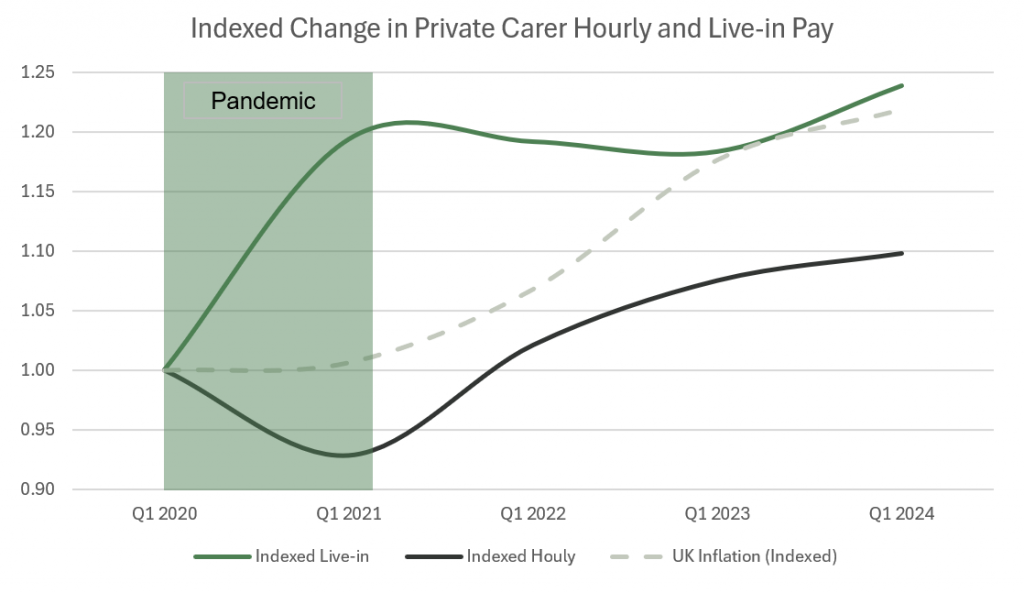
Government responded with a National Living Wage that rose faster than at almost any point since it was introduced. The chart below shows the climb.
The National Living Wage, 2021 to 2026
The wage floor has risen 43% since 2021, and most of that rise has come since inflation started falling back: it stood at 2.9% in July 2026, well down from the 11.1% peak of October 2022.
£12.60
was the median hourly pay for an independent-sector care worker in December 2025, only 11p below the wage floor due to arrive four months later
+2.1%
real-terms growth in that median pay between March and December 2025, the first sustained recovery in some years
Source: gov.uk, National Minimum Wage and National Living Wage rates; ONS, Consumer price inflation, UK; Skills for Care, Pay in the adult social care sector in England, as at December 2025 (March 2026).
That rise has consequences for anyone paying for care, whether through a council contract, an agency or directly. Each April increase pushes up what it costs to employ a carer legally, and for the first time in several years, pay has started to move ahead of inflation rather than trail behind it. What carers are paid in 2026, and why it matters to you goes through the fuller current picture, including how that affects whether a carer stays in the job.
Right up against the floor
Why typical pay has stopped moving much beyond the minimum wage
Carers employed by an agency or a council-funded provider are paid within a narrow band above the legal minimum, and that band has been shrinking rather than growing.
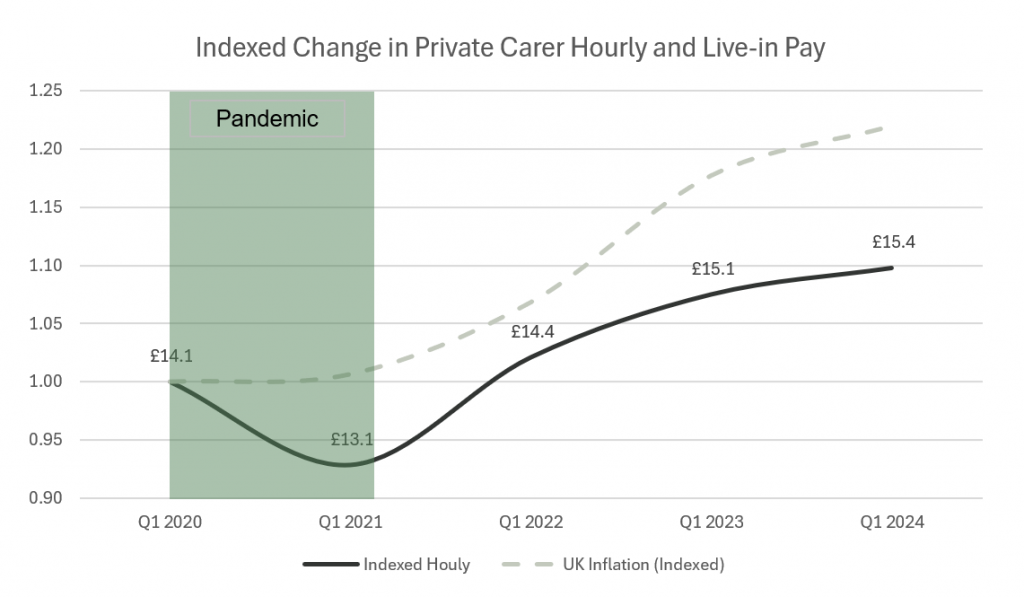
Skills for Care, which tracks pay across the independent care sector, found that by December 2025, 26% of care workers were paid on or within 10p of the National Living Wage, up from 22% in March 2025. Median pay stood at £12.60 an hour, only 11p below the rate that arrived four months later.
Part of the reason is what a council is prepared to pay for an hour of home care in the first place. The Homecare Association, the trade body for home care providers, calculates a Minimum Price for Homecare each year: what a provider needs to charge to pay a carer at least the National Living Wage, cover employment costs and travel time, and still run a viable business.
| Rate per hour | What it is meant to cover | |
|---|---|---|
| Average local authority rate (2026/27) | £25.05 | What most councils pay a provider per hour of commissioned home care |
| Homecare Association Minimum Price (2026/27) | £34.42 | Care worker pay at the National Living Wage, employment costs, travel time and a minimum contribution to running the business |
Average local authority rate (2026/27)
- Rate per hour
- £25.05
- What it is meant to cover
- What most councils pay a provider per hour of commissioned home care
Homecare Association Minimum Price (2026/27)
- Rate per hour
- £34.42
- What it is meant to cover
- Care worker pay at the National Living Wage, employment costs, travel time and a minimum contribution to running the business
A gap of £9.37 on every commissioned hour, which is why a pay rise for many carers is limited by what a council contract allows rather than by what the work is worth.
90%
of providers had staff below the incoming wage floor
around 640,000 posts needed a pay rise to comply with the April 2026 rate
26%
of care workers paid on or within 10p of the National Living Wage
up from 22% in March 2025
Skills for Care, Pay in the adult social care sector in England, as at December 2025 (March 2026); Homecare Association, Minimum Price for Homecare, England 2026/27.
None of this touches a carer you find and pay directly, which is covered further down this page. For the council-funded and agency workforce, though, a pay rise above the floor is limited by what a council contract allows, whatever the work is worth. What carers are paid in 2026 sets out what a fair rate looks like against this backdrop, and what is expected to change under the sector's incoming Fair Pay Agreement.
Fewer routes from abroad
Why the pool of carers arriving from overseas is shrinking
Much of the growth in the care workforce over the last few years came from people arriving from abroad to do this work. Since 2024, three changes have started closing that route, and the effects will build gradually rather than show up overnight.
- Mar 2024
Dependants no longer allowed
Care workers and senior care workers coming to the UK on a Health and Care Worker visa can no longer bring a partner or children with them.
- Jul 2025
Closed to new overseas applicants
Care providers can no longer sponsor a carer applying for this visa from outside the UK.
- Jul 2028
Transitional arrangements end
The last date a carer already sponsored in the UK can extend their visa or switch to a new sponsor.
The scale of what is now ending is worth setting out. Skills for Care estimates that the number of staff of non-British, non-EU nationality working in the care sector rose from around 130,000 in March 2022 to around 430,000 by the 2025-to-2026 reporting year, much of it through this visa route. From 2028, growth in the workforce will need to come chiefly from people already living in the UK.
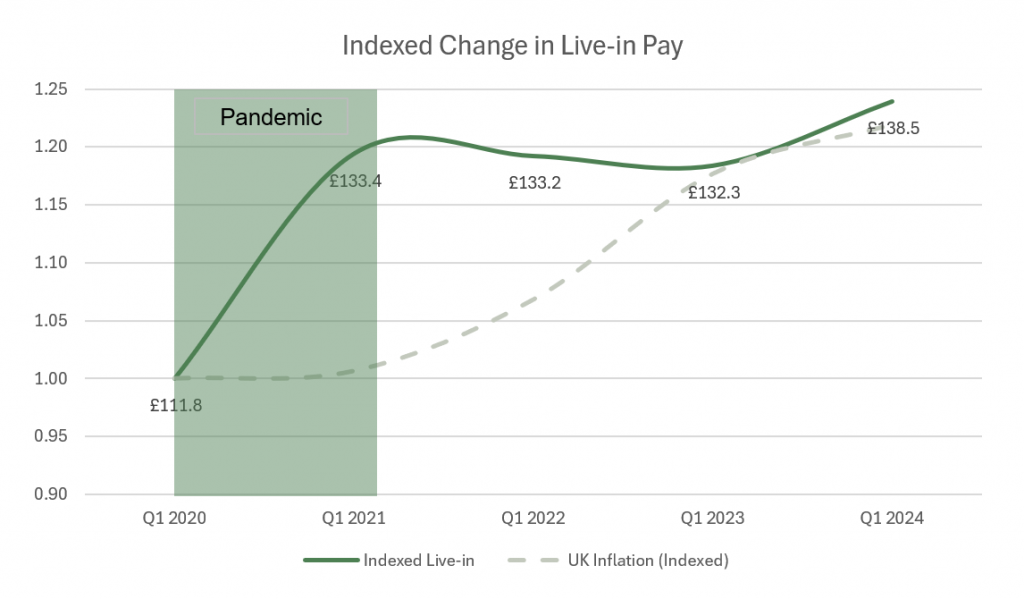
This matters more for live-in care than for an hourly visit, since a live-in arrangement asks somebody to move into a client's home for an extended placement, and a meaningful share of that workforce arrived on this route. If you are looking for live-in care, it is worth starting the search earlier than you think you need to and staying flexible about the exact start date, rather than assuming a carer can be found and in place within days. The impact of the visa changes on the care sector was written for carers, but sets out the same policy change in full, and how live-in care works is a good next stop if you are considering it for the first time.
What this means for you
What carers on PrimeCarers charge, and why it is a different number
None of the wage-floor rules above apply to a carer you find and pay directly. A self-employed carer sets their own rate based on their experience and what similar carers nearby charge, not a council contract or an agency's margin.
| On PrimeCarers | Through a home care agency | |
|---|---|---|
| Hourly visit | £18–£25 an hour, with our fee included | £28–£35 an hour |
| Live-in care | £1,050–£1,400+ a week, with our fee included | From around £1,400 a week |
Hourly visit
- On PrimeCarers
- £18–£25 an hour, with our fee included
- Through a home care agency
- £28–£35 an hour
Live-in care
- On PrimeCarers
- £1,050–£1,400+ a week, with our fee included
- Through a home care agency
- From around £1,400 a week
A self-employed carer sets this rate themselves; PrimeCarers does not set or negotiate it on their behalf.
Most of an agency's higher rate covers office costs and management layers that sit between the family and the carer. PrimeCarers connects you directly with a self-employed carer, so more of what you pay reflects the rate they have chosen to charge for their own time, rather than a wage set by an employer against the legal floor described above. Private carers against agency carers sets out that comparison in full, and what carers and agencies charge per hour and the cost of live-in care have the fuller breakdown of current rates.
Looking for a carer now
What to expect if you are looking for a carer this year
Two of the trends above are worth knowing before you start looking: rates tend to move a little each April, and a live-in carer may take longer to find than it did a few years ago.
Worth doing
- Start a live-in search earlier than you think you need to, given the narrowing overseas pipeline
- Stay flexible about the exact start date if you are looking for live-in care
- Ask a carer about their experience alongside their rate, rather than the rate on its own
- Use the cost calculator to see what a typical week looks like for your situation
- Expect hourly and live-in rates generally to drift upward a little each year, in line with the wider cost of employing somebody legally
Not a good basis for deciding
- Assume a carer can be found and in place within days for live-in care
- Choose the cheapest profile without asking why the rate is low
- Compare a private carer's rate to an agency's without checking what each one includes
- Wait for prices to fall; the wage floor has only moved in one direction since 2021
What care costs where you live gives a fuller estimate for your area and the kind of care you need, and searching for a carer near you is free and comes with no obligation to book.
Questions
Questions families ask about carer pay
From £8.91 an hour in April 2021 to £12.71 from April 2026, a rise of 43%. Most of that increase has landed since 2023, as inflation fell back from its 2022 peak and government pushed the wage floor up faster to compensate. Current rates on gov.uk.
No. Carers on PrimeCarers are self-employed and are not paid a wage by PrimeCarers or by you as an employer. They set their own hourly or weekly rate and agree it with you directly, which is why their rate does not move in step with the wage floor described on this page.
An agency's rate covers its office costs and the management layers between the family and the carer, on top of what the carer is paid. PrimeCarers connects you directly with a self-employed carer, so more of what you pay is the rate the carer has set for their own time. Private carers against agency carers sets out the full comparison.
It is likely to tighten the pool over the next few years rather than change anything immediately. The route closed to new overseas applicants on 22 July 2025, with transitional arrangements for carers already here running until 22 July 2028. Starting a live-in search early and staying flexible on the start date is a sensible precaution. The impact of the visa changes on the care sector covers the policy in full.
The Homecare Association's calculated Minimum Price for Homecare in 2026/27 is £34.42 an hour, covering pay at the National Living Wage, employment costs and a contribution to running a business. The average local authority rate is £25.05. Councils are limited by their own budgets, and that gap limits what a provider on a council contract can pay the carer doing the visit. What carers are paid in 2026 covers this in more detail.
For the wider workforce, yes, for the moment. Median independent-sector care worker pay rose 5% in cash terms between March and December 2025, 2.1% after inflation, the first sustained real-terms recovery in several years. Annual inflation has fallen a long way from its 11.1% peak in October 2022, standing at 2.9% in July 2026.
What carers are paid in 2026, and why it matters to you goes through the current pay picture in full: the wage floor, the council funding gap, the visa timeline, and what to look for when a carer's rate is part of your decision.