
The short answer
- The nursing stays with the nursesInjections, syringe pumps, dressings and decisions about symptoms belong to the district nurses and the palliative care team. Just in case medicines are usually given by a district nurse who is called out.
- Your part is personal care, done often and gentlyMouth care at every visit, changing position on the nurse's schedule, washing without moving someone more than they can manage, and sitting with them.
- Know which number to ring before you need itAsk the family for the nursing team's number and the out-of-hours number on your first visit, and keep them where you can see them.
- Your contract has no clause for when your client diesWhat happens to the visits still booked is for you and the family to agree, in writing. The usual notice terms still apply.
Checked against NICE guidelines NG31 and NG142, NHS and Marie Curie guidance and the client and carer contract on 22 September 2026. This page describes England. It is general information, not clinical advice: the nursing team caring for your client comes first.
The team around your client
Who is caring for your client, and where you fit in
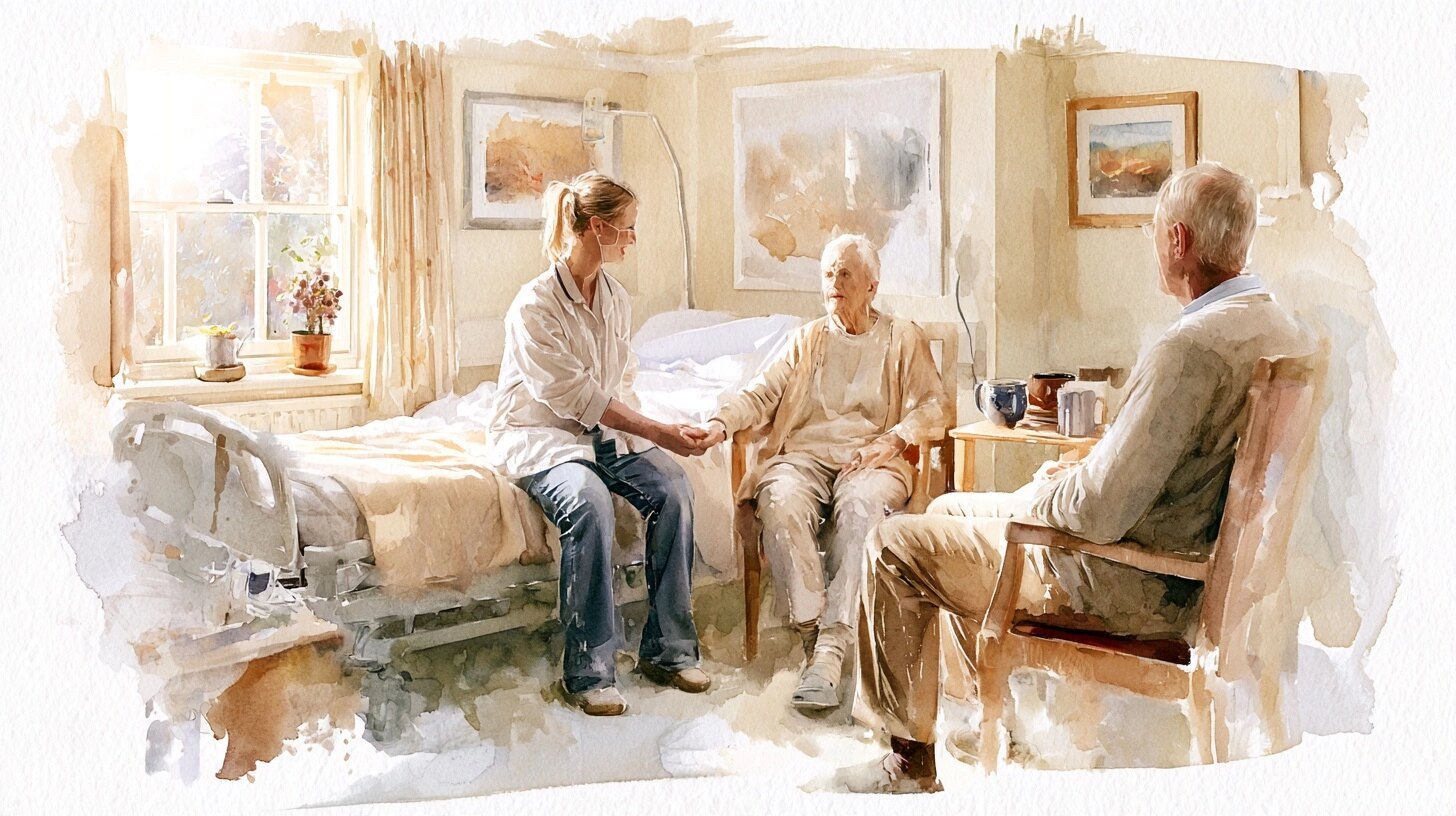
Palliative care is care for somebody whose illness cannot be cured, aimed at keeping them as comfortable as possible and supporting the people close to them. The NHS says that for somebody cared for at home, the GP has overall responsibility. You join a team that is already there, and it helps to know who each person is.
The GP
Overall responsibility at home
The district or community nurses
Visit, but do not stay
Specialist palliative care and hospice at home
Advise on pain and symptoms
The family, and you
The people in the house
NICE guideline NG142, on end of life care services for adults, asks that somebody at this stage has care coordinated across the services involved, and that the person and the people close to them are told who is in the team and how to reach them. NICE's companion guideline NG31, which covers care when an adult is expected to have only days left, asks for a named lead professional who gives the family contact details, including out-of-hours numbers. Those numbers go to the family, not to you, so ask for them.
Neither guideline is written for a self-employed carer. NG142 uses the word carer for family and friends, and says it does not mean somebody who cares professionally. So nobody in the NHS team is required to brief you, and you may need to introduce yourself. A short note left for the district nurse on your first visit, with your name, your visit times and how to reach you through the family, usually does it.
If you have not worked with a palliative client before, what families are told about who is in the team is a clear description of each role. The carer resources hub has the rest of the guides on working safely, pay and tax.
What you do
What you do at each visit, and what stays with the nursing team
Most of this work is ordinary personal care done more often and more gently. The line with nursing is clearer than carers sometimes expect, and holding it protects your client and you.
Your part, when agreed with the client
- Washing and changing your client in bed, without moving them more than they can manage
- Mouth and lip care, often, and offering small sips if they want them
- Changing position on the schedule the nurse has set, and looking at the skin each time
- Prompting tablets already prescribed, or giving them if you have been trained and have written instructions, and writing it down. Patches, creams and anything other than tablets by mouth are for the nurse to show you and agree in writing; the cover PrimeCarers arranges does not extend beyond oral medicines
- Sitting with them, talking, reading or putting the radio on
- Telling the nurse or the family what you have seen, the same day
Stays with the nursing team
- Just in case medicines, which are injections kept in the house for sudden symptoms
- Setting up, refilling or adjusting a syringe pump
- Dressings, catheters and treating a pressure ulcer
- Deciding whether a symptom needs medicine, or changing a dose
- Moving equipment the nurses have put in place
- Anything not delegated to you in writing by the nurse, and anything you are not trained and competent to do
Mouth care matters more at this stage than at almost any other. NICE asks for frequent care of the mouth and lips, help cleaning teeth or dentures, and frequent sips of fluid where the person wants them. Marie Curie's guide to mouth care suggests a small soft toothbrush, a mild toothpaste without foam, or water alone if toothpaste is uncomfortable. When your client stops wanting to drink, Marie Curie says they should not be pressured to, and that a spray, a dropper or a syringe without a needle can keep the mouth moist.
Changing position is the other job that makes a difference you can see. The district nurse will usually set how often. The NHS page on pressure ulcers lists specially designed mattresses and cushions among the ways to prevent them, and describes the signs to look for, which usually appear on bony parts such as the heels, elbows, hips and tailbone. If you are moving somebody who can no longer help, use the equipment the team has provided and ask to be shown it. Moving and handling for private clients covers your own safety.
Company is part of the care at this stage. Marie Curie says people who are sleeping most of the time may still hear what is said and feel someone holding their hand, so tell your client what you are doing as you do it. If you are working as a live-in carer, what families are told about live-in care at this stage shows what the family expects of you, and what families are told about what a carer does at this stage is worth reading before a first visit to a new palliative client.
Changes and who to call
Noticing a change, and who to call about it
Your client's condition may change from one visit to the next. Some changes you write down and mention, some the nurse needs to hear about that day, and some mean ringing the nursing team while you are still in the house.
Sleeping for longer and harder to wake
Write it down and mention it
What you can do
Keep talking to them as you work and say what you are about to do. Marie Curie says people may still hear what is said, or feel someone holding their hand.
Who to tell
Write it in the notes and tell the family, who may want to be there more.
Drinking less, or finding it hard to swallow
Tell the nurse the same day
What you can do
Offer small sips if they want them and can swallow, and do not press. A spray, a dropper or a damp mouth sponge keeps the mouth moist once sips are too much.
Who to tell
The nurse, if swallowing looks difficult. NICE asks for swallowing problems to be checked when someone is supported to drink.
A dry, sore or coated mouth
Tell the nurse the same day
What you can do
Mouth care often, not once a day: a small soft brush, water alone if toothpaste is uncomfortable, and lip balm.
Who to tell
The nurse if it looks sore or infected. They may suggest a gel or spray for a dry mouth.
Discoloured skin over the heels, hips or base of the spine
Tell the nurse the same day
What you can do
Change their position on the schedule the nurse has set, keep the sheet smooth and dry, and look at the skin each time you move them.
Who to tell
The district nurse the same day. The NHS describes a pressure ulcer as a patch that does not change colour when pressed: red on white skin, purple or blue on black or brown skin.
Pain, restlessness or agitation
Ring the nursing team now
What you can do
Check the simple things first: position, a wet pad, a full bladder. NICE says agitation is sometimes caused by pain or a full bladder or bowel.
Who to tell
Ring the nursing team, or the out-of-hours number, while you are there. They decide whether to come and give a just in case medicine.
Noisy or rattling breathing
Tell the nurse the same day
What you can do
Turning them onto their side can help, if it does not disturb them. Hospice UK says the sound is not usually painful for the person, though it is hard to listen to.
Who to tell
The nurse, who may suggest a medicine for it. Tell the family what it is before they hear it on their own.
Long pauses between breaths, cold hands and feet, or blotchy skin
Ring the nursing team now
What you can do
Keep them warm with a light blanket, and stay with them. These are changes the NHS describes in the final hours and days.
Who to tell
The family straight away, and the nursing team, so that they can decide whether to visit.
Drawn from NICE guideline NG31, NHS guidance on changes towards the end of life and on pressure ulcers, and Marie Curie and Hospice UK information for families. Not everybody has these changes, and the nursing team caring for your client may ask you to do things differently: their instructions come first.
On your first visit, ask the family for three numbers and write them somewhere you and anyone covering for you will see them: the district nursing team in the day, the out-of-hours number the team has given the family, and the GP practice. NG142 says people at this stage and those close to them should be able to reach a healthcare professional at any hour, and an out-of-hours advice line. Where there is no team number, NHS 111 is the out-of-hours route. If your client is seriously unwell and you cannot reach anyone, ring 999.
Ask, too, whether your client has a ReSPECT plan or a form recording that they do not want resuscitation, and where it is kept. The Resuscitation Council UK explains that a ReSPECT plan records what somebody would want in an emergency and should be immediately available to ambulance crews and out-of-hours doctors. If you ever ring 999, that is the document to hand them.
Write down what you see, with the time. A short note in the house for the nurse, of what you noticed, what you did and who you rang, helps the next person in the room, and it protects you if a question is ever asked later.
The family
Working with the family around your client
At this stage the family is often exhausted and frightened, and they may be doing the nights themselves. Your contract is with the client, who may be a family member booking for the person you care for. Settling a few things early saves a hard conversation later.
What to settle with the family early on
0 of 9 ticked
Who and how
In the house
The visits
NICE asks professionals to encourage the people close to somebody at this stage to help with mouth care and drinks if they want to, and to show them how to do it safely. You can do the same. A relative who has been shown how to moisten a mouth or change a pillow has something useful to do while they wait.
Families sometimes disagree about care at this stage, or ask you to do things your client would not want. Your client's own wishes come first while they can express them. If they no longer can, decisions are made under the Mental Capacity Act, which mental capacity in care explains, and a disagreement about treatment belongs with the GP or the palliative care team. If you are worried that your client is being harmed or neglected, that is a safeguarding matter, and safeguarding for self-employed carers explains how to report it.
Family members are carers in their own right. NG142 notes that health professionals should be aware of the duty to offer a carer's assessment under the Care Act 2014. You can mention to a relative who is struggling that they can ask the council for one, and that Marie Curie's Support Line, on 0800 090 2309, is free for people living with a terminal illness and their family, friends and carers. Professional boundaries covers how close to get to a family you are working for.
When your client dies
When your client dies: who to call, and what happens to your visits
If you are working when your client dies and it was expected, nothing has to happen quickly. A doctor or a nurse confirms the death, which is called verification, and you are not the person who does it.
- 1
If it was expected, you do not need to ring 999
FirstRing the nursing team or the GP practice, or the out-of-hours number the team gave the family, or NHS 111 if there is none. Somebody will arrange to come. - 2
If it was unexpected, ring 999
If it was suddenWhere somebody has died suddenly, or in a way nobody expected, ring 999 and explain what has happened. A coroner may then be involved. - 3
A doctor or a trained nurse verifies the death
VerificationMarie Curie says that at home this is usually a GP or a registered nurse. Leave the syringe pump and any equipment in place for them. - 4
Tell the family, or stay with them
The familyIf they are not there, ring your main contact. If they are, ask whether they would like you to stay, make the calls, or let the nurse in. - 5
Tell PrimeCarers support if you need help with the bookings
When you canThe contract says PrimeCarers may help you and the client communicate about cancelled visits, but does not decide the outcome.
A doctor then completes the medical certificate of cause of death, and in England a medical examiner reviews it before the family can register. None of that is yours to arrange. The family's steps are set out in GOV.UK's guide and in what families are told about the first days at home afterwards.
What happens to the visits already bookedSection titled What%20happens%20to%20the%20visits%20already%20booked
The contract between you and your client on PrimeCarers has no clause about the death of the person you care for. So what happens to the visits still booked is for you and the family to agree. The contract's usual terms are the starting point. Notice is 48 hours for hourly care, and for live-in care it is 7 days once 168 hours have been worked, or 48 hours before that. Notice applies only to visits already agreed.
A visit the client cancels is normally payable in full, with exceptions for unplanned hospitalisation, illness, or another reason you and the client agree. That situation is not named in the list, so it falls to the agreement between you. You can waive part or all of a cancellation fee if you choose to. You may prefer not to raise money in the first days, and it is fine to say you will be in touch about the bookings later in the week. Whatever you agree, put it in a message: the contract treats a written message by email, WhatsApp or chat as notice. When a client cancels or goes into hospital covers the cancellation terms in full.
If you were living in, agree with the family when you will leave, allowing for travel and somewhere to go. The contract says an immediate ending does not cancel what you are owed for work already done. The full wording is in the client and carer contract.
Looking after yourself
Looking after yourself afterwards
Losing a client you have cared for over weeks or months is a real loss, even though you were there as a paid carer. Grief can show up days later, in the middle of another client's visit.
Leave a gap before the next client, if you can
Talk to someone
Go to the funeral if the family asks you
See a GP if it is not easing
The NHS page on grief after bereavement or loss describes shock, tiredness, anger and guilt among the usual feelings, including guilt about something said or not said. You may find yourself going over a final visit and wondering whether you missed something. If you have a worry about the care your client received, the medical examiner's review exists partly to give families that conversation, and you can mention it to the family. If the worry is about yourself, talking it through with the nurse who knew your client can help.
Working alone, there is no manager to check on you afterwards. Looking after yourself as a paid carer covers rest, support and the signs of burnout. NHS talking therapies takes self-referrals for adults registered with a GP.
When you feel ready to take on other clients, you can register as a carer on PrimeCarers and describe your palliative care experience on your profile in your own words, or see the carer jobs open near you. Writing your profile covers how to set it out.
Questions
Questions carers ask about palliative clients
No. Just in case medicines are injections prescribed for sudden symptoms, and they are usually given by a district nurse who comes out when the family or you ring. A family member is sometimes asked to give them with the nurse's guidance, but that is a decision for the nursing team. Your job is to know where they are kept and to ring the team.
Training is not one of the checks PrimeCarers makes, and PrimeCarers does not verify qualifications or training. Families and nurses will want to know what you have done before, so describe your experience on your profile in your own words and talk it through with the family. Training for private carers covers courses you can take.
Offer, but do not press. The NHS says not wanting to eat is common and that nobody needs to make the person eat. Marie Curie says people who stop wanting to drink should not be pressured to. Keep the mouth moist and tell the nurse if swallowing looks difficult.
The out-of-hours number the nursing or hospice team gave the family. If there is none, ring NHS 111. If your client is seriously unwell and you cannot reach anyone, ring 999 and show the crew any ReSPECT plan. Ask for the numbers on your first visit so you are not searching for them at 3am.
The contract does not say either way. It has no clause about the death of the person cared for, so it is for you and the family to agree. The usual terms are the starting point: notice on visits already agreed, and a cancellation fee you may waive. Put what you agree in writing.
That is between you and them. Going to the funeral if you are invited, or sending a card, is a common kindness. Keep to what you were told in confidence: the contract says you must not disclose your client's confidential information at any time, except where the law or emergency care requires it.