
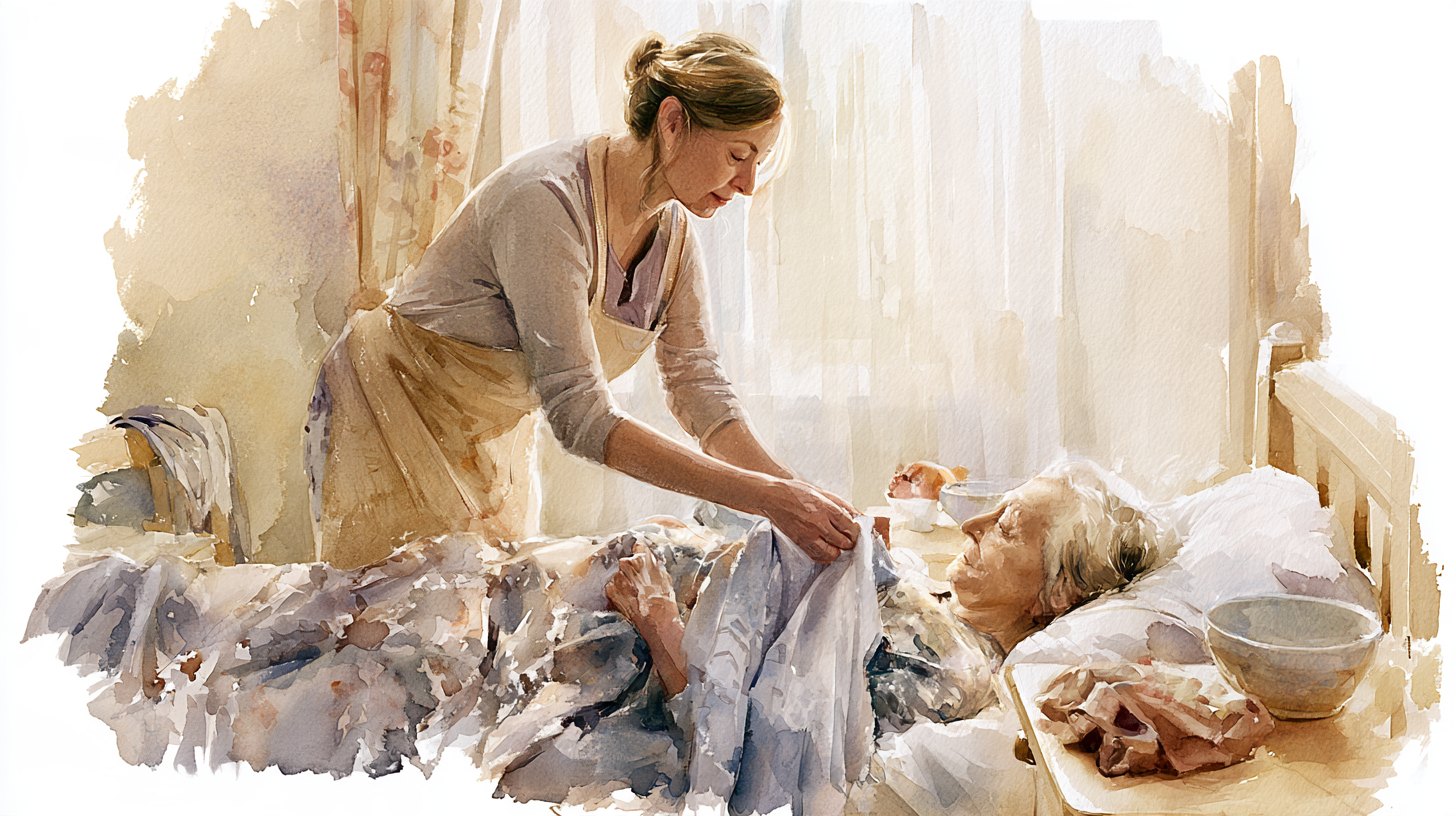
The short answer
- Mouth care is the job that does the mostMarie Curie advises keeping the mouth and lips clean and moist, with a small soft brush and water alone where toothpaste is uncomfortable. It is done several times a day, not once.
- Changing position keeps the skin intactThe NHS advice on pressure sores is to change position regularly and check the skin every day. The district nurse says how often, and a carer does it and reports what they see.
- A carer is not a nurse, and is the person who is thereDressings, catheters, syringe pumps and injections stay with the NHS team. A carer does the personal care, and notices the change that prompts the phone call.
- The nights can be covered in three waysA carer sleeping in the house is from £130 a night, a carer awake all night from £165, and a live-in carer from £1,050 a week.
Care figures are what families pay on PrimeCarers, with our fee included. Agencies charge £28 to £35 an hour for the same visit.
What changes, and what helps
What changes at this stage, and the care that follows from each change
The list of changes to expect is what a nurse or a leaflet gives you, and it stops there. The useful version of that list has a second column: what somebody in the house does about each one, and who to tell when it happens.
- Tiredness
More time asleep, and less energy
The NHS says somebody will start to feel more tired and drowsy, with less energy, and will spend more time sleeping. Care stops running to a timetable and starts running to whenever they are awake. A carer washes and changes somebody where they are lying, works slowly, and says what they are about to do before they touch anyone.
Who to tell. Tell the district nurse if they become hard to wake, or if a change happens over hours rather than days.
- Eating and drinking
Less interest in food and drink
Not wanting to eat is common, the NHS says, and swallowing medicine can become difficult. Closer to the end the body cannot digest food properly. A carer offers small amounts of whatever is wanted and puts it down again when it is not, rather than pressing food on somebody. Sips, a teaspoon at a time and ice to suck are what meals turn into.
Who to tell. Tell the nurse or the GP if tablets are getting hard to swallow, because the same medicine can usually be given another way.
- Mouth care
A dry or sore mouth
This is the part of the day that does most for how comfortable somebody is, and it is not something families are always shown how to do. Teeth or dentures cleaned with a small soft brush, the mouth moistened often with water or a sponge, lips kept from cracking with a balm. Marie Curie advises cleaning with water alone where toothpaste is uncomfortable, and giving mouth care with somebody sitting semi-upright so they do not choke.
Who to tell. Tell the nurse about ulcers, white patches, bleeding or pain in the mouth, because those need treating rather than cleaning.
- Skin and position
Staying in one position
The NHS advice on pressure sores is to change position regularly and to check the skin every day. A carer moves somebody, props the new position with pillows, keeps the sheet smooth and dry, and looks each time at heels, hips, the base of the spine, shoulders and ears for skin that has changed colour or feels warm, spongy or hard.
Who to tell. Ask the district nurse how often to turn, and whether a pressure-relieving mattress or cushion can be delivered.
- Symptoms
Pain, restlessness or agitation
Medicines for sudden symptoms can be prescribed ahead of time and kept in the house. Marie Curie says they are usually given by a district nurse called out to the house, so a carer is not the person who gives them. What a carer does is notice the change early, write down what they saw and when, and ring the number the family has agreed on. Hospice UK says that sitting with somebody who is restless can help settle them.
Who to tell. Ask now for the out of hours number as well as the daytime one, and write both where everybody in the house can see them.
- Being there
Wanting company more than conversation
Hospice UK says that somebody being unconscious does not mean they cannot hear you, and suggests carrying on speaking to them in a calm, low voice, holding a hand, or playing music they like. A carer keeps talking to the person while they work, says who has come into the room, and leaves the door open so nobody is on their own by accident.
Who to tell. Tell the carer what the person likes: a radio station, the name they answer to, which side of the bed somebody should sit.
Not everybody has all of these, and the order they come in varies. The care described is what a carer at home does; the nursing, the prescribing and the injections stay with the NHS team.
Sources: NHS: changes in the last hours and days of life; NHS: pressure sores; Marie Curie: helping someone with mouth care; Marie Curie: just in case medication; Hospice UK: what to expect in the last few days of life.
One more change is worth knowing about in advance, because it frightens families who have not been warned. Breathing can become noisy. Hospice UK explains that this is a rattling sound caused by fluids that are no longer being re-absorbed in the chest or throat, that it is not usually uncomfortable or painful for the person, and that it can be upsetting to listen to. Changing the position, onto their side for example, can help, and the nursing team can give medicine to reduce it. Hospice UK's guide to what to expect goes through this and the other changes in full, the first days after a death at home covers who to ring when the time comes, and end of life care at home covers the wider picture of arranging care at this stage.
A day of care
What a carer does across a day
The work is not complicated and it is relentless, which is why families find it hard to do alone for long. These are the jobs a carer takes on, each one agreed with you rather than assumed.
Washing and dressing, wherever they are
Each morning, and whenever it is needed again
Mouth care, several times a day
The part that changes how comfortable they are
Changing position, and watching the skin
On the schedule the district nurse sets
Medication on time, and a written record of it
Prompting and assisting, not injections
Food and drink offered, not pressed
Small amounts, as often as they are wanted
Being in the room
Through the evening, or all night
Most of this is shared with the family rather than taken over. What changes when a carer is in the house is that the jobs at four in the morning, or three times before breakfast, are not all falling on one exhausted person. What a carer can do in an hour sets out how much fits into a visit of each length, and private carers in palliative care covers the experience to look for.
Alongside the NHS team
What a carer does, and what stays with the nursing team
A carer works beside the NHS rather than instead of it. Being clear about where the line falls saves a difficult phone call later, and it changes what you need to book.
What a carer does
- Personal care: washing, dressing, continence care, hair and hands
- Mouth care, and keeping lips and mouth from drying out
- Changing position on the schedule the nurse has set, and checking the skin
- Prompting or assisting with medicines that are already prescribed, and recording them
- Meals and drinks offered in small amounts, and the shopping and laundry around them
- Sitting with somebody through the evening or the night, and ringing the number agreed if something changes
What stays with the NHS team
- Dressings, catheters, pressure ulcer treatment and other hands-on nursing: the district nurses
- Injectable medicines kept in the house for sudden symptoms: a district nurse called out
- Setting up or refilling a syringe pump: the nursing team
- Prescribing, and deciding what to do about a symptom: the GP or the palliative care team
- Specialist advice on pain that is hard to control: the community palliative care team
- Emergency care decisions overnight: the out of hours number the GP or nurse has given you
The NHS part of this is free wherever somebody is cared for: the GP, the community nurses, the specialist palliative care team and hospice care. What is not automatically free is having a person in the house for the hours between the visits, and that is the gap a carer fills. Two routes can pay for it. NHS continuing healthcare has a quicker route for somebody whose health is declining rapidly, where a doctor or registered nurse completes the form rather than the family, and a package should be in place as soon as possible: the fast track pathway covers how to ask, and NHS Continuing Healthcare covers the standard assessment. Attendance Allowance is not means-tested and has special rules for people nearing the end of life, with a doctor or nurse completing an SR1 form instead of the usual assessment; Attendance Allowance explained covers the claim.
If you are not sure who is already involved, who is in the team goes through everybody who may be visiting, and palliative care, end of life care and hospice at home explains the three words families are given in the same conversation. On medicines, can a private carer give medication? sets out the difference between prompting, assisting and administering.
Evenings and nights
Covering the evenings and the nights, and what each way costs
Whether somebody can be at home can come down to the nights, because that is when the family runs out of energy. There are four ways to cover them, priced differently.
| What it covers | What it costs on PrimeCarers | When it fits | |
|---|---|---|---|
| An evening visit | A carer comes for an hour or two to settle somebody for the night: a wash, nightclothes, mouth care, a change of position and the evening medication. | £18 to £25 an hour, with our fee included | The family is in the house overnight, and the evening is the part that has become hard. |
| A carer sleeping in the house | The carer sleeps in a bed in the house and gets up when they are needed. Suited to nights that are disturbed once or twice rather than continuously. | £130 to £145 a night | Somebody needs the toilet or turning once or twice, and the family has to sleep. |
| A carer awake all night | The carer stays awake, turns somebody on the schedule agreed, keeps the mouth moist, and watches for a change worth ringing the nurse about. | £165 a night | Position changes through the night, restlessness, or breathing the family would rather not be listening for alone. |
| A live-in carer | A carer lives in the house and covers the day, with a break each day and undisturbed sleep at night. A waking night can be added on top. | From £1,050 a week, and from £1,260 a week where care is complex | Help is needed across the whole day as well as the night, and there is a spare room. |
An evening visit
- What it covers
- A carer comes for an hour or two to settle somebody for the night: a wash, nightclothes, mouth care, a change of position and the evening medication.
- What it costs on PrimeCarers
- £18 to £25 an hour, with our fee included
- When it fits
- The family is in the house overnight, and the evening is the part that has become hard.
A carer sleeping in the house
- What it covers
- The carer sleeps in a bed in the house and gets up when they are needed. Suited to nights that are disturbed once or twice rather than continuously.
- What it costs on PrimeCarers
- £130 to £145 a night
- When it fits
- Somebody needs the toilet or turning once or twice, and the family has to sleep.
A carer awake all night
- What it covers
- The carer stays awake, turns somebody on the schedule agreed, keeps the mouth moist, and watches for a change worth ringing the nurse about.
- What it costs on PrimeCarers
- £165 a night
- When it fits
- Position changes through the night, restlessness, or breathing the family would rather not be listening for alone.
A live-in carer
- What it covers
- A carer lives in the house and covers the day, with a break each day and undisturbed sleep at night. A waking night can be added on top.
- What it costs on PrimeCarers
- From £1,050 a week, and from £1,260 a week where care is complex
- When it fits
- Help is needed across the whole day as well as the night, and there is a spare room.
Figures are what families pay on PrimeCarers with our fee included. Carers set their own rates, and rates for complex care sit higher. Agencies charge £28 to £35 an hour, and from £1,400 a week for live-in cover. Bank holidays are charged at one and a half times the carer's rate, and Christmas Day at twice.
The nights do not have to be covered all at once. You can book two or three a week and keep the ones you can manage yourself. Waking night or sleeping night explains how to tell which of the two is needed, night care at this stage covers what the free services can and cannot cover overnight, and how live-in care works covers the arrangement where somebody is there day and night. Live-in care at end of life takes the same decision from the other side, including what happens to the placement when it ends. Current rates lists what every type of visit costs.
Finding someone
How to look for a carer, and what to ask them
You are choosing somebody to be in the house at a difficult time, so the conversation with them matters more than the profile. This takes days rather than weeks.
- 1
Write down the week as it is now
TodayThe times somebody needs help, the turns through the night, when the district nurse comes, what the family can cover and what it cannot. A carer reads that and tells you plainly which parts they could take on. - 2
Search where the person lives
FreeLook at carers near the house rather than near you, because the travel is what decides whether somebody can be there at seven in the morning. Search carers by postcode, and read the rate, the experience and the reviews on each profile. - 3
Ask about experience at this stage in their own words
On the callAsk what they have covered before, how they do mouth care and turning, what they would do at three in the morning if breathing changed, and who they would ring. What you are listening for is whether this is familiar to them or new. - 4
Agree the hours, the rate and what happens if plans change
Before the first visitAgree the visits, the rate and the notice directly with the carer. Say out loud that plans may change at short notice, and ask how they would want to handle a hospital admission, so it is settled before it happens. - 5
Tell the nursing team a carer is coming
The same weekGive the district nurse and the GP surgery the carer's name and the hours they will be there. It helps them plan their own visits, and it means there is somebody in the house who can let them in and tell them what the night was like.
Two parts of the agreement between a client and a carer matter more at this stage than at any other. A visit cancelled by the client is payable in full, apart from unplanned hospitalisation, illness, or another reason the carer agrees to, which is worth knowing if an admission happens at short notice. Ending the arrangement takes 48 hours' notice for hourly visits, and seven days for live-in care once 168 hours have been worked, with 48 hours before that point. Travel time and travel costs are chargeable only where the two of you have agreed them in advance in writing. PrimeCarers charges nothing itself to cancel, and it does not set the terms between a client and a carer.
Questions
Questions families ask about care at home at this stage
Personal care in bed or in a chair, mouth care several times a day, changing position on the schedule the district nurse has set, prompting or assisting with prescribed medicines and recording them, offering small amounts of food and drink, and being in the house through the evening or the night. They also notice changes and report them, which can get a symptom treated sooner.
A carer can prompt or assist with medicines that have already been prescribed, and write down what was taken and when. Injectable medicines kept in the house for sudden symptoms are a different matter: Marie Curie says these are usually given by a district nurse who is called out to the house. Can a private carer give medication? sets out the difference between prompting, assisting and administering.
The NHS says not wanting to eat is common, that swallowing medicine can become difficult, and that closer to the end the body cannot digest food properly and will not need food. Offer small amounts of what is wanted, and stop when it is not. If somebody cannot swallow a drink, the NHS says their carers can wet their lips with water. Tell the nurse or the GP if tablets are getting hard to swallow, because the same medicine can usually be given another way.
Ask the district nurse, because it depends on the person, the mattress and the state of their skin. The general NHS advice for anyone at risk of pressure sores is to change position regularly and to check the skin every day for patches that have changed colour or feel warm, spongy or hard. Ask at the same time whether a pressure-relieving mattress or cushion can be delivered, because that changes the answer.
Yes. A carer who sleeps in the house and gets up when needed is £130 to £145 a night on PrimeCarers, and a carer who stays awake all night is £165 a night, both with our fee included. You can book two or three nights a week rather than seven. Waking night or sleeping night helps you work out which one is needed.
No. The nursing stays with the NHS: dressings, catheters, pressure ulcer treatment, syringe pumps and symptom control, with the GP prescribing. A carer covers the personal care and the hours in between. Telling the nursing team that a carer is involved, and when they are in the house, helps them plan their visits. Who is in the team goes through everybody who may be visiting.
Your agreement is with the carer, and PrimeCarers does not set its terms. A visit cancelled by the client is payable in full, with unplanned hospitalisation, illness, or another reason the carer agrees to as the exceptions, so an admission is covered by that. Ending the arrangement takes 48 hours' notice for hourly visits, and seven days for live-in care once 168 hours have been worked, with 48 hours before that point. It is worth agreeing with the carer at the start how they would want to handle a sudden change, so nobody is working it out on the day.