
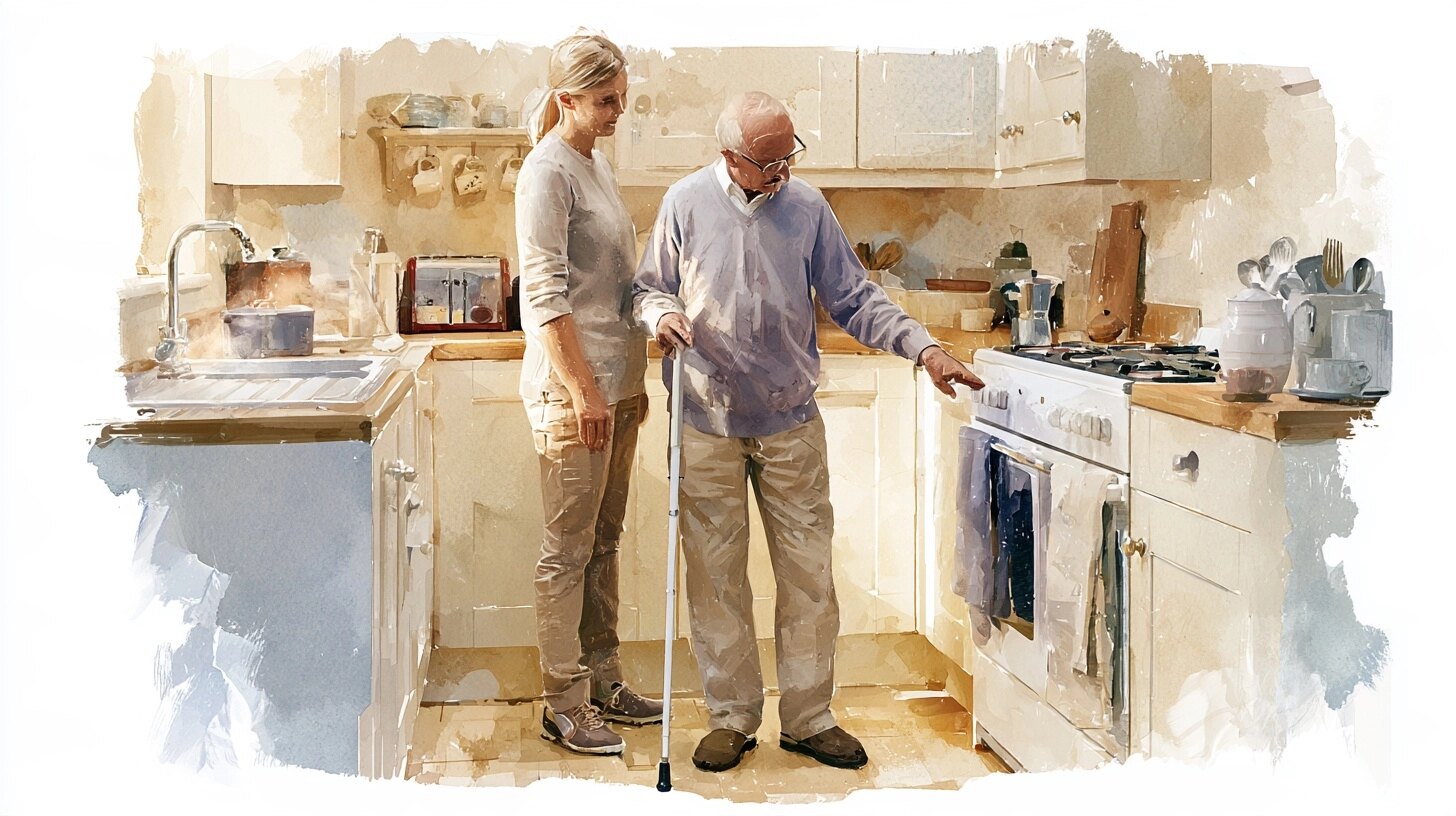
The short answer
- A change in sight is worth an appointmentCataract is treated with an operation, usually as a day case, and wet macular degeneration and glaucoma are treated too. An NHS sight test is free for anyone aged 60 or over.
- Seeing things that are not there can come from the eyesCharles Bonnet syndrome causes vivid pictures in people who have lost a lot of sight. The NHS is clear it is not caused by dementia or a mental health problem.
- The council has a free rehabilitation serviceA rehabilitation officer teaches new ways of cooking, finding things and getting out. It is free for at least six weeks, and your relative does not need to be registered to ask.
- Light, contrast and a fixed place for thingsMuch of what helps at home costs little. The rule for everyone in the house, carers included, is to put things back where they were and say so when something moves.
This page is general information, not medical advice. Carers on PrimeCarers charge £18 to £25 an hour for visits with our fee included, against £28 to £35 at an agency.
The common causes
Four common causes in older people, and which of them can be treated
The NHS lists cataracts, age-related macular degeneration, diabetic eye disease and glaucoma among the common causes of sight loss, alongside a detached retina. They affect sight in different ways, and knowing which one your relative has explains a lot about what they can and cannot see.
| What happens to sight | What can be done | |
|---|---|---|
| Cataract | The lens clouds over, so everything looks blurred or misty, colours fade and bright light dazzles. | An operation replaces the cloudy lens. It is done under local anaesthetic and people usually go home the same day. |
| Age-related macular degeneration (AMD) | The middle of the picture goes, so reading and recognising faces get hard. Straight lines can look wavy. It does not cause total blindness. | The wet type is treated with injections into the eye or light treatment, and a sudden change needs seeing urgently. The dry type has no treatment at present, but the NHS offers help with low vision. |
| Glaucoma | Damage to the nerve behind the eye, usually slow and without symptoms, and usually found at a routine sight test. | Eye drops, laser or surgery to protect the sight that is left. Sight already lost does not come back, so the drops matter every day. |
| Diabetic eye disease | Diabetes damages the back of the eye. There are often no symptoms early on, and later sight can blur or fill with floaters. | Screening every one to two years for anyone with diabetes, and treatment if changes are found. Finding it early reduces the risk of sight loss. |
Cataract
- What happens to sight
- The lens clouds over, so everything looks blurred or misty, colours fade and bright light dazzles.
- What can be done
- An operation replaces the cloudy lens. It is done under local anaesthetic and people usually go home the same day.
Age-related macular degeneration (AMD)
- What happens to sight
- The middle of the picture goes, so reading and recognising faces get hard. Straight lines can look wavy. It does not cause total blindness.
- What can be done
- The wet type is treated with injections into the eye or light treatment, and a sudden change needs seeing urgently. The dry type has no treatment at present, but the NHS offers help with low vision.
Glaucoma
- What happens to sight
- Damage to the nerve behind the eye, usually slow and without symptoms, and usually found at a routine sight test.
- What can be done
- Eye drops, laser or surgery to protect the sight that is left. Sight already lost does not come back, so the drops matter every day.
Diabetic eye disease
- What happens to sight
- Diabetes damages the back of the eye. There are often no symptoms early on, and later sight can blur or fill with floaters.
- What can be done
- Screening every one to two years for anyone with diabetes, and treatment if changes are found. Finding it early reduces the risk of sight loss.
From the NHS pages on vision loss, cataracts, AMD, glaucoma and diabetic retinopathy, September 2026.
Poor sight is worth a check rather than being put down to age. Cataract is treatable, and an older person who has stopped reading, stopped driving or stopped recognising people across a room may have one; recovery at home after a cataract operation covers the eye drops and the first weeks afterwards. The NHS says a sight test is free for anyone aged 60 or over, and an optometrist will come to the house if your relative cannot go out on their own. If they have not had a test in the last couple of years, book one before deciding anything else, and if they still drive, the eyesight rules for older drivers are one more reason to. For other long-term conditions your relative may have, the health conditions guide covers what help at home looks like, and if their hearing is going as well, hearing loss and care at home covers hearing aids and communication.
If your relative has diabetes, the eye screening appointments are worth keeping even when sight seems fine, because the early stages often have no symptoms.
Charles Bonnet syndrome
Seeing things that are not there, and how sight loss can cause it
Hallucinations are frightening to see in somebody you love, and few families expect sight loss to be the cause. It is worth knowing about before it happens, because an explanation takes much of the fear away.
What Charles Bonnet syndrome is
- Pictures created by the brain when it gets less information from the eyes than it used to
- Patterns, shapes, people, animals or whole scenes, still or moving, lasting minutes or hours
- Only seen: the images make no sound, have no smell and cannot be touched
- Something the person usually knows is not real, even when it is vivid
- Something that usually happens less often as time goes on
What it is not
- A sign of dementia
- A mental health problem
- Something to keep quiet about for fear of what people will think
- A reason to stop any prescribed medicine without asking the GP
- A diagnosis to make at home without the GP ruling other causes out
The NHS page on Charles Bonnet syndrome states that it happens after significant sight loss and is not caused by a mental health problem or dementia. It is more likely when sight has got worse suddenly or when both eyes are affected, and it is linked with macular degeneration and cataracts. Somebody might see a grid of coloured shapes laid over the carpet, small figures in costume, or an animal on a chair. RNIB notes that people sometimes keep the hallucinations to themselves because they are afraid they are losing their mind, so it helps to ask gently whether your relative has been seeing anything unusual.
Hallucinations still need a doctor. The NHS asks for an urgent GP appointment, or a call to 111, when somebody has them, so that more serious causes can be ruled out. Sudden confusion is a different picture. If your relative is muddled, drowsy or not themselves over a day or two, that is more like delirium, often from an infection, and UTIs and sudden confusion explains who to ring. RNIB also says Charles Bonnet hallucinations can come back or get worse during an infection, which is another reason to mention a change to the GP.
Registration and the council
How registration works, and the free rehabilitation service
When sight cannot be brought back far enough, there is a set route from the eye clinic to help at home. The last stop on it is easy to miss: a council service that teaches your relative how to manage with the sight they have.
From the optician to help at home
- 1
Optician or GP
Get the change looked at
An NHS sight test is free for anyone aged 60 or over, and an optometrist can come to the house if your relative cannot leave home on their own. The optician refers on to the hospital eye clinic if something needs treating.
- 2
Hospital eye clinic
Treatment first, and certification if sight stays low
When sight cannot be brought back far enough, a consultant ophthalmologist can complete a Certificate of Vision Impairment, called a CVI. It certifies somebody as sight impaired (partially sighted) or severely sight impaired (blind). Some clinics have an eye clinic liaison officer, or ECLO, who can go through it with you.
- 3
The council
The council should be in touch within two weeks
With your relative’s consent, the hospital sends a copy of the CVI to the council and the GP within five working days. The council should then contact them within two weeks to offer registration and to ask what help they need with everyday tasks.
- 4
The council
Registration, and an assessment if there is a need
Registration is voluntary. Saying yes brings a registration card and makes concessions easier to prove. Saying no does not close the door: the council should still offer a needs assessment.
- 5
Sensory or vision team
Vision rehabilitation at home
A rehabilitation officer, sometimes called a ROVI, teaches ways of managing the house, the kitchen and getting out, including using a white cane. Equipment such as kitchen gadgets, a talking clock or a large-button phone can come with it, along with small changes like better lighting.
What certification and registration can open up
Sight impaired or severely sight impaired
- A council needs assessment, which does not depend on registering at all
- Vision rehabilitation, free for at least the first six weeks
- Free NHS sight tests, at any age
- A disabled person’s bus pass, which covers people who are blind or partially sighted
Severely sight impaired only
- A Blue Badge without a further assessment
- Blind Person’s Allowance, an extra amount of income you can have before paying tax
- A reduced TV licence fee
From the Care Act statutory guidance on sight registers, the NHS, GOV.UK and TV Licensing, September 2026. Each concession is applied for separately and asks for its own evidence of sight loss.
The Certificate of Vision Impairment is signed by a consultant ophthalmologist at the hospital, not by an optician or the GP. If the clinic has not raised it and your relative's sight has been low for some time, ask at the next appointment whether they would qualify. Registration itself is a choice. The Care Act statutory guidance says it should be encouraged because it helps with concessions and benefits, but that access to care and support does not depend on it.
The rehabilitation service is the part worth pressing for. The statutory guidance treats vision rehabilitation as a specific form of reablement, which councils must provide free for up to six weeks, and it asks councils to consider keeping it free for longer, since rehabilitation for somebody with sight loss may be expected to last more than six weeks. You can ask adult social care for it directly, and for a care needs assessment at the same time. The council may pass you to a sensory or vision team. If you have difficulty getting it, RNIB has advice for people in that position.
Changes at home
The changes at home that make the most difference
Many of these cost little or nothing. They work because they let your relative use whatever sight they still have, and use touch and memory for the rest.
| What to change | Why it helps | |
|---|---|---|
| Light | Brighter bulbs, a lamp that shines onto the task, and lights at the top and bottom of the stairs and by the front door lock. | Brighter light helps somebody make the most of the sight they have, and a well lit stair shows the edge of each step. |
| Contrast | A dark mug for milky tea, a white plate on a dark tablecloth, a coloured strip on step edges, a light switch that stands out from the wall. | Things that match their background disappear, and contrast makes them visible without extra detail. |
| A fixed place for everything | Keys, glasses, the phone, the remote and the tablets live in one spot each, and go back there every time. | Memory then does the work that sight used to. One thing moved can mean an hour of searching, or a fall. |
| Touch markers | Raised bump-on dots on the cooker dial, the washing machine programme, the microwave and the thermostat. | The settings that are used every day can be found by feel, so cooking and washing stay in your relative's hands. |
| Large print and talking devices | Large print or a magnifier, a talking clock, a large-button phone, and a smart speaker for the time, the radio and phone calls. | These take over the reading jobs that cause daily frustration. A rehabilitation officer can advise on which are worth having. |
| Clear floors | Rugs taken up or fixed down, trailing wires moved, and doors kept either fully open or fully shut. | A half-open door is hard to see edge-on, and NHS falls advice asks people to clear clutter, loose rugs and wires. |
Light
- What to change
- Brighter bulbs, a lamp that shines onto the task, and lights at the top and bottom of the stairs and by the front door lock.
- Why it helps
- Brighter light helps somebody make the most of the sight they have, and a well lit stair shows the edge of each step.
Contrast
- What to change
- A dark mug for milky tea, a white plate on a dark tablecloth, a coloured strip on step edges, a light switch that stands out from the wall.
- Why it helps
- Things that match their background disappear, and contrast makes them visible without extra detail.
A fixed place for everything
- What to change
- Keys, glasses, the phone, the remote and the tablets live in one spot each, and go back there every time.
- Why it helps
- Memory then does the work that sight used to. One thing moved can mean an hour of searching, or a fall.
Touch markers
- What to change
- Raised bump-on dots on the cooker dial, the washing machine programme, the microwave and the thermostat.
- Why it helps
- The settings that are used every day can be found by feel, so cooking and washing stay in your relative's hands.
Large print and talking devices
- What to change
- Large print or a magnifier, a talking clock, a large-button phone, and a smart speaker for the time, the radio and phone calls.
- Why it helps
- These take over the reading jobs that cause daily frustration. A rehabilitation officer can advise on which are worth having.
Clear floors
- What to change
- Rugs taken up or fixed down, trailing wires moved, and doors kept either fully open or fully shut.
- Why it helps
- A half-open door is hard to see edge-on, and NHS falls advice asks people to clear clutter, loose rugs and wires.
Drawn from RNIB's guidance on adapting the home, the NHS falls prevention advice and the CVI patient information, September 2026.
Much of this overlaps with making the home dementia-friendly, which covers contrast and lighting room by room and is worth reading if your relative has memory problems as well. For talking devices, using Alexa to make life easier goes through setting one up for an older person.
Sight loss and fallsSection titled Sight%20loss%20and%20falls
The NHS lists problems with eyesight among the causes of falls, and advises regular eye tests as part of preventing them. If your relative lives alone, pendant alarms and sensors covers the options for calling for help. If they have already fallen, after a fall: the checklist sets out what to check and who to ring, and asking the GP for a falls assessment is worth doing even when nothing seemed hurt.
What a carer does
What a carer does for somebody losing their sight
A carer does not replace the rehabilitation service or the eye clinic. What a carer can do is cover the jobs that sight loss makes hard, in the way your relative wants them done, so they keep as much of their own life as possible.
Reading the post
Every visit
Medicines when the labels cannot be read
Every visit
Getting out as a sighted guide
As needed
Never moving things without saying
Always
Appointments and shopping
As needed
Company, and describing the world
Every visit
RNIB's advice on guiding adds two details a good carer will know: place the person's hand on the back of a chair before they sit down, and never walk away without saying you are leaving. Tell the carer about any Charles Bonnet hallucinations too, so they know how your relative likes to be reassured. Can carers give medication? explains the difference between prompting, assisting and giving medicines, and what to agree with a carer.
If you want somebody to read the post, sort the medicines and go out with your parent, you can search for carers near you and compare their rates. Every carer has had their identity and right to work checked, holds an accepted criminal-record check (Enhanced DBS issued within the last 2 years, DBS Update Service, Scottish PVG or Access NI), and has been interviewed online, and carers are insured while they work. We do not check qualifications, training or references, so anything a carer says about experience with sight loss is their own account on their profile, for you to ask them about. PrimeCarers is an introductory service, not an agency or a care provider: carers are self-employed, and you agree the visits and the rate with them directly.
Questions
Questions families ask about sight loss
Some change is normal, but a lot of sight loss in older people has a cause that can be treated or slowed. Cataract is treated with an operation under local anaesthetic, wet macular degeneration can be treated if it is caught quickly, and glaucoma drops protect the sight that is left. An NHS sight test is free for anyone aged 60 or over, and an optometrist can visit at home if your relative cannot go out alone.
Not necessarily. If she has lost a lot of sight, it may be Charles Bonnet syndrome, which the NHS says is caused by sight loss and not by dementia or a mental health problem. People with it usually know the images are not real. She still needs an urgent GP appointment, or a call to 111, so other causes can be ruled out, and it helps to tell the GP about her eyesight.
A consultant ophthalmologist at the hospital eye clinic completes a Certificate of Vision Impairment. With your relative's consent, a copy goes to the council and the GP within five working days, and the council should be in touch within two weeks to offer registration and ask what help is needed. Registration is voluntary.
No. The Care Act statutory guidance says access to care and support does not depend on registration, and that somebody who declines it should still be offered a needs assessment. You can ask adult social care for an assessment and for vision rehabilitation at any point.
It is training at home from a specialist rehabilitation officer, covering things like cooking safely, finding things, using a white cane and getting out. The statutory guidance treats it as a form of reablement, which councils must provide free for up to six weeks, and asks them to consider keeping it free for longer, since sight rehabilitation often takes more time.
Carers commonly prompt and assist with medicines and record what was taken, and some will put in eye drops. What a carer does depends on the carer and on what you agree with them, so ask each one directly. The pharmacist can also help with large print labels and ways of telling medicines apart by touch. Can carers give medication? explains the options.