
The short answer
- Each aid helps with one movementRails and frames help with standing up and sitting down. Seats let your parent wash sitting. A commode saves a walk to the toilet at night.
- Ask the council before you buyAn occupational therapy assessment is free. In England, aids and adaptations costing £1,000 or less that it finds are needed are provided free, whatever your parent's savings.
- Buying is fine if you measure firstMany of these aids are sold in ordinary shops. Your parent may pay 0% VAT if they have a disability or long-term illness, or 5% on a fitted grab rail if they are 60 or over.
- A rail is only as strong as its fixingIt has to take your parent's full weight. That means screws into brick, block or timber, not into plasterboard on its own.
If washing and the toilet have become hard even with the right aids, a carer can help with the parts your parent cannot manage. Personal care visits cost around £18 to £25 an hour on PrimeCarers, with our fee included.
The seven aids
Which bathroom aid helps with which part of the day
Most of the difficulty in a bathroom comes from a few movements: lowering onto the toilet and getting up again, stepping into the bath or shower, standing long enough to wash, and getting to the toilet in time. Each of the small aids below helps with one of them.
The small aids, where each one goes
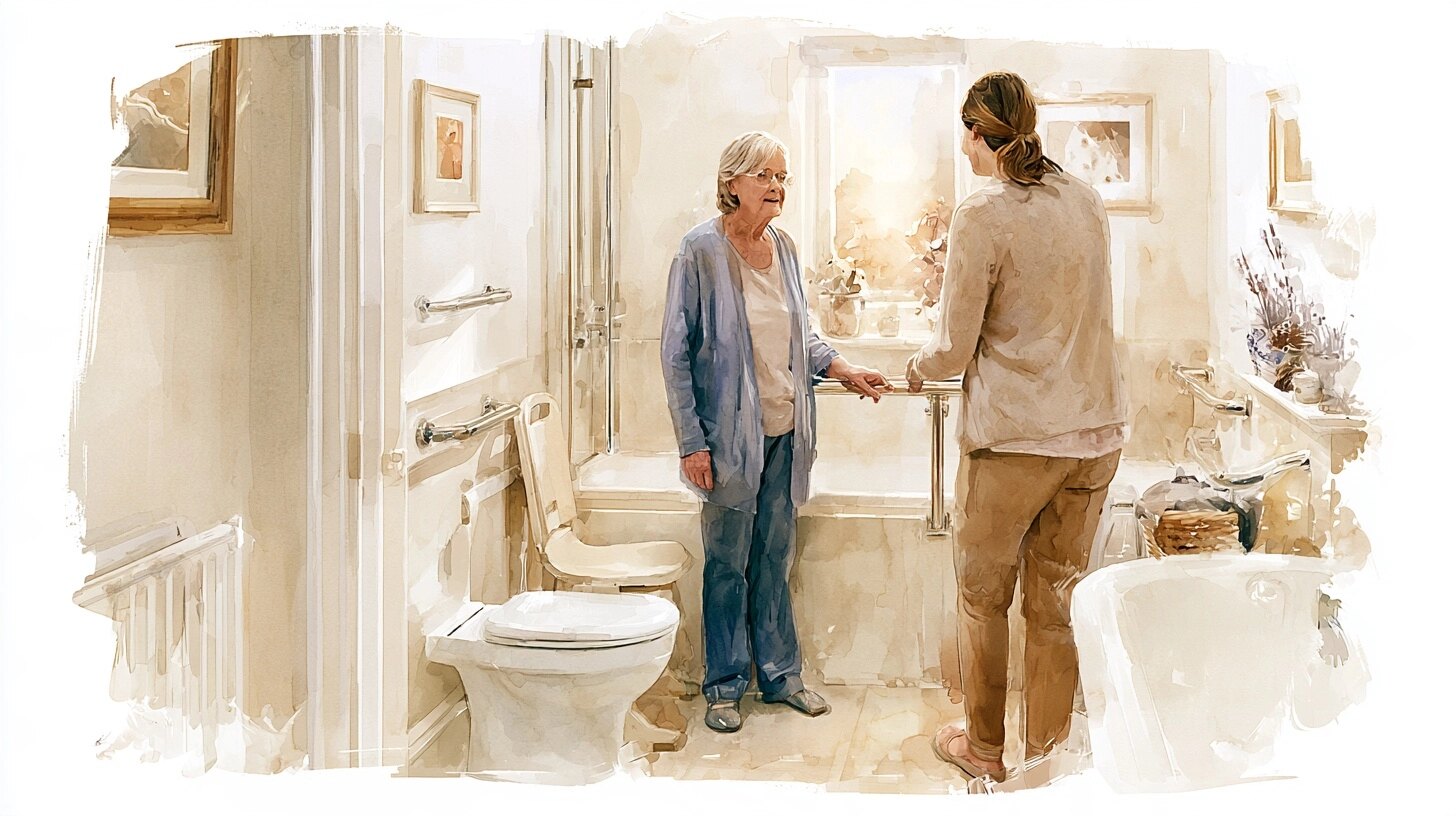
One bathroom wall from the toilet to the shower, and the commode by the bed.
A grab rail beside the toilet
Fitted free after an assessment
Something solid to push on when standing up and to hold while sitting down. A towel rail or a basin edge is not built to take that weight.
A toilet frame
Lent free, or bought
A frame with two arms that stands round the toilet, so your parent can push up with both hands. It helps where there is no wall close enough for a rail.
A raised toilet seat
Lent free, or bought
A thicker seat that clips onto the bowl and makes it higher, so there is less distance to lower down and to stand up from.
A perching stool
Lent free after an assessment
A tall stool with a seat that slopes forward, so your parent can half sit, half stand at the basin or the kitchen worktop to wash, shave or do their teeth.
A grab rail by the bath or shower
Fitted free after an assessment
Usually an upright rail to hold while stepping in and out, when wet feet can slip on the tray or the bath floor. An occupational therapist marks the height and angle.
A shower chair or stool
Lent free, or bought
A seat with rubber feet that stands in the shower, so your parent can wash sitting down. A chair has a back and arms; a stool takes less room.
A commode
Lent free, or bought
A chair with a toilet pan under a lid, kept by the bed for the night, or for when the bathroom is upstairs or too far to reach in time.
This page sits alongside our guide to mobility and falls care, and covers the small items that do not need building work. If getting over the side of the bath is the main problem, a bigger answer such as a walk-in bath has its own page. The Disabled Facilities Grant can pay for the bigger work.
Start with what your parent finds hardSection titled Start%20with%20what%20your%20parent%20finds%20hard
It helps to watch, or to ask your parent to describe, a normal morning in the bathroom. Notice where they reach for something to hold, whether that is the edge of the basin, a towel rail or the door handle. Those are the places a rail or a frame will help, because your parent already needs support there.
Notice too how long they stand. If they lean on the basin to wash, a perching stool lets them sit. If standing in the shower tires them, a shower chair or stool lets them take their time. If they are getting up several times a night, or the toilet is up a flight of stairs, a commode by the bed may be safer than the walk in the dark, and our page on falls and toilet trips at night covers the wider picture.
A commode can feel like a big step, and it may help to explain it as something for the night only. Bathing and toileting an elderly parent covers helping your parent with the toilet and the wash in a way that keeps their dignity, and managing incontinence covers the products and routines if that is part of the reason the toilet has become difficult.
Getting them free
Ask the council for an assessment before you buy anything
In England the council must not charge for aids, or for minor adaptations costing up to a set amount, that an assessment finds your parent needs. That covers almost everything on this page, so the assessment is worth asking for even if you could afford to buy.
- 1
Contact adult social services
Free, at any incomeRing or apply online to the council where your parent lives and ask for a needs assessment, saying the bathroom and the toilet have become hard. Say if they have fallen, are coming out of hospital or live alone, because that can make it more urgent. - 2
An occupational therapist visits
At least an hourAn occupational therapist watches how your parent gets on and off the toilet and in and out of the bath or shower, and measures them and the room. They decide what would help and where it should go. - 3
Aids arrive on loan
From the community equipment serviceLoose items such as a toilet frame, a raised seat, a shower stool, a perching stool or a commode are delivered and lent for as long as your parent needs them. When they are no longer needed, you ring the service to arrange their return. - 4
Rails are fitted free
£1,000 or lessGrab rails and other small adaptations the assessment finds are needed are fitted free if each costs £1,000 or less. Bigger work, such as replacing the bath with a level-access shower, goes through a means-tested Disabled Facilities Grant of up to £30,000 in England.
The rule that these are free is in the Care and Support (Charging and Assessment of Resources) Regulations 2014. They say a council must not charge for "community equipment (aids and minor adaptations)", and that an adaptation counts as minor if it costs £1,000 or less. Your parent's savings and income do not come into it. The NHS guide to home adaptations gives the same £1,000 figure and lists grab rails among the examples, and you can apply for a needs assessment on GOV.UK, which takes you to your parent's council.
Each council runs its own equipment service, so the details vary. Wakefield's community equipment service, for example, describes its toilet seats, commodes and bath equipment as "a free loan for as long as it's needed". Ask who to ring if an item does not fit.
If your parent is in hospital, ask the ward about an occupational therapy assessment before they come home. Aids for the bathroom and toilet can then be in place on the day they arrive, and hospital discharge explained covers what else to ask for before that day.
Buying one yourself
Choosing a toilet seat, frame or shower chair if you buy one
Some families buy because the wait is long, because they want something sooner for a parent coming home, or because the aid is cheap enough not to bother the council. That is fine, as long as the aid is the right height and stable. Measure your parent and the room before you order.
| What to measure | What to check | VAT | |
|---|---|---|---|
| Raised toilet seat | The height of the back of your parent's knee from the floor, and the shape of the toilet bowl. | That it fixes to the bowl with clamps or brackets and does not shift when sat on. | 0% for somebody with a disability or long-term illness. |
| Toilet frame | The width of the toilet and the space either side of it. | Adjustable legs with rubber feet, and arms at a height your parent can push down on. | 0% for somebody with a disability or long-term illness. |
| Shower chair or stool | The floor area of the shower and the height of your parent's knee. | Adjustable legs, rubber feet that grip a wet floor, and a weight limit above your parent's weight. | Ask the seller. Equipment designed for disabled people is 0% for a disabled buyer. |
| Perching stool | The height of the basin or worktop it will be used at. | Adjustable height and slope, arms if your parent pushes up from it, and stable legs. | Ask the seller. Equipment designed for disabled people is 0% for a disabled buyer. |
| Commode | The space beside the bed, and your parent's seat height. | Arms to push up from, a lid that covers the pan, and that the pan lifts out easily to empty. | 0% for somebody with a disability or long-term illness. |
Raised toilet seat
- What to measure
- The height of the back of your parent's knee from the floor, and the shape of the toilet bowl.
- What to check
- That it fixes to the bowl with clamps or brackets and does not shift when sat on.
- VAT
- 0% for somebody with a disability or long-term illness.
Toilet frame
- What to measure
- The width of the toilet and the space either side of it.
- What to check
- Adjustable legs with rubber feet, and arms at a height your parent can push down on.
- VAT
- 0% for somebody with a disability or long-term illness.
Shower chair or stool
- What to measure
- The floor area of the shower and the height of your parent's knee.
- What to check
- Adjustable legs, rubber feet that grip a wet floor, and a weight limit above your parent's weight.
- VAT
- Ask the seller. Equipment designed for disabled people is 0% for a disabled buyer.
Perching stool
- What to measure
- The height of the basin or worktop it will be used at.
- What to check
- Adjustable height and slope, arms if your parent pushes up from it, and stable legs.
- VAT
- Ask the seller. Equipment designed for disabled people is 0% for a disabled buyer.
Commode
- What to measure
- The space beside the bed, and your parent's seat height.
- What to check
- Arms to push up from, a lid that covers the pan, and that the pan lifts out easily to empty.
- VAT
- 0% for somebody with a disability or long-term illness.
VAT from HMRC's VAT Notice 701/7. The 0% rate is for somebody with a disability or long-term illness buying equipment designed for disabled people, for their own use. The 5% rate for people 60 or over covers listed items such as grab rails and built-in shower seats, only when the same firm supplies and fits them in a private home.
The most useful single measurement is the height from the floor to the back of your parent's knee when they are sitting with their feet flat. A toilet seat, a shower chair or a commode at about that height is one your parent can sit down on with control and stand up from without a struggle. Too low and they drop the last few inches. Too high and their feet do not reach the floor firmly, which makes them unsteady as they lower themselves down. Check the weight limit on anything they sit on.
Where to look for independent adviceSection titled Where%20to%20look%20for%20independent%20advice
We do not name makers or shops on this page, and we are not paid by any company to recommend one. For product information that is not trying to sell you something, Living Made Easy lists daily living equipment with details and where to buy it, and its AskSARA tool asks about what your parent finds hard and suggests the kinds of equipment that might help. The NHS points families to Living Made Easy in its guide to household equipment. The NHS also suggests hiring an item first if you are not sure it will suit. The British Healthcare Trades Association is the trade body for suppliers of healthcare and mobility products, and its members sign up to a code of practice.
Claiming the VAT reliefSection titled Claiming%20the%20VAT%20relief
There are two separate reliefs, and your parent can only use one for each item. If they have a disability or a long-term illness, equipment designed for disabled people is free of VAT when they buy it for their own use, and HMRC lists commodes and "frames or other devices to help sitting on or rising from a sanitary appliance" among the qualifying goods. They sign a short declaration for the supplier, and nothing goes to HMRC. If they do not qualify that way but are 60 or over, the reduced rate for mobility aids means a grab rail or a built-in shower seat supplied and fitted by the same firm is charged at 5% rather than 20%. The same GOV.UK page has the wording of the declaration, and council tax, VAT relief, Pension Credit and grants covers both reliefs.
Fixing a grab rail
Fixing a grab rail so it takes your parent's full weight
A grab rail is only useful if your parent can trust it. When they push up from the toilet or steady themselves stepping out of the shower, the whole of their weight can go through it. The fixing behind the rail matters more than the rail.
What holds is a screw into solid brick or concrete block with fixings made for that wall, or, in a stud wall, into the timber studs or a timber board fixed across them behind the plasterboard. Plasterboard on its own fails, even with cavity fixings, and lightweight or hollow blocks are risky unless the fitter is sure the fixings will hold. Never let a towel rail, a radiator, a soap dish or a basin become the thing your parent holds.
Some bathroom walls are timber stud partitions covered in plasterboard, a thin sheet of plaster and paper that is not meant to hold somebody's full weight pulling on a screw. Behind a stud wall, a fitter finds the upright timbers and screws into those, or fixes a strong board across them so the rail can go exactly where it is needed. On a solid brick wall the fitter uses plugs and screws made for masonry. Some newer homes have bathroom walls built to take rails. The Centre for Accessible Environments' Lifetime Homes guidance asks for walls in bathrooms and toilets that are "capable of firm fixing and support for adaptations such as grab rails", but in an older house nobody can know without checking. So do not let anyone fit over tiles without knowing what is behind them.
Use a rail made for the job, with a textured grip that wet hands can hold, at the height and position an occupational therapist marked for your parent, not where it was easiest to fit. Once it is up, pull on it hard to check it does not move, and check it again from time to time.
If you are paying rather than the council, a handyperson service, which some councils run, or a local home improvement agency can fit rails for older people, and Find My HIA, from Foundations, the national body for these agencies in England, finds the one that covers your parent's area. Whoever fits it, ask how they will fix it to that wall before they start.
Where the rails go is a decision for your parent's body, not the room. An upright rail by the bath or shower helps them hold on while they step in and out. A rail beside the toilet, or a frame round it, helps them push up. Whether a rail is upright, flat or at an angle depends on whether your parent pulls, pushes or steadies themselves, and on which side is their stronger one after a stroke or an operation. This is the main reason to let an occupational therapist mark the positions, even if you pay for the fitting. Reducing fall risks in the home covers the rest of the house in the same way.
Help with the wash
When an aid is not enough on its own, a carer can help
Aids make each movement easier, but they cannot wash your parent's back and feet or help them dress again. If those parts have become hard, or your parent is frightened of falling in the bathroom, a carer can help with them.
While the aids or the adaptations are on their way
Before the delivery or the building work
A steady hand at the risky moments
Inside an ordinary visit
The evening and the night
The commode and the walk to the toilet
After a fall or a hospital stay
When confidence has gone
Help with washing, dressing and the toilet is personal care, and it fits inside a morning or evening visit. Personal care explains what a carer can help with, and the morning, lunch and tucking-in calls shows what fits in each visit. If your parent is reluctant to accept help with washing, when a parent refuses to wash suggests ways to start the conversation.
PrimeCarers is an introductory service. You search for and choose a self-employed carer, and agree the visits with them directly; we do not provide or manage the care. Before a carer's profile appears, we check their identity and right to work, confirm they hold an enhanced DBS check (or PVG in Scotland, Access NI in Northern Ireland) issued within the last 2 years, and interview them online. We do not check qualifications, training or references, so ask each carer about their experience with personal care and with helping somebody wash safely. References and reviews on a profile are not verified by us. For visits booked through PrimeCarers, insurance cover is arranged where the carer does not have their own, subject to the policy terms.
A personal care visit costs around £18 to £25 an hour on PrimeCarers, with our fee included, against £28 to £35 for the same visit through an agency. When you are ready, search for carers near you and compare their rates, and message the ones who mention help with washing, dressing and the toilet. Hourly care explains how visits are booked and changed.
Questions
Questions families ask about bathroom aids
Yes, in England, if an assessment finds your parent needs them. Councils must not charge for aids and minor adaptations, and an adaptation counts as minor if it costs £1,000 or less, which covers a grab rail and its fitting. Savings and income do not matter. Ask adult social services at your parent's council for a needs assessment.
Perching stools are lent through the local community equipment service, which supplies equipment prescribed by council and NHS staff. An occupational therapist, either from the council or from the hospital before your parent comes home, decides whether one would help and requests it, and it is lent free for as long as your parent needs it. You can also buy one yourself.
A raised toilet seat makes the toilet higher, so there is less distance to lower down and stand up. A toilet frame stands round the toilet and gives your parent two arms to push on. A grab rail on the wall does the same job as a frame where there is a wall close enough to fix one to.
A chair has a back and arms, so it suits somebody who tires quickly or needs something to push up from. A stool takes less room in a small shower. Measure the shower floor first, and check the legs adjust to your parent's knee height.
Not if your parent has a disability or long-term illness and the item is for their own use: HMRC lists commodes and frames to help sitting on or rising from a toilet as zero-rated. Your parent signs a short declaration for the seller. Being 60 or over on its own does not make these items VAT-free, although a grab rail supplied and fitted by the same firm is charged at 5% for somebody that age.
You can if you know what the wall is made of and use fixings made for it, but a rail that comes away is worse than no rail. On plasterboard the screws must go into the timber studs or a board fixed behind, not into the plasterboard alone. If the council assesses your parent as needing a rail, it fits it free, and a local handyperson service can fit one if you are paying.