
The short answer
- A short visit in the wedding clothesOn the morning, between the ceremony and the meal, or the day before. Twenty minutes and a few photographs together is plenty.
- A livestream needs two peopleOne guest runs the phone at the venue, and someone sits with your grandparent at the other end.
- Ask the care home a few weeks aheadThey can plan a quiet room, a screen, the wifi and staffing around the time of the ceremony.
- A second celebration can come laterCake, a toast and the couple in their wedding clothes, where your grandparent lives, at a time that suits them.
The care home rules mentioned here apply in England. Homes in Wales, Scotland and Northern Ireland have their own regulators, and the manager can tell you the home's policy.
Before you decide
Check whether something could make it possible for them to come
Sometimes a grandparent cannot come, and nothing will change that. Sometimes the reason is one particular problem that has a practical answer. It is worth looking at that problem before you plan around their absence.
| The worry | What might change it | |
|---|---|---|
| A whole day is too long | They tire quickly or need to rest in the afternoon. | Come for the ceremony and photographs only, and go home before the meal. |
| They live in a care home | The family is not sure the home will allow it or help. | Talk to the manager early. In England a home must not discourage residents from going out with family. |
| They have dementia | Noise, crowds or a strange place may upset them. | A quiet room, a short visit and one familiar person beside them can help. |
| The journey or the toilets | The venue is far away, or they need help with continence. | Plan the transport and the accessible toilet in advance, and pack for the day. |
| Nobody is free to look after them | Their usual carer is in the wedding party. | Ask a relative or friend with no other role, or book a paid carer for the day. |
A whole day is too long
- The worry
- They tire quickly or need to rest in the afternoon.
- What might change it
- Come for the ceremony and photographs only, and go home before the meal.
They live in a care home
- The worry
- The family is not sure the home will allow it or help.
- What might change it
- Talk to the manager early. In England a home must not discourage residents from going out with family.
They have dementia
- The worry
- Noise, crowds or a strange place may upset them.
- What might change it
- A quiet room, a short visit and one familiar person beside them can help.
The journey or the toilets
- The worry
- The venue is far away, or they need help with continence.
- What might change it
- Plan the transport and the accessible toilet in advance, and pack for the day.
Nobody is free to look after them
- The worry
- Their usual carer is in the wedding party.
- What might change it
- Ask a relative or friend with no other role, or book a paid carer for the day.
Each of those has a guide of its own. Bringing a relative from a care home to a wedding covers asking the home and the medicines it will pack. How families decide whether someone with dementia should come helps you weigh the day against the upset. Getting an older guest to and from the wedding deals with the journey. If the only obstacle is that everyone who could help will be busy, a wedding carer who stays with them all day is one answer.
If your grandparent tells you they would rather not come, that is their choice to make, and it does not have to be argued with. The rest of this guide is for that situation, and for the times when they are too unwell to come. If they are seriously ill and you would like to marry where they are, getting married quickly in a hospital, hospice or at home explains how the ceremony can come to them.
A visit in the dress
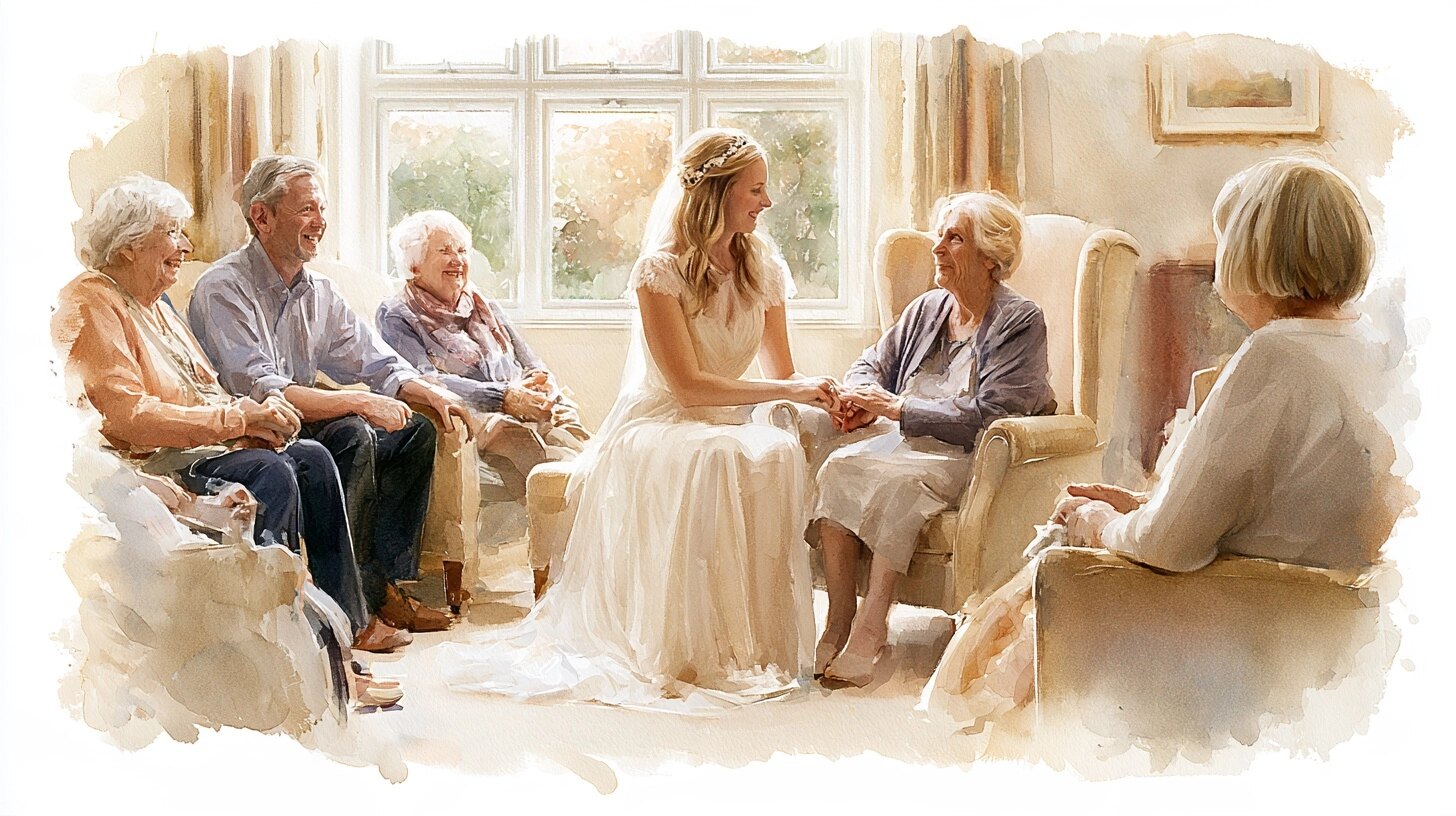
Visiting your grandparent in your wedding clothes
A visit from the couple dressed for the wedding is something a grandparent can see for themselves and talk about afterwards. It needs only a short time and a call ahead to whoever looks after them.
On the morning, on the way
Before the ceremony
Between the ceremony and the meal
If they live nearby
The day before, at a fitting or rehearsal
A calmer option
The day after, with cake
For a longer visit
Ring whoever looks after your grandparent a few days before, and again on the morning, to say when you will arrive. If they are in a care home, ask the staff to have them up and dressed and sitting somewhere you can manage in a long dress, with space for a photograph. Since 6 April 2024, Regulation 9A has required care homes in England to make it possible for residents to receive visits, so a home will usually help you plan one. If there is an infection outbreak at the home that week, ask what arrangements it can make.
If your grandparent has dementia, keep the visit small: the couple and perhaps one parent, rather than the whole wedding party. Tell them who you are and why you are dressed up, gently and more than once if needed. The Alzheimer's Society's advice on communicating with a person with dementia suggests short, simple sentences and time to respond. Holding a flower or touching the fabric of the dress can mean more than anything you say.
Livestreaming it
How to livestream the wedding to a grandparent at home or in a care home
A livestream lets your grandparent watch the vows as they happen. It works well when both ends are planned and each has a named person looking after it.
At the wedding
Looked after by: One named guest, not the couple
- Permission first. Ask the registrar, vicar or celebrant whether you may stream, and whether any part has to be left out.
- A phone on a small tripod. Set at the end of a front row, plugged in or with a charged power bank, and a spare phone ready.
- Signal tested at the venue. Check the wifi or mobile signal in the ceremony room itself on a visit beforehand.
- A call before it starts. Connect ten minutes early and say hello, so they know they are expected.
Where they are watching
Looked after by: A relative, friend or member of staff sitting with them
- A big screen in a quiet room. A television shows faces far better than a tablet. Ask whether a room can be kept free of noise and other residents.
- The link written down. On paper, with the start time and a phone number at the venue, in case the link fails.
- Timed around their day. Meals, medicines and the toilet before it starts, with a drink and glasses or hearing aids to hand.
- A test call the week before. Use the same device, room and app, so nobody is learning it on the day.
Ask permission at the venue end first. In a Church of England church, the Church of England's guidance on filming a wedding asks couples to talk to the vicar early, because streaming music can need a licence from PRS for Music, and the vicar can say what the church already holds. For a civil ceremony, ask the register office or the registrar attending your venue. Some register offices run their own streaming service, as Nottinghamshire's does, so it is worth asking before you set up your own.
Whoever holds the phone should not be the couple, a parent with a part to play, or the photographer, who will be busy. Choose a guest who is comfortable with video calls and happy to stand at the side for the ceremony.
At the other end, a care home will need to know a few weeks ahead. Ask the manager for a quiet room with a television and reliable wifi, and whether a member of staff or a relative can sit with your grandparent for the whole ceremony. Other residents may be nearby, so check the home is happy for the room to be used and for faces to appear on screen. If your grandparent lives at home, a relative or friend who sits with them can deal with the volume and the picture, and help if the link drops.
A small celebration
Holding a second, small celebration where they live
A short celebration at your grandparent's home or care home, a day or two after the wedding, gives them their own part of it. It can be as simple as cake and a toast with the couple in their wedding clothes.
What helps
- Agree a date and time with the care home manager, and ask which room you can use
- Choose the time of day when your grandparent is usually at their brightest
- Bring cake, the flowers or a buttonhole, and a few printed photographs
- Invite other residents to share the cake, if the home is happy for you to
- Keep it to an hour, and leave while everyone is still enjoying it
What tends to make it harder
- Bringing the whole wedding party, so the room becomes noisy and crowded
- Arriving at a mealtime or when medicines are due
- Bringing food or drink they cannot have, without checking with the staff
- Expecting them to remember the details, rather than enjoying the afternoon
If your grandparent has dementia, familiar faces and a familiar room matter more than how much is planned. Family occasions and dementia has more on keeping a gathering calm. If they cannot join in the way they once would have, ways to include a frail grandparent in the wedding suggests small roles that suit someone who stays at home, such as a recorded message read out at the reception or a family ring passed down.
Photos the same day
Sending photos and a message on the wedding day
Photographs sent as the day goes on let your grandparent follow it in pieces. A named person and a simple plan stop it being forgotten once the party starts.
- Morning
A photo of the couple getting ready
A picture of the outfit, the flowers or the cars, with a few words saying they are being thought of.
- After the ceremony
The first photo as a married couple
Sent straight away by the guest who ran the livestream, or by a parent.
- The reception
A short video message
Thirty seconds from the couple, or a toast raised to them by the guests.
- The next day
Printed photographs
Two or three prints for their room, so they can look at them and show visitors.
- Later
The order of service and the album
Keep a copy for them, and take the album to show them when the photographer sends it.
Send the photographs to the person who will show them, not only to your grandparent's phone. In a care home, that may be a relative who visits that evening or a member of staff who has agreed to help. Ask the photographer for a handful of pictures within a day or two, since a full album can take weeks.
Questions
Questions families ask when a grandparent cannot come
Ask the venue and the person leading the ceremony for permission first. Then ask one guest to run a phone on a small tripod at the front, with a charged power bank, and test the signal in the ceremony room. At your grandparent's end, set up a large screen in a quiet room, write the link down, and ask someone to sit with them. A test call the week before, with the same device and room, makes the day much easier.
Yes. Ring the home a few days before and again on the morning to say when you will arrive, and ask staff to have your grandmother ready somewhere with space for a photograph. In England, care homes must make it possible for residents to receive visits under Regulation 9A, which came into force in April 2024.
Ask first. In a church, talk to the vicar, because streaming music can need a licence and the church may hold some already. For a civil ceremony, ask the register office or registrar, and ask your venue about wifi. Some register offices offer their own streaming service.
A quiet room with a television or large screen, reliable wifi, the link and start time written down, and a member of staff or a relative to sit with your grandparent. Give the manager a few weeks' notice so meals, medicines and staffing can be planned around the ceremony time, and agree a test call the week before.
It can be. Enjoying the visit or the cake in the moment is worth having, even if the details are not remembered later. Keep it small and calm, and leave printed photographs that staff and visitors can talk about with them over the following weeks.