
The short answer
- Noise and crowds are the hardest partDementia can make it hard to pick one voice out of many, and loud or sudden sounds can be frightening. Plan the room before you plan the food.
- Go for the part that matters mostArrive for the most meaningful part of the occasion and leave while they are still enjoying it. Dementia UK suggests a break every 30 to 40 minutes.
- A quiet room, an exit plan and one companionSomewhere to rest away from the noise, a set time and a way to go home, and one person who stays with them and has no other job that day.
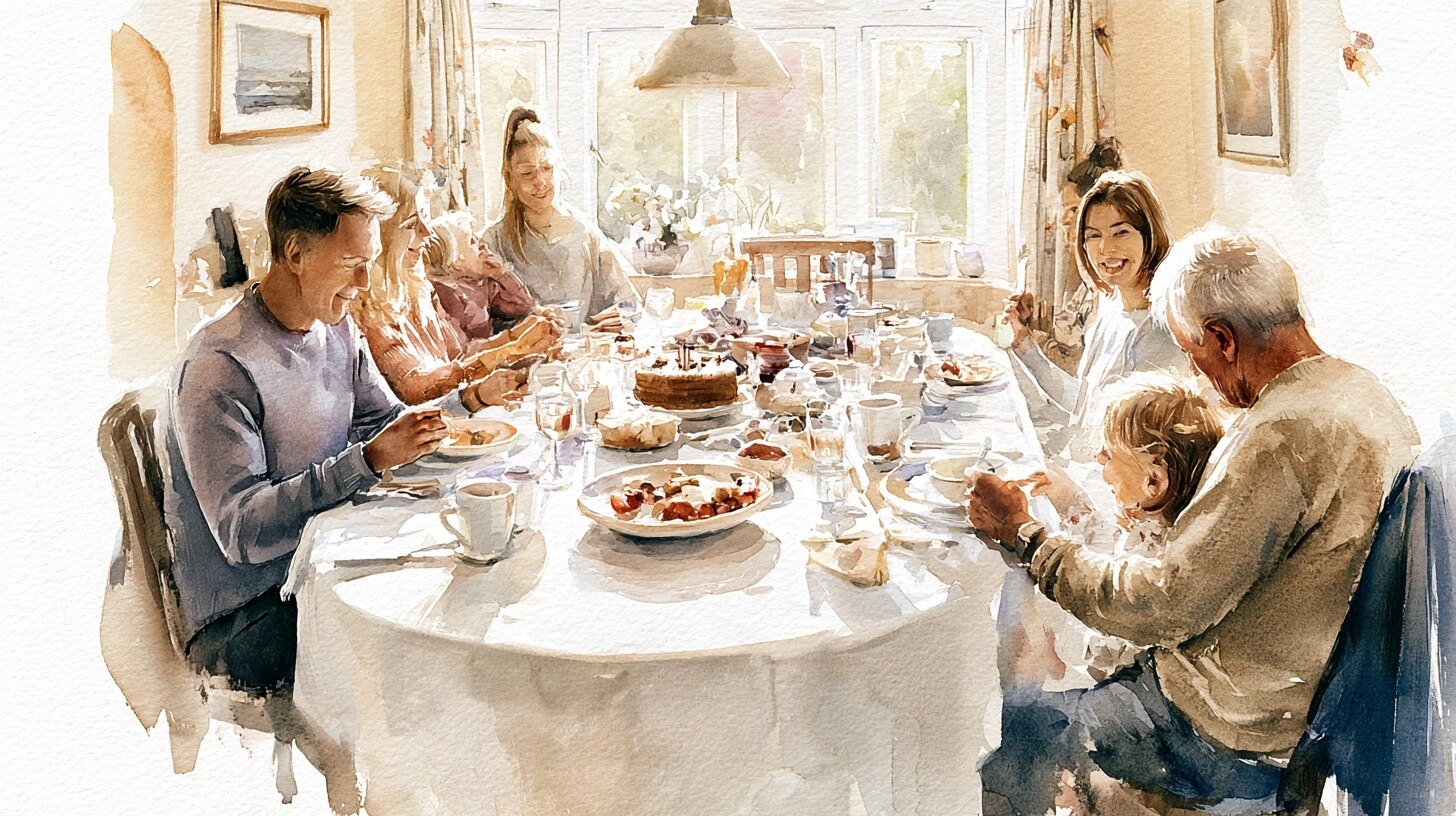
- A birthday can be small and still feel specialTea with a few people, music from their younger years, old photographs, and visitors spread over the day rather than all at once.
- If they want to go home, take themReassure them, move somewhere quieter, and if that does not settle them, leave. Leaving early is what the exit plan is for.
Based on guidance from Dementia UK, the NHS and the Alzheimer Society of Canada on dementia, sound, communication and celebrations. October 2026.
This guide sits in the dementia care section and is for anybody organising a gathering that a relative with dementia will come to, or helping someone who is. It covers every kind of family occasion. If the occasion is a wedding, taking a parent or grandparent with dementia to a wedding goes through that day in more detail, from preparing them in the weeks before to settling back afterwards.
Noise and crowds
Why noise and crowds are hard for someone with dementia
The music and the full room that make a gathering lively can be tiring for a person with dementia. Knowing which parts are hard tells you where to put your planning.
Several sounds at once
Dementia and loud noises
A room full of people
Dementia and crowds
Faces they cannot place
Being greeted
A long day out of routine
Tiredness
Dementia UK is clear that the answer is not to stop going to gatherings. Its advice on difficulty with sounds says that "in noisy social situations such as parties and weddings", a quiet place for the person to take time out, such as a spare room, can help. It also points out that some sounds help rather than hinder: music from someone's younger years can be comforting.
Before any occasion, check the simple things that make sound harder to follow. Have hearing aids checked and pack spare batteries, and make sure they have the right glasses. If you think their hearing has changed, a hearing test can rule out wax or an ear infection. Hearing loss and care at home covers what helps day to day, and if confusion tends to build late in the day, what is sundowning? explains the pattern and why an earlier occasion may suit them better.
Six occasions
How to shape six common family occasions
A birthday tea at home and a christening in a church ask very different things of a person with dementia. The Alzheimer Society of Canada suggests keeping celebrations short and, at longer gatherings, going for only the most meaningful part. Here is what that looks like for six occasions.
Six family occasions, and how to shape each one around your relative
Each occasion asks something different of a person with dementia. Find the one you are planning and use the three lines as a starting point.
- In their own home
- At a relative’s home
- At a venue, church or restaurant
Their own birthday
In their own home- What can make it hard
- Being the centre of attention, with everyone wanting a word at once and a cake arriving to singing.
- A shape that tends to work
- Small groups visiting through the day, or a short tea at the hour they are usually brightest.
- The part to protect
- The few people closest to them, and a moment with the cake that does not feel like a performance.
A christening or naming day
At a venue, church or restaurant- What can make it hard
- A service in a building they may not know, a crying baby, then a crowded party afterwards.
- A shape that tends to work
- The service and a photograph with the baby, then home or to a quiet corner before the party fills up.
- The part to protect
- Holding the baby, or sitting beside them, for a photograph taken early while things are calm.
Christmas or a big family meal
At a relative’s home- What can make it hard
- A long day with crackers, presents, a loud table and children excited from the morning onwards.
- A shape that tends to work
- Their usual morning routine, the meal at a time close to their normal lunch, and visitors spread over several days.
- The part to protect
- The meal itself, in a seat at the end of the table with somebody they know beside them.
An anniversary or milestone party
At a venue, church or restaurant- What can make it hard
- A function room full of people, a speech or two, music, and an evening start when they may be tired.
- A shape that tends to work
- An afternoon party if you are planning it, or arriving early and leaving before the music begins if it is somebody else’s.
- The part to protect
- The part that is about them or their family, such as a toast, a cake or a group photograph.
A wedding
At a venue, church or restaurant- What can make it hard
- The longest of these days, with waiting between the ceremony and the meal, speeches, and a band in the evening.
- A shape that tends to work
- Arrive as guests sit down for the ceremony, rest in a quiet room, and leave before the speeches.
- The part to protect
- The vows and a family photograph straight after the ceremony.
A family meal out
At a venue, church or restaurant- What can make it hard
- Background noise from other tables, a menu to choose from, and waiting for food to come.
- A shape that tends to work
- A quiet time of day, a table in a corner away from the kitchen and the door, and their choice made in advance.
- The part to protect
- Eating together without a rush, then leaving while they are still enjoying it.
For a gathering not on this list, such as a reunion or a barbecue, ask which part your relative would most want to be at, which part is noisiest or longest and can be missed, and where they will rest.
Where you hold the occasion matters too. Their own home is usually the easiest place for them, because they know where the toilet is, they have their own chair, and nobody has to travel. If the occasion has to be elsewhere, choose somewhere familiar if you can, such as a relative's house they have been to many times rather than a hired room they have never seen.
Five things to plan
Five things to plan for any gathering
Whatever the occasion, the same five things make the most difference: the noise, the crowd, the timing, how they will leave, and who will be with them. Put each one in place before the day and there is much less to work out in a busy room.
- 1
Bring the noise down
NoiseTurn off the television and any background music while people are talking. Leave out party poppers, crackers and balloons that might burst. Seat them away from speakers, the kitchen and the door, and have a quiet room ready for breaks. - 2
Keep the crowd small around them
CrowdsAsk guests to come and say hello one or two at a time, sitting down beside them. Spread visits over several days if there are many people who want to see them, rather than everyone arriving at once. - 3
Fit it around their best hours
TimingHold the occasion, or their part of it, at the time of day they are usually brightest. Keep meals, medicines and the toilet close to their usual times, and plan a break every 30 to 40 minutes. - 4
Agree how and when they will leave
An exit planSet a time to leave before the day starts, and book the lift or the taxi for it. Agree that they can go earlier if they want to, without anybody having to be asked. - 5
Name one person to stay beside them
One companionSomebody they know, who has no other job that day: not the host, not anyone giving a speech, and not the person who looks after them every day unless that is what they want.
Dementia UK's tips for celebrations also suggest telling guests in advance about the diagnosis and the changes they may notice, and asking them to take turns talking. A short message to close family a few days before is enough.
Why the companion matters mostSection titled Why%20the%20companion%20matters%20most
A person with dementia can lose track of where they are and who they came with, and being handed from one relative to another through the afternoon makes that harder. One familiar person who stays beside them can notice the first signs of tiredness or worry and take them to the quiet room before it becomes distress. Give that person the timings, the medicines, a change of clothes, the phone number of whoever is driving, and agreement in advance that they can leave early without checking with anyone. Looking after an elderly relative at a wedding sets out who does what on a long day, and the same roles work at any big gathering.
Write the plan down, so it does not depend on one person's memory. A single page with timings, tablets, food, what upsets them, what settles them and who to ring is enough. The wedding day care plan template is a printable sheet that works for any occasion.
If nobody in the family is free to do itSection titled If%20nobody%20in%20the%20family%20is%20free%20to%20do%20it
Sometimes the person who would be the natural companion is the host, the grandparent of the baby or the parent of the bride, and everyone else has a role too. For a few hours at a birthday or Christmas, a carer your relative already knows from their usual visits can be the simplest answer, because they are a familiar face. Carers on PrimeCarers charge £18 to £25 an hour with our fee included, and under the client contract bank holidays are charged at one and a half times the carer's normal rate and Christmas Day at twice. Sitting services explained covers what a few hours of company and supervision involve. For a wedding, where the day is long and there is a journey either side, you can book a wedding carer who stays with them all day for a fixed price instead of by the hour.
Birthday ideas
Birthday party ideas for someone with dementia
A birthday party for a person with dementia works best when it is built around what they enjoy now, rather than the kind of party they might have had ten years ago. Small, familiar and short is usually the right scale.
Afternoon tea at home
Small and familiar
Visitors spread through the day
Instead of one big party
Music from their younger years
Songs they know
An afternoon with old photographs
Talking about the past
Their favourite food, at their usual time
Easy to eat
A short trip somewhere they love
A day out
Involve them in the preparation if they enjoy it. Icing the cake, choosing the music or looking through photographs together in the days before can be as much a part of the occasion as the day itself, and the Alzheimer Society of Canada suggests exactly this kind of shared activity. For presents, something they can use or hold tends to go down better than a surprise they have to work out: a soft blanket, a favourite sweet, a photograph in a frame, an album of music. 37 activities for people with dementia has more ideas that work as party activities, and how do you make someone with dementia happy? looks at what tends to bring a good day.
Party games, and when to leave them outSection titled Party%20games%2C%20and%20when%20to%20leave%20them%20out
Party games for people with dementia work when nobody can lose and nobody is put on the spot. Singing along to old songs, guessing the year of a photograph together, or passing round objects from the past to talk about are gentle options. Quizzes about names and dates, and anything with a winner, can make someone feel tested in front of their family. If your relative lives in a care home, ask the activities staff what they already enjoy; they may be glad to help you hold a small tea there, in a room your relative knows.
Christmas and other long daysSection titled Christmas%20and%20other%20long%20days
Christmas can be hard to shape, because it lasts all day and everyone wants to be together. Dementia UK suggests keeping the morning routine as normal as possible, offering food they like rather than insisting on a traditional dinner, watching how much alcohol they have, and, if they live in a care home, taking them back in daylight rather than after dark. If your relative lives alone and the family cannot be there for all of it, Christmas companionship covers having somebody with them for part of the day.
If they get upset
If they get upset or want to go home, and the day after
Even a well-planned occasion can have a moment when your relative becomes anxious, tearful or asks to leave. Agree in advance how the companion will respond, so nobody is working it out in a crowded room.
| What may be behind it | What tends to help | |
|---|---|---|
| They keep asking to go home | Feeling unsafe or unsure where they are. "Home" may mean a feeling of being settled rather than a particular address. | Do not argue about where they are. Reassure them that they are safe and with you, move somewhere quieter, and if they still want to leave, take them. That is what the exit plan is for. |
| They become tearful, cross or agitated | Too much noise, too many people talking at once, tiredness, hunger, thirst, needing the toilet, or pain they cannot explain. | Take them out of the noise first and talk afterwards. Sit at their level, speak slowly in short sentences, and offer a drink, a snack or the toilet. |
| They do not recognise someone | Memory loss, made harder by a busy room and somebody greeting them who expects to be known. | Introduce people by name and relationship before they speak: "Here is Sarah, your niece." Let a mistake pass without correcting it. |
| They get up and walk off | Looking for the toilet, for somebody, or for a way out of a room that feels too much. | Walk with them rather than steering them straight back. Ask whether they need the toilet or some air, and offer the quiet room or a short walk outside. |
They keep asking to go home
- What may be behind it
- Feeling unsafe or unsure where they are. "Home" may mean a feeling of being settled rather than a particular address.
- What tends to help
- Do not argue about where they are. Reassure them that they are safe and with you, move somewhere quieter, and if they still want to leave, take them. That is what the exit plan is for.
They become tearful, cross or agitated
- What may be behind it
- Too much noise, too many people talking at once, tiredness, hunger, thirst, needing the toilet, or pain they cannot explain.
- What tends to help
- Take them out of the noise first and talk afterwards. Sit at their level, speak slowly in short sentences, and offer a drink, a snack or the toilet.
They do not recognise someone
- What may be behind it
- Memory loss, made harder by a busy room and somebody greeting them who expects to be known.
- What tends to help
- Introduce people by name and relationship before they speak: "Here is Sarah, your niece." Let a mistake pass without correcting it.
They get up and walk off
- What may be behind it
- Looking for the toilet, for somebody, or for a way out of a room that feels too much.
- What tends to help
- Walk with them rather than steering them straight back. Ask whether they need the toilet or some air, and offer the quiet room or a short walk outside.
Drawn from NHS guidance on communicating with someone with dementia and Dementia UK guidance on celebrations. If distress does not ease, leaving early is the right thing to do.
When it is time to go, Dementia UK suggests saying "Let's go home now" rather than "You have to go home", so leaving feels like something you are doing together. Put a small card in their pocket or bag with their name, a contact number and a line saying they have dementia, so another guest or a member of staff can help if they become separated. What are dementia assistance cards? explains the kinds of card available, and the Hidden Disabilities Sunflower lets people know, without anyone having to explain, that somebody may need more time or help. If your relative has walked off before, wandering and leaving the house covers what helps.
The day afterSection titled The%20day%20after
A busy day can leave someone tired and more muddled than usual for a day or two. Plan a quiet day afterwards with no visitors and the usual routine, and look at a few photographs from the occasion together later in the week; they may enjoy the pictures even if they do not remember the day. If you look after them yourself and the occasion has worn you out too, respite care for dementia explains how families arrange a break.
Questions
Questions families ask about dementia and family gatherings
Keep their part of the gathering short, hold it at the time of day they are usually at their best, and give them a quiet room to rest in. Ask guests to come and talk to them one or two at a time, and to say who they are as they say hello. Dementia UK suggests a break every 30 to 40 minutes and keeping meals and medicines at their usual times. Most of all, ask one familiar person to stay with them throughout and agree in advance when and how they will leave.
Dementia UK explains that dementia can affect how the brain makes sense of sounds, even when hearing itself is fine. A person may find it hard to tell one voice or sound from another, need longer to work out what has been said, and be startled or frightened by loud or sudden noises. That can leave them anxious, confused or withdrawn in a noisy room. Turning off background music, avoiding crackers and party poppers, and having a quiet room helps.
Crowds can be hard for a person with dementia. A crowded room means several conversations at once, people moving around them and faces they may not place, and it can be harder to work out where they are and how to get out. Keep the group around them small, seat them at the end of a table or a row near the door, and use the quiet room before they become tired rather than only when things go wrong.
Small and familiar works best: afternoon tea at home with a few close family, visitors spread through the day instead of one big party, music from their younger years, an afternoon looking at old photographs, their favourite food at their usual mealtime, or a short trip somewhere they love. Gentle activities where nobody can lose, such as singing along, suit a party better than quizzes on names and dates.
If they would enjoy it and can be there for part of it, it is usually worth planning for. Choose the part that matters most, such as the service and a photograph with the baby, keep it short, and have a quiet place and a time to leave agreed in advance. If the whole occasion would be too much, a short visit with the family before or afterwards can mean as much to them.
Dementia UK suggests letting guests know about the diagnosis and the changes they may notice before the occasion. A short message is enough: that your relative may not remember names, that it helps to say who you are as you say hello, to sit beside them and to take turns talking, and not to ask whether they remember you.