
The short answer
- Prepare them with pictures, not datesA visit to the venue, photographs of the people who will be there and the outfit worn once at home make the day feel less strange when it comes.
- Give them a shorter day inside the weddingArrive as the last guests sit down, protect the ceremony, take a break every 30 to 40 minutes, and leave before the speeches if that suits them.
- One named person stays with them all daySomebody with no other job at the wedding, who knows their routine and has the car booked for the time they leave.
- Agree now what happens if they want to go homeReassure rather than argue, move somewhere quieter, and if they still want to leave, take them. An early trip home that was planned for means the day went to plan.
- Plan the evening and the next day tooA familiar routine at home or in the care home, a quiet day afterwards, and a word with staff about how they were.
Based on guidance from Alzheimer's Society, Dementia UK and the NHS on dementia, celebrations and changes in behaviour. October 2026.
This guide is part of the wedding carers section, for families planning a wedding that an older or frail relative will attend. It assumes you have already decided your relative is coming. If you are still weighing that up, should someone with dementia come to the wedding? covers how families decide, and the options short of the whole day.
Why it is hard work
Why a wedding asks a lot of someone with dementia
Most of what makes a wedding lovely for the other guests is what makes it tiring for a person with dementia. Knowing which parts are hard tells you where to put your planning.
Crowds and being surrounded
Dementia and large crowds
Noise from several directions
Dementia and loud noises
Faces they may not place
Unfamiliar and half-familiar people
A long day with a lot of waiting
Stamina and routine
A place they do not know
An unfamiliar building
The late afternoon
When confusion can build
None of this means your relative will not enjoy the day. The ceremony itself tends to be one of the easier parts: it is short, everyone is seated and quiet, and the shape of a wedding service is something an older guest will have seen many times. The harder parts tend to be the waiting, the noise and the length of the day, and all three can be planned around. The rest of this guide is about doing that.
If your relative's confusion builds in the late afternoon, what is sundowning? explains the pattern, and it is a good reason to plan for them to be home before then. Dementia care is the wider guide if the diagnosis is recent.
The weeks before
Getting your relative ready for the day
The aim of the preparation is to make the day feel less strange when it comes. A person with dementia may not hold on to a date, but a familiar place, familiar clothes and familiar faces in photographs can still help.
- 1
Visit the venue with them if you can
A month or so beforeWalk the route from the car to the ceremony room, find the toilets and choose the room they can rest in. If a visit is not possible, take photographs of the entrance, the room and the toilets so you can look at them together. - 2
Ask the venue for a quiet room
When you book or soon afterA side room, a library or a small lounge close to the main room, with a comfortable chair, a door that closes and a toilet nearby. Ask whether it can be kept free for them all day, and put a sign on it if that helps. - 3
Make a small photo book of who will be there
In the weeks beforePictures of the couple, close family and the people they will sit with, each with a name underneath. Look through it together a few times, in a relaxed way, without testing them on who is who. - 4
Choose clothes they know and wear them once
A week or two beforeComfortable shoes they have worn before, layers for a cold church or a warm marquee, and an outfit tried on at home so it feels like theirs on the morning. - 5
Write a one-page plan for the day
The week beforeTimings, medicines, food and drink, what upsets them and what settles them, who to ring and when they leave. Give a copy to the person who will be with them, and to the care home if they live in one. - 6
Talk about it close to the day
The last few daysMention the wedding in the days before rather than counting down for weeks, which can cause worry. On the morning, keep things calm and unhurried and allow more time than you think you need.
The Alzheimer Society of Canada suggests spending time at a gathering looking at old family photographs or singing favourite songs, and the same idea works in the weeks before: photographs of the couple as children, or of your relative's own wedding, give you an easy way into talking about the day. A wedding day care plan gives you a printable sheet for the timings, medicines and likes and dislikes, so nothing depends on one person's memory.
When you look at the venue, look at it through their eyes. Is the accessible toilet near the room they will sit in, or along a corridor and through two doors? Is the entrance one level, or is there gravel or a step? It is worth asking the venue about these early, while there is time to change the room plan.
Arrive late, leave early
Plan a shorter day for them inside the wedding
Your relative does not need to be there for the whole wedding to be part of it. A good plan picks the parts that matter most, leaves out the waiting, and builds in rest. Dementia UK's advice for family celebrations is to keep activities short, with a break every 30 to 40 minutes, and to set aside a quiet room.
An example day: a 2pm ceremony, and their part of it
- At home, in their usual routine
- Travelling with their companion
- With the other guests
- Resting in the quiet room
- 11:00
The wedding: Guests are getting ready and the couple are having their hair and photographs done.
Your relative: An ordinary late morning at home, with lunch at the usual time and their tablets as normal. (At home, in their usual routine)
- 12:50
The wedding: Early guests start to arrive at the venue.
Your relative: They set off with their companion. The bag was packed the night before and the outfit has been worn once already. (Travelling with their companion)
- 13:45
The wedding: Most guests are seated and the room is full.
Your relative: They arrive as the last guests sit down, go straight to the reserved end seat by the door, and avoid the crowd in the entrance. (With the other guests)
- 14:00
The wedding: The ceremony.
Your relative: They watch the vows from the end of a row, with their companion beside them and the toilet a few steps away. (With the other guests)
- 14:40
The wedding: Confetti, then drinks and the family photographs.
Your relative: Their family photograph is taken first, while they are still fresh, and then they sit down somewhere quieter. (With the other guests)
- 15:00
The wedding: The drinks reception carries on, loud and crowded.
Your relative: Time in the quiet room: a cup of tea, something to eat, the toilet, and a rest with one or two visitors at a time. (Resting in the quiet room)
- 15:45
The wedding: Guests are called in to the meal.
Your relative: Back with everyone for the start of the meal, at the end of a table near the door. (With the other guests)
- 16:30
The wedding: The meal goes on, and the speeches are next.
Your relative: Their companion takes them out before the speeches, at the time agreed weeks ago, to a car that was booked for it. (Travelling with their companion)
- 17:30
The wedding: Speeches, the cake and the evening music to come.
Your relative: Home, in their own chair, with a familiar tea and the evening as it usually goes. (At home, in their usual routine)
Under 3 hours
at the venue, out of a wedding that runs from early afternoon into the night
Ceremony first
the part to protect if the day has to be cut short
30 to 40 minutes
between breaks, the spacing Dementia UK suggests for a family celebration
Arriving late sounds like bad manners, but for a guest with dementia it is kind. If they arrive as the last guests are sitting down, they miss the crush in the entrance, the waiting and the run of greetings from people they may not place. Ask an usher to keep their seat free and to walk them straight to it. In the same way, leaving before the speeches spares them the longest stretch of sitting still in a loud room, usually at the hour when they are most tired.
Plan the rest of the day around the parts that matter most to your family. If those are the ceremony and a family photograph, put them first. Ask the photographer to take the group with your relative in it straight after the ceremony, before the drinks reception gets loud, and tell them your relative may only manage a few minutes.
Food, drink and medicinesSection titled Food%2C%20drink%20and%20medicines
Keep meals and tablets as close to the usual times as you can. Dementia UK suggests keeping normal routines going at celebrations, including meals, personal care and medication. That might mean lunch at home before setting off and a sandwich in the quiet room rather than waiting for the wedding breakfast. Have water to hand all day, since a long, warm afternoon of talking is tiring, and some people with dementia forget to drink. Toilets, continence and medicines across a long wedding day covers medicine timings, regular toilet trips and what to pack.
Getting there and backSection titled Getting%20there%20and%20back
Book the journey home for the time you agreed, not for when somebody notices they are tired. A car booked for 4.30pm means nobody has to make a decision in the middle of the meal. Getting an older guest to and from the wedding compares the ways of travelling, from a family car to an accessible taxi.
One person beside them
Where to seat them, and who stays with them all day
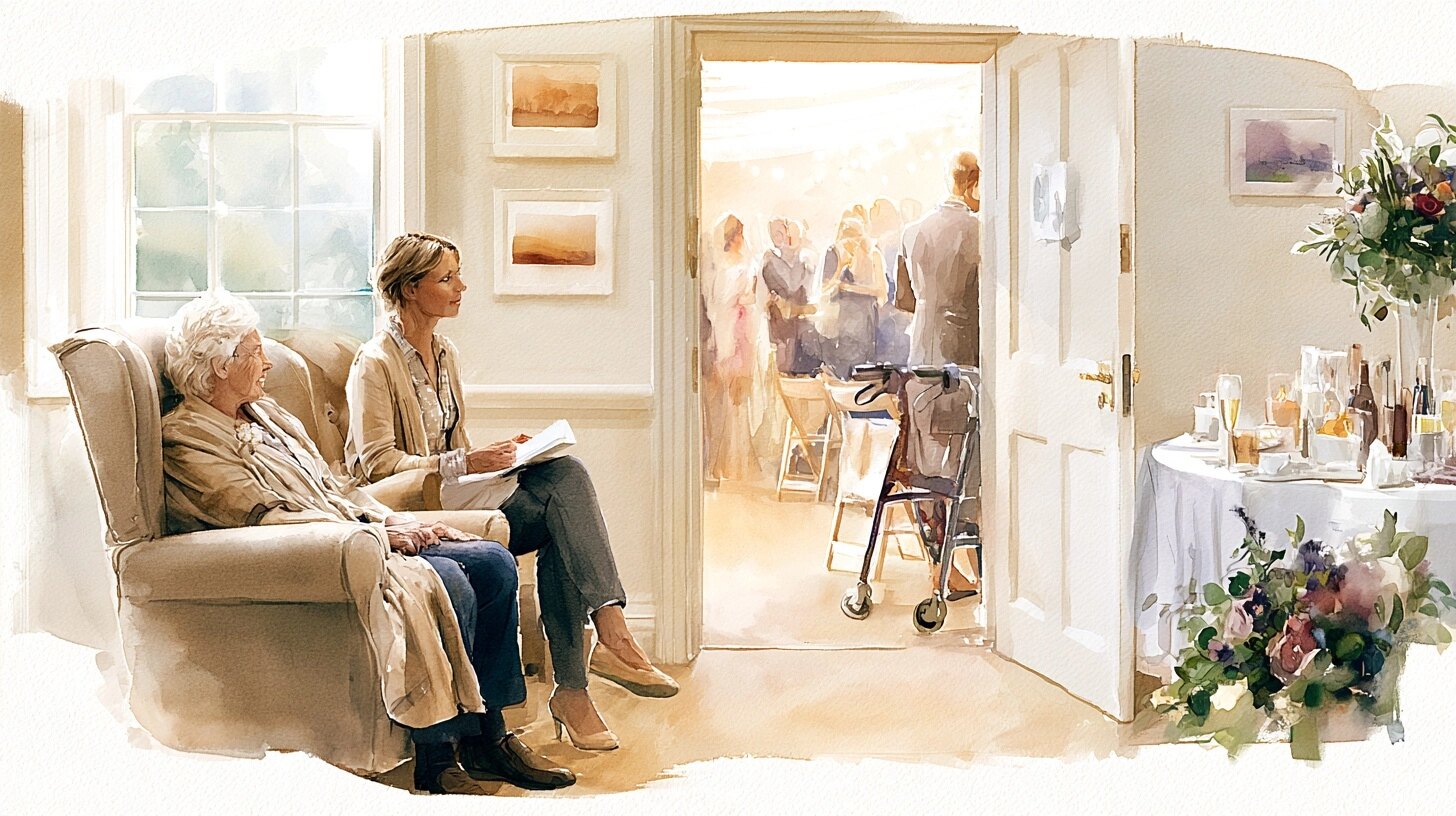
Two things make the most difference on the day: a seat that lets them come and go easily, and one familiar person who is with them from the moment they leave home until they are back.
At the end of a row, near an exit
The ceremony
At the end of a table, with people they know
The meal
A quiet room they have already seen
Through the day
One named companion all day
From door to door
The companion matters more than any other part of the plan. A person with dementia can lose track of where they are and who they came with, and being handed from one relative to another through the day makes that harder. One familiar person, who stays beside them, can notice the early signs of tiredness or worry and do something about it before it becomes distress. Where should grandparents sit at a wedding? has more on seating plans for older guests.
Choose the companion carefully. It should not be one of the couple, a parent of the couple, or anybody with a speech to give or guests to greet. It should not be the person who usually cares for your relative either, unless that is what they want, because this may be their one chance in a long time to be a guest. A cousin, a close friend or a neighbour your relative knows can do it well, as long as they are happy to miss parts of the wedding and to leave early. Looking after an elderly relative at a wedding sets out who does what on the day, including the companion's role.
Give the companion what they needSection titled Give%20the%20companion%20what%20they%20need
Make sure the companion has the one-page plan, the car booking, a phone number for whoever is at home or at the care home, the medicines and a change of clothes. Agree with them beforehand that they can decide on the day to leave early, or to go to the quiet room, without asking anyone. That way they never have to interrupt the couple or a parent of the couple to check.
If nobody in the family can give the whole day to it, you can book a wedding carer who stays with them all day instead, from the journey there to the journey home, so the person who usually looks after them can be a guest too.
Going home or upset
If they want to go home, walk off or become upset
Even with good planning, there may be a moment when your relative becomes anxious, asks to go home or sets off on their own. Agree in advance how the companion will respond, so nobody is working it out in a crowded room.
| What may be behind it | What tends to help | |
|---|---|---|
| They keep asking to go home | Alzheimer's Society explains that "home" can mean a feeling of being safe and relaxed rather than an address, and that anxiety, insecurity or fear can be behind the wish to go there. | Do not argue about where they are. Reassure them that they are safe and with you, move somewhere quieter, and talk about the home they mean. If they still want to leave, take them, since that is what the car booking is for. |
| They get up and walk off | Alzheimer's Society lists reasons such as looking for someone or something, needing the toilet, being in pain, restlessness or feeling lost in an unfamiliar place. | Walk with them rather than steering them back at once. Ask whether they need the toilet or some air, and offer a short walk outside or a sit in the quiet room. |
| They become tearful, cross or agitated | Too much noise, too many people talking to them at once, tiredness, hunger, needing the toilet, or pain they cannot explain. | Take them out of the noise first and talk later. Sit at their level, speak slowly in short sentences and keep your voice calm. Offer a drink, a snack or the toilet. |
| They do not recognise someone, or say something hurtful | Memory loss, and the strain of being greeted by people they cannot place. | Introduce people by name and relationship before they speak, and let a hurtful remark pass without correcting them. Tell the other person afterwards that it was the dementia and not meant. |
They keep asking to go home
- What may be behind it
- Alzheimer's Society explains that "home" can mean a feeling of being safe and relaxed rather than an address, and that anxiety, insecurity or fear can be behind the wish to go there.
- What tends to help
- Do not argue about where they are. Reassure them that they are safe and with you, move somewhere quieter, and talk about the home they mean. If they still want to leave, take them, since that is what the car booking is for.
They get up and walk off
- What may be behind it
- Alzheimer's Society lists reasons such as looking for someone or something, needing the toilet, being in pain, restlessness or feeling lost in an unfamiliar place.
- What tends to help
- Walk with them rather than steering them back at once. Ask whether they need the toilet or some air, and offer a short walk outside or a sit in the quiet room.
They become tearful, cross or agitated
- What may be behind it
- Too much noise, too many people talking to them at once, tiredness, hunger, needing the toilet, or pain they cannot explain.
- What tends to help
- Take them out of the noise first and talk later. Sit at their level, speak slowly in short sentences and keep your voice calm. Offer a drink, a snack or the toilet.
They do not recognise someone, or say something hurtful
- What may be behind it
- Memory loss, and the strain of being greeted by people they cannot place.
- What tends to help
- Introduce people by name and relationship before they speak, and let a hurtful remark pass without correcting them. Tell the other person afterwards that it was the dementia and not meant.
Drawn from guidance by Alzheimer's Society on wanting to go home and walking about, and the NHS on communication and changes in behaviour. If distress does not ease, leaving early is the right thing to do.
The hardest of these to plan for is your relative walking away from the venue on their own, especially if it is in a place they do not know. Alzheimer's Society suggests making sure the person carries some identification, keeping a recent photograph of them, and telling the police if you cannot find them. It also describes the Herbert Protocol, a national scheme in which families fill in a form of useful information in advance, to hand to the police if a vulnerable person goes missing. If your relative has walked off before, fill one in before the wedding and give a copy to the companion. Wandering and leaving the house covers the reasons people with dementia walk about and what helps at home.
A small card in their pocket or bag with their name, a contact number and a line saying they have dementia also helps, so that venue staff or another guest can help them if they become separated from their companion. What are dementia assistance cards? explains the kinds of card available. The Hidden Disabilities Sunflower is a scheme for letting people know, without having to explain, that somebody has a condition that may not be obvious and may need more time or help.
Other guests
Helping other guests talk to them
Guests will want to say hello, and some will not know what to say to somebody with dementia. A short word in advance, from you or the couple, can make those conversations easier for everyone.
What helps
- Saying who you are and how you know them as you say hello: "Hello Mary, it is Sarah, your niece"
- Sitting down beside them rather than standing over them
- Talking one at a time, so they only have one conversation to follow
- Talking about the couple, the music or what they are wearing, things they can see in front of them
- Keeping a visit short and coming back later, rather than staying a long time
What tends to upset
- Asking "Do you remember me?" or quizzing them on names and dates
- A group gathering round their chair all at once
- Correcting them when they get a name or a relationship wrong
- Talking about them to their companion as though they were not there
- Taking them off to the bar or the dance floor without telling their companion
Dementia UK suggests telling family and friends beforehand about the changes they may notice, and asking them to take turns talking to the person, so they are not trying to follow several conversations at once. The NHS gives similar advice for talking to someone with dementia: speak clearly and slowly in short sentences, get down to their level and make eye contact, and be patient while they answer. A short message to close family a week before the wedding, or a word from the couple, is enough to pass this on.
When a familiar song helpsSection titled When%20a%20familiar%20song%20helps
Music can reach a person with dementia when conversation is hard. If there is a song your relative loves, or the song from their own wedding, ask the band or the DJ to play it early in the evening reception, or have it played during the drinks while they are still there. A dance with a grandchild, or a few minutes holding hands while it plays, can be a lovely part of the day for them and for you.
Home again
Settling back at home or in the care home
Plan the end of the day as carefully as the start. A tiring day out can leave a person with dementia unsettled for a while afterwards, and a familiar evening helps them back into their routine.
- Journey
A calm journey home
Quiet in the car, no questions about the day, and a drink and a snack to hand. Let them doze if they want to.
- Evening
The usual evening, as close to normal as you can make it
Their own chair, a familiar tea, evening medicines on time and the bedtime routine they know. Change out of wedding clothes early so they are comfortable.
- Night
A restless night is possible
After a busy day some people sleep deeply and some are restless or confused in the night. If they usually have someone with them overnight, keep that in place.
- Next day
A quiet day with nothing planned
No visitors, no outings, and the usual routine. If they are tired or muddled, give it time before deciding the trip was too much.
- Next week
Look at the photographs together
A few printed photographs from the day, or a short album, give you something to look at and talk about. They may enjoy the pictures even if they do not remember the day.
- If it lasts
Unsettled for more than a few days
If tiredness or muddle lasts longer than a few days, talk to their GP. If they become suddenly much more confused than usual, the NHS says to go to A&E or call 999, because sudden confusion can be caused by an infection or another illness.
If your relative lives in a care home, agree the time they will be back with staff beforehand and stick to it, and let the home know how the day went when you drop them off: what they ate and drank, when they last had their medicines, and whether anything upset them. Ask staff to tell you how they were over the next day or two. Bringing a relative from a care home to a wedding covers the arrangements with the home, from getting ready to the handover when they return.
If you look after your relative yourself and the wedding has left you tired too, plan some rest for yourself in the week after. Respite care for dementia explains how families arrange a break, from a few hours to a week, and how to build up to it so it is easier on the person you care for. Family occasions and dementia covers other gatherings, from birthdays to christenings, if the wedding is one of several this year.
Questions
Questions families ask about dementia and the wedding day
Prepare her with photographs of the venue and the people who will be there, plan a shorter day for her inside the wedding, and ask one familiar person with no other job that day to stay with her throughout. Arrive as the last guests sit down, seat her at the end of a row near the door, use a quiet room for breaks every 30 to 40 minutes, and book the car home for a set time, often before the speeches. A wedding day care plan puts all of this on one page.
Keep the time short, give them a quiet room to rest in, and limit how many people talk to them at once. Dementia UK suggests a break every 30 to 40 minutes, keeping normal routines such as meals and medication, and asking guests to take turns talking to the person. Introducing people by name and relationship, and never asking "Do you remember me?", also helps.
Noise from several directions makes it harder to follow what is being said and to work out what is going on, which can be tiring and frightening. The NHS suggests reducing background noise when you talk to someone with dementia, and asking whether a place is too noisy when their behaviour changes. At a wedding, sit them away from the speakers and the band, and use a quiet room before they become tired.
Do not argue with her about where she is. Alzheimer's Society explains that wanting to go home can come from anxiety or fear, and that "home" can mean a feeling of being safe rather than a particular house. Reassure her, move somewhere quieter, and talk about the home she means. If she still wants to leave, take her home. That is why the companion and the car booking are there.
It can help. A wheelchair saves energy across a long day, makes the walk from the car park and between rooms easier, and gives the companion a simple way to move him out of a crowd. Try it at home first so it is not new on the day.
As long as they are enjoying it, with a set time to leave agreed in advance. If the parts that matter most to you are the ceremony and a family photograph, leaving before the speeches avoids the longest, loudest stretch of the day. Start from the hours when they are usually at their best, and plan the journey home before the late afternoon if their confusion tends to build then.
A busy day can leave someone tired and more muddled for a day or two afterwards, and rest and the normal routine help. If that lasts longer than a few days, talk to her GP. If she becomes suddenly much more confused than usual, the NHS says to go to A&E or call 999, and notes that urinary tract infections are a common cause of sudden confusion in people with dementia.