
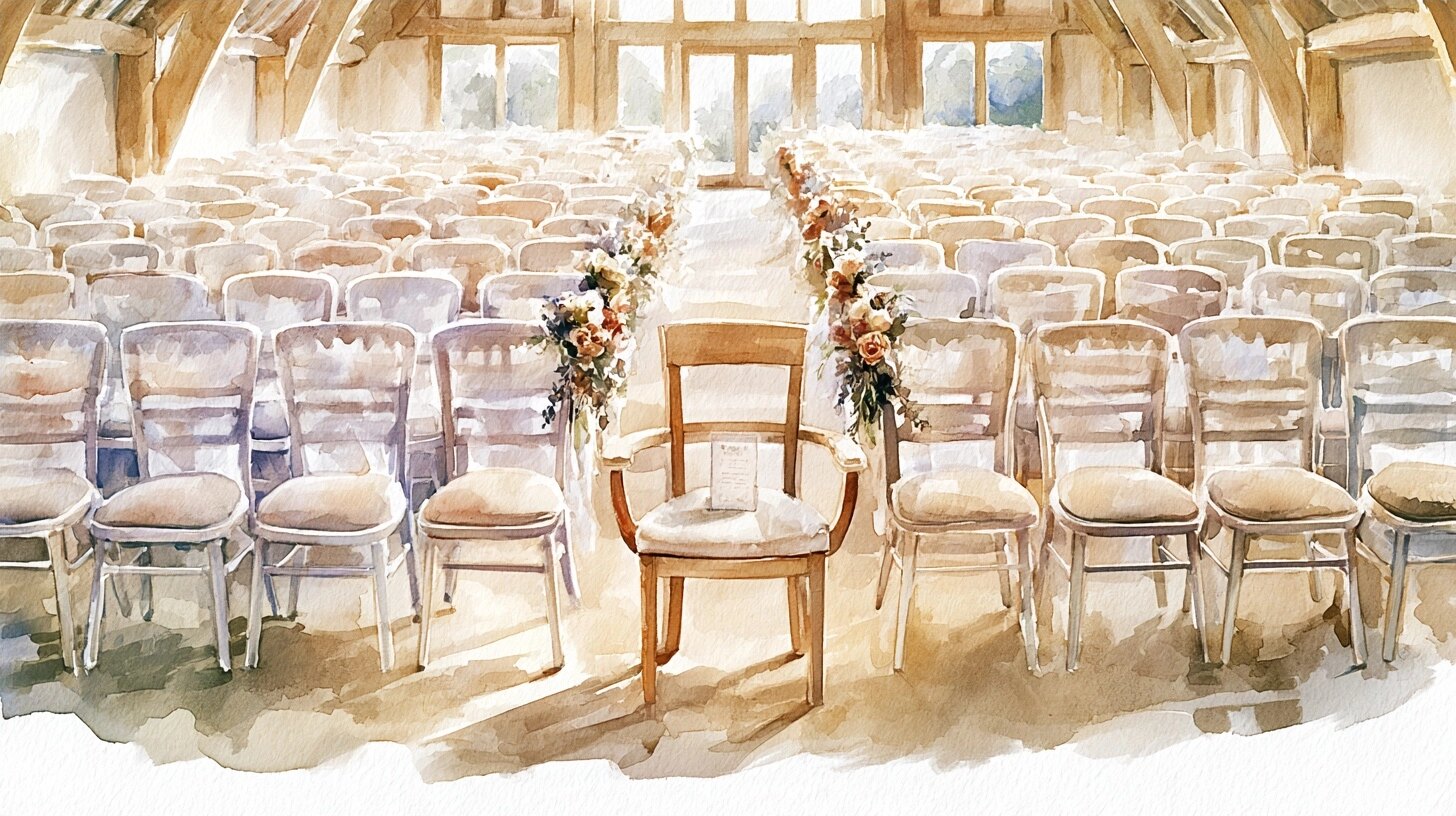
The short answer
- At the ceremony, the end of the second rowBehind the parents, on their own side, at the end of the row nearest a door.
- Seat them early and calmlyTradition seats grandparents just before the parents. A frail guest can be taken in before the crowd builds.
- At the reception, near the toilets and the top tableChoose a table with a short route to the toilets and a clear view of the speeches, and keep it well away from the band and speakers.
- Someone they know beside themA chair with arms helps them stand, and a familiar person in the next seat helps with everything else.
The traditions are a guide. Where they clash with what your guest needs, choose comfort.
At the ceremony
Where grandparents sit at the ceremony
The custom already puts grandparents near the front. For an older guest, the detail that matters is which end of which row.
The ceremony: a seat at the end of a row, near the front
- 1
Parents in the front row
The couple's parents usually take the front row on their side, so the grandparents sit just behind them.
- 2
The end of the second or third row
Close enough to see and hear the vows, and on the end so they can sit down and get up without anyone standing aside.
- 3
A companion beside them
The person helping them sits on the inside seat, so they can lean in, pass a tissue or walk them out.
- 4
A short way to the door
Choose the side nearer a door that leads to the toilet, so a trip out mid-ceremony is a few steps rather than the length of the room.
In a traditional church wedding in the UK, the bride's family and friends sit on the left as you face the front, and the groom's on the right. The couple's parents take the front row on their side, and the grandparents sit in the row behind. You do not have to keep to sides. Couples can mix them or let guests sit where they like, and a civil ceremony has no set custom. Even then, reserving the second row for grandparents keeps them close to the vows without asking them to take part in anything.
For a guest who is frail, slow on their feet or uses a wheelchair, the end of the row matters more than the row number. An end seat means they can sit down and stand up without a line of people shuffling past, and they can leave without fuss if they need the toilet or start to feel unwell. Pick the end nearest a door, and walk the route from that seat to the accessible toilet when you visit the venue. The accessible wedding venue checklist lists what else to ask about the ceremony room, such as the lift and the distance from the drop-off.
If your grandparent uses a wheelchair, ask the venue to take out the end chair in their row so the wheelchair sits in line with the family, rather than out in the aisle or at the back. A venue has to plan how everyone gets out in an emergency, as the government's fire safety guidance explains, so agree with them where the chair can go without blocking the aisle.
If your guest needs to slip out often, a seat further back on the end of a row is fine. If they are walking in during the procession, grandparents walking down the aisle covers who walks them in and when.
When they are seated
When grandparents are seated, and who takes them in
In the traditional order, the closest family are seated last, just before the procession starts. Grandparents come shortly before the parents.
- 45 min
Guests start to arrive
A frail guest who would struggle with the crowd can be brought in now, while the room is quiet.
- 20 min
A last trip to the toilet
Whoever is with your grandparent offers a visit to the toilet and checks they have their glasses, hearing aids and a drink of water.
- 10 min
Grandparents are seated
Traditionally the groom's grandparents are seated first, then the bride's, each taken to their seat by an usher or a grandchild.
- 5 min
The parents are seated
The groom's parents next, then the mother of the bride, whose arrival signals that the ceremony is about to begin.
- Start
The procession
Everyone stands for the couple. A grandparent who cannot stand for long can stay seated, and that is fine.
This order comes from formal ceremonies, and you can follow it as closely or as loosely as you like. Its purpose is to give the closest family the honour of being seated last, near the start. For a frail grandparent, being taken in early is the kinder choice. A long wait in a hallway or on a path, standing among guests they may not recognise, can tire them out before the ceremony has begun, and arriving to a quiet room is calmer for someone living with dementia. The guide to taking someone with dementia to a wedding explains how to judge the timing and when arriving last suits a guest better.
Choose who takes them in before the day. An usher is traditional, but a grandchild your grandparent knows well is more reassuring, and will walk at their pace. Put a reserved sign on the seat and the one beside it, because a guest without a plan can easily take the end of a row that looks free.
At the reception
The grandparents' table at the reception: near the toilets and away from the band
A reception lasts for hours, so the seat decides how long an older guest can stay and how much they can follow.
The reception: near the top table, near the door, away from the band
- 1
A clear view of the top table
A table close to the top table, with their chair facing it, so they can see the faces of whoever is speaking.
- 2
The grandparents' table
Close to the door that leads to the toilets, with the chair on the side nearest that door.
- 3
A clear, lit route out
Nothing in the way between their chair and the door, and enough light to see the floor after dark.
- 4
Band, speakers and dance floor at the far end
Loud music is hard on hearing aids and tiring for anyone. Sitting at the other end of the room lets them stay longer in the evening.
Grandparents are not usually on the top table, which by tradition seats the couple, their parents, the best man and the chief bridesmaid. They usually have their own table close to it, often with other older relatives or family friends of their own generation. You can seat them there if you want to, but a traditional top table faces the room, so your grandparent would be on show through the meal, and it can be harder to get in and out of.
Three things decide where the grandparents' table goes.
- The walk to the toilet. Put the table close to the door that leads to the toilets, and seat your grandparent on the side nearest it. An older guest who has a long walk across a crowded room may drink less to avoid it, and drinking too little is best avoided on a long day. Toilets, continence and medicines across a long wedding day covers what to pack and how to plan toilet visits.
- The view of the speeches. Face their chair towards the top table so they can see the faces of the people speaking. The NHS lists difficulty hearing people clearly, especially in noisy places, as a sign of hearing loss, and being able to see a face makes speech easier to follow. Ask whether the venue has a microphone and a hearing loop for the speeches.
- The distance from the band and the dance floor. Seat them at the far end of the room from the speakers. Loud music makes conversation hard for everyone, and harder still with hearing aids.
The Alzheimer's Society recommends reducing background noise and making sure the area is well lit for someone with dementia and hearing loss, and a table by a lit doorway helps with both. Helping a guest with hearing or sight loss enjoy the wedding goes further on loops, microphones and lighting.
Chairs and company
Chairs with arms, and who sits with them
Once you know where the seat is, two smaller details decide how comfortable it is: the chair itself, and the person in the next seat.
A chair with arms
Ceremony and meal
The right height
Getting up and down
Room for a wheelchair at the table
The meal
Their better side
Conversation
The person in the next seat matters as much as the chair. Seat your grandparent with someone they know well and who can help them through the day without being asked: fetching a plate from the buffet, walking with them to the toilet, noticing when they are cold or tired, and knowing when it is time to go home. Avoid giving this job to a parent of the couple or anyone in the wedding party, who will be called away at the moments your grandparent most needs them. Looking after an elderly relative at a wedding goes through who does what on the day, and a wedding day care plan puts the seat, the helper and the medicine times on one page.
Sometimes there is nobody free to do it. The relative who usually looks after your grandparent may be the mother of the bride, and the cousins may have young children of their own. If that is your family, a wedding carer who sits with your grandparent all day can take that place at the table and in the row, so the family can enjoy the day too.
Questions
Questions about seating grandparents at a wedding
Traditionally in the second row, behind the couple's parents, on their own family's side. In a UK church wedding the bride's family sits on the left and the groom's on the right as you face the front. For a frail grandparent, choose the end of that row nearest a door.
In the traditional order, grandparents are seated a few minutes before the ceremony starts: the groom's grandparents first, then the bride's, followed by the groom's parents and finally the mother of the bride. A grandparent who finds crowds or waiting hard can be taken to their seat earlier, while the room is quiet.
Not usually. The traditional top table seats the couple, their parents, the best man and the chief bridesmaid, and grandparents have a table close to it. You can include them if you like, but a top table faces the room and can be hard to get in and out of, so a nearby table may suit an older guest better.
Near the door to the toilets, with a clear view of the top table for the speeches, and at the far end of the room from the band, the speakers and the dance floor. Seat your grandparent on the side of the table nearest the door, in a chair with arms.
Yes. Ask the venue to remove the end chair in the family's row at the ceremony and one chair at the reception table, so the wheelchair sits in line with everyone else. Agree the space with the venue so it does not block an aisle or an exit.