
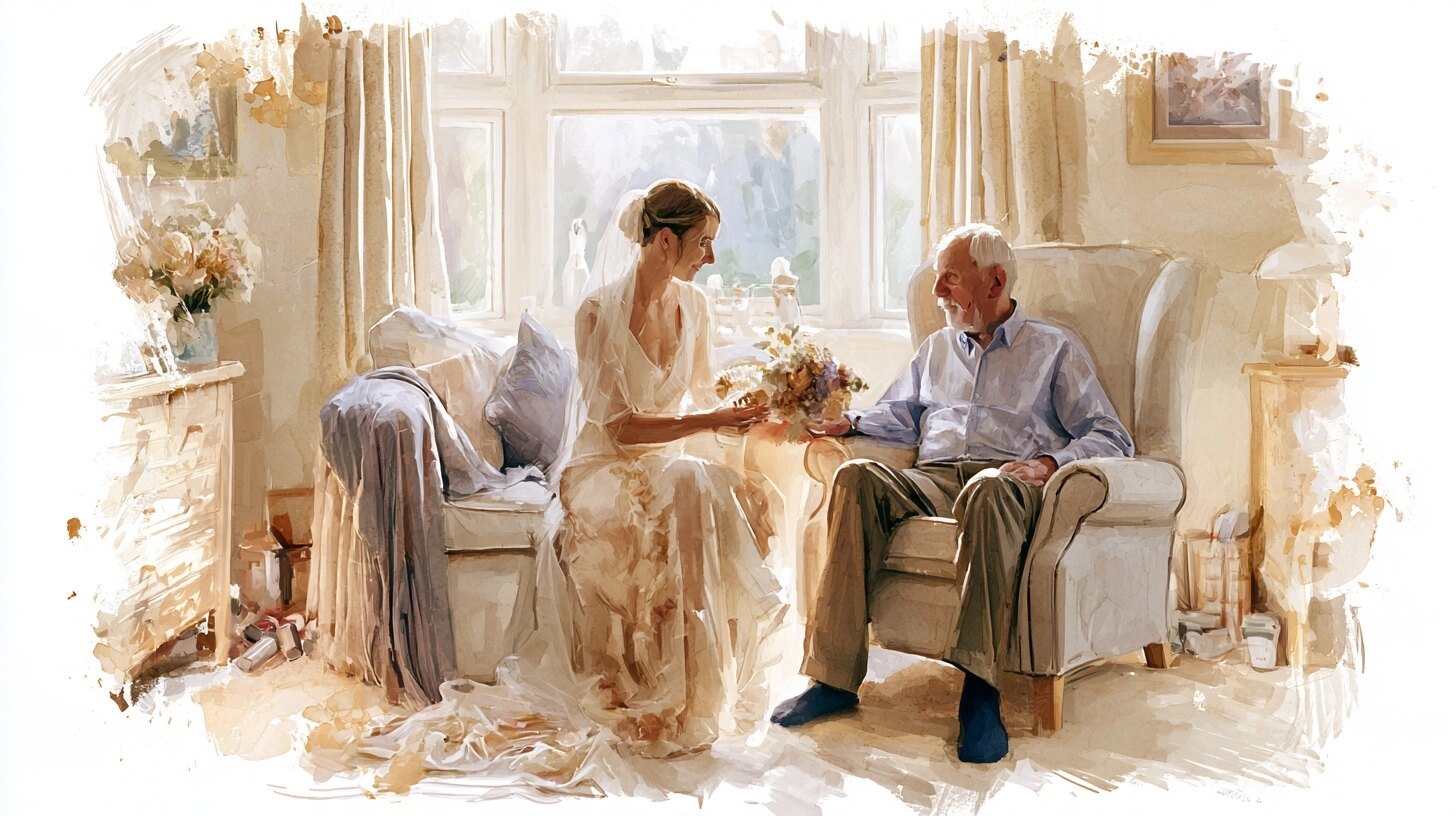
The short answer
- Put their moments early in the dayA visit before the ceremony, a reading, and the family photographs straight afterwards all fall in the hours when an older guest is likely to be freshest.
- Ask them what they would likeSome grandparents would love to speak or dance. Others would rather be honoured without a role. Offer a choice, including the choice to say no.
- Every idea has a seated versionReadings, toasts, photographs and even the dance can all be done from a chair, so nobody has to choose between taking part and staying safe.
- Some honours need no energy at allA corsage, their name in the order of service, a family heirloom worn by the couple or a mention in a speech can mean as much as a role.
Every idea here works without paying anyone. Where help is needed through the day, someone has to stay with your grandparent so these moments happen at the right time.
Plan around their energy
How to include grandparents in the wedding when their energy is limited
The most useful thing you can do is decide when each moment happens, before you decide what it is. A frail guest can manage a lot in a short window and very little once they are tired.
For a grandparent who uses a frame, lives with heart or lung problems, has Parkinson's or is recovering from an illness, a wedding can be the longest day they have had in months. Some people are at their best in the late morning and flagging by the time the meal is cleared; others come to life in the afternoon. You or their usual carer will know which pattern they follow.
So start from their day rather than the wedding's. Ask the person who looks after them when they are most alert, how long they can sit comfortably and when they usually rest. Then place each moment you would like them to have in their good hours. The map below shows one way of doing it for an afternoon ceremony.
One wedding day, planned around a grandparent’s energy
An example with a 1pm ceremony, for a guest who is at their best in the late morning. The bars show how much energy they may have left; move every idea to your own relative’s best hours.
11am · Before the ceremony
FreshA private visit from the bride or groom, already dressed, and a wrist corsage put on
The gentler version: Do it at home or in a side room, sitting down, for ten minutes before the car comes.
12.30pm · Arrival and seating
FreshSeated before the other guests, with their name printed in the order of service
The gentler version: An end-of-row seat near the front and the door, so they arrive without a crowd around them.
1pm · The ceremony
FreshA short reading, or signing the register as a witness
The gentler version: Read from their seat with a microphone brought to them, or sign at the table where they sit.
1.45pm · The photographs
SteadyThe family photographs with grandparents taken first
The gentler version: A chair in every group shot and a list for the photographer, so it is over in ten minutes.
2.15 to 3.30pm · The drinks reception
TiringA rest, which is what makes the speeches and the dance possible
The gentler version: A quiet room or a comfortable chair away from the noise, with a drink, a snack and the toilet nearby.
3.30pm · The meal and speeches
SteadyA toast from them, or a mention in a speech
The gentler version: Put their words first in the running order, or have a grandchild read what they wrote.
6pm · The cake and the first dance
SteadyA short dance with the bride or groom, standing or seated
The gentler version: One verse of a song they know, danced holding hands from a chair, before the evening band starts.
7pm · The evening
TiringA proper goodbye from the couple, then home
The gentler version: Leave before the evening guests arrive, so the goodbye happens while they still have the energy to enjoy it.
The quieter stretches are part of the plan. A rest in the afternoon is what lets them enjoy the speeches and the dance.
Two things make the plan work. The first is a rest. An hour in a quiet room during the drinks reception, with the toilet nearby and something to eat, can be what lets a grandparent stay awake and enjoy the speeches. The second is agreeing a time to go home before the wedding, so that leaving is part of the plan rather than a disappointment. Where grandparents should sit at a wedding covers finding them a seat that makes both of those easier.
For any of this to work, someone has to keep an eye on the time, walk your grandparent to the photographs, and notice when they need to sit down. If the person who usually does that is the mother or father of the bride, they will be busy at exactly the moments that matter. Who looks after an elderly relative on the day sets out a simple rota so the family can share the job, and the wedding day care plan template puts the timings on one page.
The ceremony
Ways to honour grandparents at the wedding ceremony
The ceremony is usually early in the day and short, which makes it the best place for a grandparent's role. Each idea below has a version that needs very little walking or standing.
| What it asks of them | The gentler version | |
|---|---|---|
| A visit before the ceremony | Sitting with the bride or groom for a few minutes while they get ready. | Bring the couple to them, at home or in a side room at the venue. This needs no walking at all, and it gives the photographer a quiet moment with no crowd. |
| Walking in or being escorted to their seat | Walking the length of the aisle in front of everyone, on time. | Take their seat before the other guests arrive, or be wheeled in by a grandchild just before the procession. |
| A reading | Standing at the front and reading aloud for a minute or two. | Choose a short piece, print it in large type, and let them read from their seat with a microphone brought to them. |
| Being a witness | Coming to the table after the vows and signing the register. | Ask the registrar or minister in advance whether the signing can take place where they can reach it easily, with a chair ready. |
| A blessing or a few words | Speaking during the ceremony itself. | In a religious ceremony, ask the minister whether a grandparent can say a short blessing. In a civil ceremony, choose words that are not religious. |
A visit before the ceremony
- What it asks of them
- Sitting with the bride or groom for a few minutes while they get ready.
- The gentler version
- Bring the couple to them, at home or in a side room at the venue. This needs no walking at all, and it gives the photographer a quiet moment with no crowd.
Walking in or being escorted to their seat
- What it asks of them
- Walking the length of the aisle in front of everyone, on time.
- The gentler version
- Take their seat before the other guests arrive, or be wheeled in by a grandchild just before the procession.
A reading
- What it asks of them
- Standing at the front and reading aloud for a minute or two.
- The gentler version
- Choose a short piece, print it in large type, and let them read from their seat with a microphone brought to them.
Being a witness
- What it asks of them
- Coming to the table after the vows and signing the register.
- The gentler version
- Ask the registrar or minister in advance whether the signing can take place where they can reach it easily, with a chair ready.
A blessing or a few words
- What it asks of them
- Speaking during the ceremony itself.
- The gentler version
- In a religious ceremony, ask the minister whether a grandparent can say a short blessing. In a civil ceremony, choose words that are not religious.
Check every role with whoever is leading the ceremony. Registrars, ministers and celebrants each have their own rules about who can speak and where.
Check the rules on readings for a civil ceremonySection titled Check%20the%20rules%20on%20readings%20for%20a%20civil%20ceremony
In England and Wales, a civil ceremony can include readings, songs and music, but it must not include anything religious, such as a hymn or a reading from the Bible. That matters if a grandparent has a favourite passage from scripture. If the ceremony is civil, the passage may fit better in a speech at the reception, or at a blessing afterwards. GOV.UK advises couples to discuss any wording with the person carrying out the ceremony, so send your grandparent's reading to them early. A civil ceremony also needs at least two witnesses, and a grandparent is a lovely choice for one of them.
If walking in matters to themSection titled If%20walking%20in%20matters%20to%20them
For some grandparents, walking in or walking the bride down the aisle is the part they care about most. It can often be done with the right help, a slower pace and a chair waiting at the end. Grandparents walking down the aisle goes through who walks them in and when, and walking down the aisle with a parent in a wheelchair covers the aisle itself if they use a chair.
Whatever you choose, ask in a way that makes it easy to say no. A grandparent who would dread reading in front of a hundred people may be relieved to sign as a witness instead.
Speeches and toasts
A grandparent's speech at the wedding, or a mention in someone else's
Speeches are the part of the day where a grandparent's words can carry the most weight. They do not need to stand up or speak for long for it to work.
A short toast from a grandparent, a few sentences about the couple and a glass raised, gives the room a moment to hear from the oldest generation. If your grandparent would like to give one, keep it to a minute or two and put it at the start of the speeches, while they are still fresh and before the room gets loud.
If speaking is too much, they can write something for a grandchild to read, or record a short video at home in the weeks before, to be played at the reception. Or the bride, groom or best man can mention them by name in their own speech. A line such as "my grandparents have been married for sixty years, and I hope we manage half as well" can mean a great deal to the person sitting at the top table.
- 1
Ask, and offer a choice
A few months beforeAsk whether they would like to say a few words, have someone read them, record a video, or simply be mentioned. Let them pick, and make sure they know any of these is welcome. - 2
Write it down in large print
A few weeks beforeHelp them write the words, keeping it to a minute or two. Print it in large type on a single card, with plenty of space between the lines. - 3
Put them first in the running order
When you plan the speechesTell the toastmaster or best man to call them first. Waiting through three longer speeches before theirs is tiring and makes nerves worse. - 4
Bring the microphone to them
On the dayLet them speak from their seat at the table, with a hand-held microphone passed to them. Check it works beforehand, and that a hearing loop is switched on if the venue has one.
If your grandparent has hearing loss, they may follow less of everyone else's speeches than you would expect, especially in a noisy room with a poor sound system. A printed copy of the speeches beside their plate, or a seat near the speakers, helps. Helping a guest with hearing or sight loss enjoy the wedding has more on seating, loops and microphones.
If your grandparent has dementia, a speech may still be possible if it is very short and written down, and if nobody minds what happens. How it goes on the day is hard to predict, so a mention in someone else's speech carries less risk of them feeling put on the spot, and is a good fallback to plan for.
Photos, taken early
Wedding photos with grandparents: take them first
Photographs are the part of the wedding that lasts longest, and the family groups are the ones most likely to include a frail grandparent. Taking them early, with a chair ready, spares a frail grandparent a long wait on their feet.
The family photographs usually happen straight after the ceremony and can run on for a long time. Standing in a garden or a draughty doorway while the photographer works through twenty groups of relatives can tire an older guest out before the meal starts. Ask the photographer to take every group that includes your grandparent first, then let them go and sit down.
Give the photographer a written list of those shots before the day, with the names of the people in each one, and tell them about your grandparent's needs. A good photographer will build the groups around a chair rather than asking a frail guest to stand for long.
The groups to put first
Straight after the ceremony
A chair in every shot
Bring one from inside
One quiet portrait
Away from the crowd
The before photographs
While the couple gets ready
If your grandparent uses a wheelchair, there is no need to hide it or move them out of it. Tell the photographer in advance and they can arrange each group around the chair. A few photographs of the couple crouching or sitting beside them can be among the best of the day.
A dance they can manage
A grandma and grandson wedding dance, standing or seated
A dance with a grandparent is a lovely moment, and it can be adapted to almost any level of mobility. The two things that matter most are when it happens and how long it lasts.
Plan the dance for the early evening, around the cutting of the cake or straight after the first dance, rather than late in the night when your grandparent is tired and the floor is crowded. Keep it short: one verse and a chorus is enough, and other guests can join in after that.
Choose a song that means something to them, perhaps one from when they were young or the song from their own wedding. Familiar music matters most of all for a grandparent with dementia. The NHS suggests music, singing and sharing memories as good activities for people with dementia, and the charity Playlist for Life helps families put together music that is personal to someone. Taking a parent or grandparent with dementia to a wedding covers the rest of the evening, including noise and a calm way to leave.
A seated dance
For someone who cannot stand for long
A short standing dance
For someone steady with support
A dance with the whole family
For someone who would like company
A song dedication
For someone who would rather not dance
If your grandparent is nervous about falling, the dance can become something they worry about all day rather than something they look forward to. Talk it through with them before the wedding and offer the seated version as the plan, not the fallback. Fear of falling explains why the worry can grow after a fall and what helps.
Small ways to honour them
Small ways to honour grandparents that ask nothing of them
Not every grandparent wants a role, and some cannot manage one. These gestures honour them without asking them to walk, speak or stay up late.
A corsage or buttonhole
Matching the wedding flowers
Their names in the order of service
A line of thanks
Something of theirs worn on the day
Something borrowed
Their wedding photograph on display
At the reception
A table or a toast named for them
At the meal
A visit the next day
If the evening was too much
The corsage advice is practical rather than decorative. A pin pushed through thin fabric close to fragile skin can scratch, and a magnet worn near a heart device can briefly affect how it works. The heart device maker Medtronic advises keeping magnetic items such as name badges at least 15cm from the device. A wrist corsage on an elastic band sidesteps both.
Who makes sure these moments happenSection titled Who%20makes%20sure%20these%20moments%20happen
Every idea on this page depends on timing, and timing depends on somebody watching the clock for your grandparent. That person walks them to the photographs, brings them to the edge of the floor for the dance, takes them to the quiet room after the ceremony and gets them home before they are worn out. A grandchild or a family friend can do it for part of the day, but rarely for all of it, and the people who know your grandparent best may be the busiest people at the wedding.
If that is the gap in your plan, a wedding carer who stays with them all day can take it for the day, with the journey there and back agreed in advance, so the family can be guests. If your grandparent is not well enough to come at all, bringing the day to a grandparent who cannot come has ideas for a visit in the dress, a livestream and a second celebration.
Questions
Questions families ask about including grandparents
Ask them what they would enjoy, then give them a part early in the day when they have the most energy. Good options include a visit from the couple before the ceremony, a short reading or being a witness, a toast at the start of the speeches, being in the first family photographs, and a short dance in the early evening. If they would rather not take a role, a corsage, their names in the order of service or a mention in a speech honours them just as well.
Print their names and a line of thanks in the order of service, give them a corsage or buttonhole, display a photograph from their own wedding at the reception, name a table after the place they married, or have the bride or groom wear something of theirs. A toast to them in someone else’s speech is another good choice. None of these asks them to walk, stand or speak.
If they would like to, yes, but keep it short. A minute or two from their seat, with a microphone brought to them and the words printed in large type, works well. Put them first in the running order so they are not waiting all through the meal. If speaking would worry them, a grandchild can read their words, or they can record a short video in advance.
As early as possible, ideally the first group photographs straight after the ceremony. Give the photographer a list of the groups that include your grandparents, ask them to take those first and have a chair ready for every shot. Your grandparent can then go and rest while the other photographs are taken.
Choose something that means something to her: a song from her own wedding, one she loved when she was young, or one the two of you share. Keep it short and play it early in the evening. If she has dementia, a song she has known for most of her life is the most likely to reach her.
Yes. A seated dance, with the bride or groom holding their hands and swaying with them at the edge of the floor, is lovely to watch and carries no risk of a fall. Some couples have the family dance in a circle around them. The wheelchair guide has more ideas for the dance and the photographs.
Plan for it. Agree a time to leave before the wedding and who will take them home, and make sure the couple says goodbye properly before then. If they leave early, a visit the next day with cake and the first photographs lets them share the rest of it.