
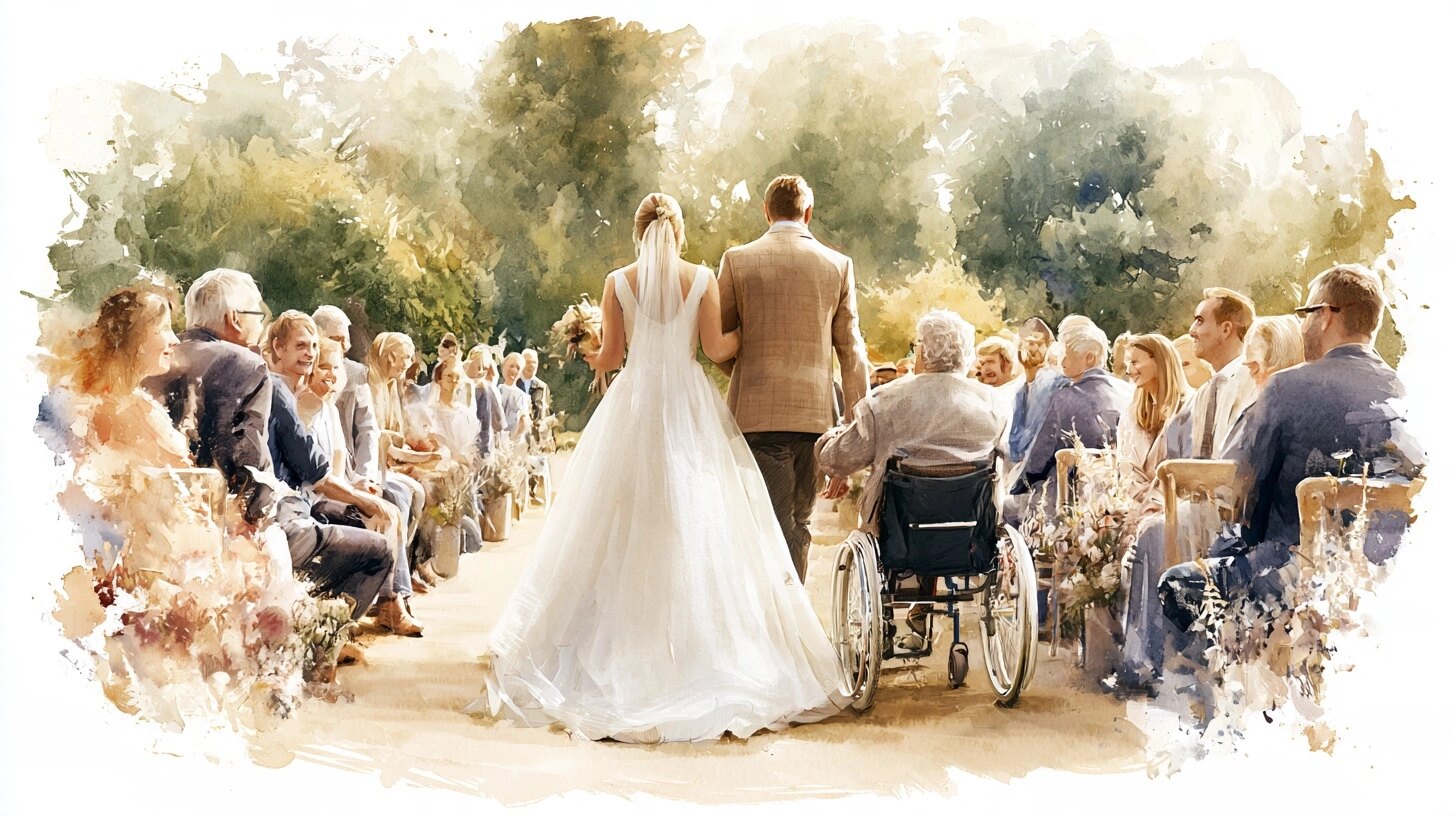
The short answer
- Ask your parent how they want to do itWhether they move the chair themselves, who pushes, and whether they would rather wait at the front is their choice first.
- Measure with the chair they will useTake its widest point to the venue and check the aisle, the end of the front row, the doors and any step at the front.
- Bring the photos down to their heightAsk the photographer to shoot at seated eye level and to build the group photos around your parent.
- Check the ground outdoorsSmall front wheels sink into gravel and soft grass. Matting or a hard path, laid where the chair will go, solves most of it.
Run through the aisle, the top table and the dance floor once with the chair before the day. A rehearsal shows up a narrow gap or a loose runner while there is still time to change it.
Who pushes, and how
Walking down the aisle with dad or mum in a wheelchair: four ways to do it
There is no single right way. What works depends on the chair, how your parent feels about being pushed in front of everyone, and how wide the aisle is.
Four ways to walk in together, seen from above
- You
- Your parent in their wheelchair
- Someone helping
Your parent moves the chair, you walk beside them
- Who moves the chair
- Your parent, in a powered chair or wheeling themselves
- Aisle width it needs
- The chair and a person side by side, so the widest of the four
- Suits
- A parent who drives a powered chair or wheels a manual chair with confidence over that distance.
- Watch for
- Agree a slow, steady speed and practise it. Walk on the side away from the controls, and hold their hand or rest yours on their shoulder rather than the armrest.
Someone else pushes, you walk beside
- Who moves the chair
- A sibling, an usher or a carer, walking behind the chair
- Aisle width it needs
- As wide as the first, with a third person behind
- Suits
- A parent who cannot move the chair themselves, when you want to hold their hand on the way in.
- Watch for
- Choose someone who pushes the chair often and knows its brakes. They need a seat at the end of a row so they can step away once your parent is in place.
You push the chair yourself
- Who moves the chair
- You, the bride or groom
- Aisle width it needs
- Only the width of the chair, so this suits a narrow aisle
- Suits
- A narrow church aisle, or a couple who want it to be just the two of them.
- Watch for
- You cannot link arms, and your parent will be facing away from you. Keep a long dress or train clear of the back wheels, and practise in the shoes you will wear.
Your parent waits at the front and you go to them
- Who moves the chair
- Nobody pushes during the walk itself
- Aisle width it needs
- Only room for your parent beside the front row
- Suits
- A parent who would find the walk tiring or crowded, or a venue where the aisle is too narrow or uneven for a chair.
- Watch for
- Settle them in place before the guests arrive. They can take your hand for the last few steps, or come forward to meet you as you reach them.
Walking in together is a custom, not part of the legal ceremony. For a marriage in England and Wales the law asks for vows, at least two witnesses and the signing of the marriage schedule, as the government guide to planning the ceremony explains. That leaves you free to shape the entrance around your parent, and to ask a registrar or minister to fit the order of the ceremony around them as well.
Start with a conversation with your parent rather than a plan. Some fathers and mothers who use a wheelchair will want to move the chair themselves, because being pushed in front of a room of people feels like being put on show. Others will be glad to be pushed and to hold your hand. A parent who has only recently started using a chair, after a stroke or a fall, may feel differently about it than you expect, and may need time to say so. If they would rather not do the walk at all, there are other ways to give them a part in the ceremony, such as a reading or a blessing, set out in ways to include a frail grandparent in the wedding, which apply just as well to a parent.
Whoever pushes should be someone who handles that chair often and knows where its brakes are. The bride or groom may not be the best person to push: a long dress or train can catch in the back wheels, and you lose the moment of walking arm in arm. If your parent is less steady on their feet than they used to be and hopes to stand for the last few steps, plan where the chair will be and who will be at their side, and decide on the day rather than in advance whether they feel up to it. The same thinking applies to an older grandparent, and who walks a grandparent down the aisle covers walking frames and sticks.
Width and surface
Measuring the aisle, the front row and the surface
A ceremony room set out for a hundred guests can leave the aisle narrower than it looks on the venue's photos. Measure the chair your parent will use, then take the numbers with you.
| What to check | A useful reference point | |
|---|---|---|
| The aisle | The width once the chairs are set out, against the chair's widest point plus a person walking beside it if that is your plan. | Guidance for new public buildings asks for corridors at least 1,200mm wide, with wider passing places. |
| A space at the front | Where your parent will sit during the ceremony. Ask for one or two chairs to be taken out at the end of the front row so they sit with the family, not in the aisle. | The same guidance allows 900mm by 1,400mm for a wheelchair parked in a seating area. |
| Doors on the way in | The narrowest door between the car and the ceremony room, with the door fully open. | For existing buildings the guidance gives a minimum clear width of 750mm for a door approached straight on. |
| A step or platform at the front | Whether the couple stand on a raised area, a chancel step or a stage, and whether your parent needs to reach it. | A ramp should be no steeper than 1 in 12, and then only over a short run of up to 2 metres. |
| The aisle surface | Carpet runners, petals and loose rugs. A thin runner can ruck up under small front wheels, and petals hide the edges of steps. | Ask for the runner to be taped down, and for petals to be scattered only after your parent has gone by. |
The aisle
- What to check
- The width once the chairs are set out, against the chair's widest point plus a person walking beside it if that is your plan.
- A useful reference point
- Guidance for new public buildings asks for corridors at least 1,200mm wide, with wider passing places.
A space at the front
- What to check
- Where your parent will sit during the ceremony. Ask for one or two chairs to be taken out at the end of the front row so they sit with the family, not in the aisle.
- A useful reference point
- The same guidance allows 900mm by 1,400mm for a wheelchair parked in a seating area.
Doors on the way in
- What to check
- The narrowest door between the car and the ceremony room, with the door fully open.
- A useful reference point
- For existing buildings the guidance gives a minimum clear width of 750mm for a door approached straight on.
A step or platform at the front
- What to check
- Whether the couple stand on a raised area, a chancel step or a stage, and whether your parent needs to reach it.
- A useful reference point
- A ramp should be no steeper than 1 in 12, and then only over a short run of up to 2 metres.
The aisle surface
- What to check
- Carpet runners, petals and loose rugs. A thin runner can ruck up under small front wheels, and petals hide the edges of steps.
- A useful reference point
- Ask for the runner to be taped down, and for petals to be scattered only after your parent has gone by.
The reference points come from Approved Document M, the building regulations guidance on access for buildings other than homes in England. They are design standards for buildings, not rules for laying out a wedding, but they are a fair guide to what a wheelchair user needs.
These figures come from Approved Document M, volume 2, the government's guidance on access to buildings. A venue built or refurbished recently should have doors and corridors to that standard, but the aisle is set out by the venue's staff on the day and depends on how many chairs they fit in. Ask the venue to leave the width you need and to note it on the room plan, and check it when you arrive.
If the front of the room has a step, ask whether there is a portable ramp, or whether the couple and the registrar can stand on the main floor instead. The rest of the building, from the car park to the accessible toilet, is covered in the accessible wedding venue checklist, which you can print and take to the venue visit.
The dance
The first dance or father-daughter dance with a parent in a wheelchair
A dance with a parent in a wheelchair can be every bit as close as one on foot. It works best when you plan the space, the length of the song and what your parent is comfortable doing.
What helps
- Hold both of their hands and move around the chair, so you stay face to face for the whole song
- Agree beforehand whether you can turn the chair, and practise one or two turns at home
- Clear the dance floor of cables, drinks and loose decorations before you start
- Choose a slower song, or ask the DJ or band to fade it out after a couple of minutes
- Invite the other guests to join you after the first minute, so your parent is not the only focus for long
- Let your parent decide on the day whether to stand for part of it, with the person who usually helps them close by
What tends to go wrong
- Spinning or tipping the chair quickly, which can frighten someone and unsettle their balance
- A dance floor with a raised edge or a gap where the panels join, which catches small front wheels
- A full-length song that leaves your parent tired before the evening has started
- Sitting on your parent's lap without asking first, as it can hurt someone frail or with weak legs
- Hanging bags or jackets on the push handles while you dance, which can tip the chair backwards
The first dance between the couple can include a parent too. One way is for the couple to dance the first verse together and then each bring a parent onto the floor, so the father-daughter or mother-son dance runs on from it and nobody waits alone in the spotlight. If your parent uses a powered chair, they can lead some of the movement themselves; ask them to try it on the dance floor at the venue if they can, because a smooth floor that looks fine can feel different under a heavy chair.
If your parent has been unsteady or has had a fall, standing to dance carries more risk than it seems, because a dance asks for turns and weight shifts that ordinary standing does not. Their physiotherapist can say whether it is safe, and fear of falling explains why some people lose confidence on their feet and how to talk about it. A seated dance is no less of a dance.
The photos
Wheelchair wedding photos: bringing everyone down to seated height
Photos taken from standing height look down on a person in a wheelchair, and a group photo arranged in rows can leave them at the edge. A short conversation with the photographer before the day avoids both.
Shoot at their eye level
Every photo with your parent
Close photos of the two of you
Bride or groom with a parent
Group photos built around them
Family groups
Their chair, their choice
In the chair or on a seat
Photos with them first
Timing
Put it on the shot list
Before the day
If your parent moves to another seat for a few photos, the person who usually helps them to transfer should do it, in the way they always do, with the wheelchair's brakes on. A transfer in good shoes on a lawn is harder than one at home. If one side of their body is weaker after a stroke, transfers with one-sided weakness explains the safe way to help.
What your parent wears will show in every photo, and some clothes sit better in a chair than others. A mother of the bride who uses a wheelchair may want a dress that is shorter at the front so it does not catch in the wheels, and a jacket that does not bunch up behind her. What an older guest can wear to a wedding has more on outfits for wheelchair users and keeping warm.
Top table and speeches
The top table, the father of the bride's speech, and the rest of the day
The meal and the speeches are the longest part of the day spent sitting still. A few changes to the top table let your parent stay at the heart of it without having to ask for help in front of everyone.
Before the day, ask the venue
0 of 7 ticked
The top table
The speeches
Comfort through a long day
Sitting in the same position for many hours puts pressure on the same areas of skin. The NHS advises people at risk of pressure sores to change position regularly, so build short breaks into the day, perhaps between the ceremony and the meal, and again before the evening. People also get colder when they sit still, so a blanket or wrap on the back of the chair is useful in a large room or a marquee. Where your parent sits at the ceremony and the meal, near the toilet and away from the speakers, is covered in where grandparents should sit at a wedding, and the timing of toilet trips and medicines in toilets, continence and medicines across a long wedding day.
All of this needs someone watching out for your parent through the day. If that is usually you, or your other parent, it means stepping away from your own guests again and again. One way round it is a wedding carer who stays with your parent all day, pushing the chair from one part of the day to the next and helping with the toilet and breaks, so that the family can be in the photos with them.
Grass and gravel
Grass, gravel and outdoor weddings with a wheelchair user
Gardens, barns and country houses are where a wheelchair is hardest to manage. The small front wheels dig into gravel and soft ground. A firm path laid along the right route makes most outdoor venues manageable.
- 1
Walk the outdoor route
At the venue visitFollow the path the chair will take: from the car to the ceremony spot, to the photos, the marquee or barn and the toilets. Note every stretch of gravel, lawn, cobbles and slope. - 2
Ask for a firm path
When you bookAsk the venue or marquee company about matting, hard trackway or boards over grass and gravel, and for a level floor inside the marquee with a ramp at the entrance. - 3
Place the ceremony on firm ground
Planning the layoutSet the outdoor aisle and the front row on a terrace, a path or a hard surface where you can. Grass that is firm in the morning can soften after a shower or a day of footfall. - 4
Plan for the weather
The week beforeSomeone sitting still in a chair feels the heat and the cold more than people moving about. Plan shade, water and a wrap, and an indoor option if it rains. - 5
Check the toilets are reachable
Final checkA portable accessible toilet on firm, level ground close to the marquee, with light outside after dark.
Wheelchair guides for families advise looking for a ramp or a dropped kerb rather than taking a chair up or down a kerb, and going slowly down a slope so the chair stays under control. Getting a chair over a kerb or loose ground needs practice and a confident pusher, so if nobody in the family has done it before, keep to the firm path rather than learn on the day. If the day is likely to be warm, the hot weather guide explains the signs of heat exhaustion to watch for in an older person.
Getting there is part of the plan too. Getting an older guest to and from the wedding covers wheelchair accessible taxis and cars, and where to drop your parent so they are not wheeled across a car park in their wedding clothes.
Questions
Questions families ask about a parent in a wheelchair at the wedding
Decide together who moves the chair. Your dad can wheel himself or drive a powered chair with you walking beside him, someone else can push while you hold his hand, you can push the chair, or he can wait at the front and you go to him. Measure the aisle against the chair, and practise once at the venue.
Someone who pushes that chair often and knows its brakes, such as a sibling, an usher or a carer. The bride can push, but a long dress can catch in the back wheels and she cannot hold her father's arm. Give whoever pushes a seat at the end of a row so they can step away.
Wide enough for the chair at its widest point, plus a person walking alongside if that is the plan. Building guidance for new public buildings asks for corridors of at least 1,200mm and allows 900mm by 1,400mm for a parked wheelchair. Ask the venue to set the aisle to your measurement and to take a chair out at the end of the front row.
Hold both of his hands and move around the chair so you stay face to face, and agree beforehand whether you can turn the chair. Clear the floor, choose a slower song or ask for it to be faded after a couple of minutes, and invite guests to join you. Only plan for him to stand if his physiotherapist says it is safe.
Ask the photographer to shoot at seated eye level, put your parent in the centre of the front row with some people seated beside them, and keep group photos off steps and slopes. Ask your parent whether they want to stay in their chair or move to an ordinary seat for some portraits.
Something comfortable to sit in for many hours: a skirt or dress that is shorter at the front so it stays clear of the wheels, a jacket that does not bunch up behind her, and a warm layer. Avoid long, loose sleeves that can catch on the wheels when she moves the chair.