
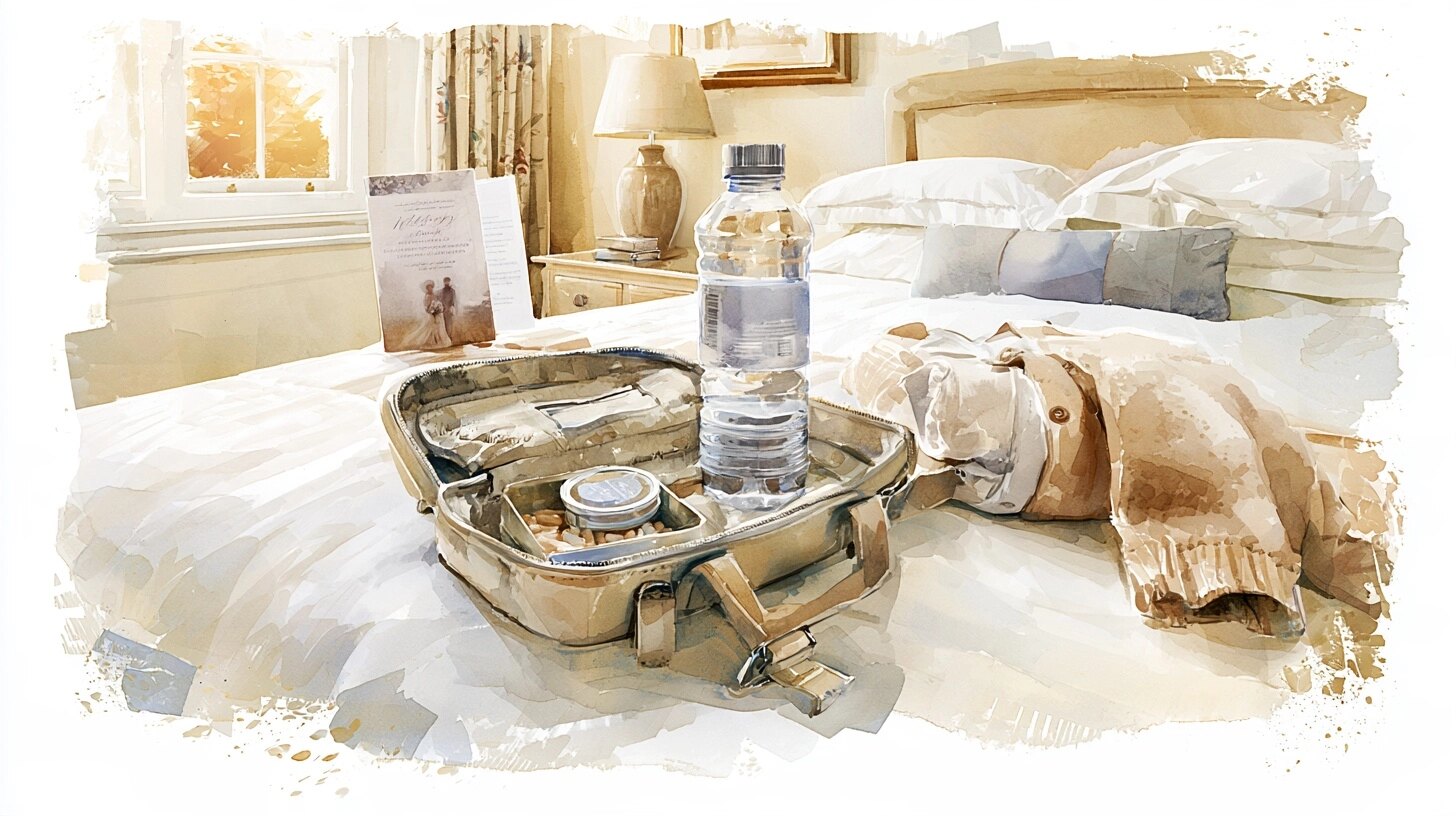
The short answer
- Ask the pharmacist about medicine times nowIf a dose falls during the ceremony or before a late meal, ask before the day whether it can move. Do not change times or doses on the day without advice.
- Keep drinking, but choose the drinksCutting back on fluids makes bladder problems worse, not better. Water and decaffeinated drinks are kinder to the bladder than coffee, cola or a lot of fizz.
- Find the accessible toilet firstCheck where it is, that it is unlocked and not used for storage, and seat your guest close to it. A guest who needs a hoist needs a Changing Places toilet.
- Plan for the weatherOlder people are more at risk in hot weather and can get cold quickly in a marquee. Plan shade, water and layers for both.
This guide is for families doing it themselves. It is general information, not medical advice: the guest's pharmacist, GP or continence nurse knows their medicines and needs.
The day at a glance
Lay out the wedding day hour by hour to see where the gaps are
Toilets, drinks and tablets all depend on the timings of the day, so start with the order of the day from the couple and write the guest's routine against it. The example below shows one guest across one day.
One wedding day, with a 1pm ceremony and a 4pm meal
The guest: Ted, 84. Walks slowly with a stick, wears pull-up pads, and takes tablets at 8am, 1pm, 6pm and 10pm. Two of them need to be taken with food.
Laid out like this, the gaps show: four hours between the ceremony and the meal, and a long drive home.
8am · Breakfast at home
- Toilet
- Unhurried time in the bathroom, a fresh pad, then the wedding clothes.
- Drinks and food
- A proper breakfast and a full drink, to last until mid-afternoon.
- Medicines
- Morning tablets with breakfast, at the usual time.
11.30am · Leaving for the venue
- Toilet
- The toilet just before leaving, even if he says he does not need it.
- Drinks and food
- A bottle of water and a snack go in the day bag.
- Medicines
- The 1pm tablets go in a labelled pouch, with a spare day of everything.
12.30pm · Arriving, before the ceremony
Seat him at the end of a row, near the door
- Toilet
- Find the accessible toilet first, check it is unlocked and clear, and use it before he sits down.
- Drinks and food
- A few sips of water. Nothing fizzy or caffeinated just before a ceremony he cannot leave easily.
- Medicines
- Nothing due yet.
1pm to 2pm · The ceremony and photographs
A dose that moves by an hour, agreed before the day
- Toilet
- A quiet trip straight after the ceremony, before the photographs start.
- Drinks and food
- Water while the photographs are taken. Shade in summer, a coat in winter.
- Medicines
- The 1pm dose falls during the ceremony. Agreed with the pharmacist in advance: take it at 2pm with a sandwich instead.
2pm to 4pm · The drinks reception
The longest gap of the day without a meal
- Toilet
- Offer the toilet about every two hours, and before he goes anywhere new.
- Drinks and food
- This is the long gap. A snack with the 2pm tablets, then a soft drink or water for every glass of fizz.
- Medicines
- Check the leaflet or ask the pharmacist about alcohol with each of his medicines.
4pm to 6.30pm · The meal and speeches
- Toilet
- Before he sits down at the table, and once between courses if the speeches run long.
- Drinks and food
- The meal. Water on the table beside him all the way through.
- Medicines
- The 6pm tablets with dessert, as long as the meal has run roughly to time.
6.30pm to 9.30pm · The evening
- Toilet
- A change of pad in the accessible toilet, using the change bag.
- Drinks and food
- A hot drink if the room is cooling down. Something to eat from the evening food.
- Medicines
- Nothing due. Watch for tiredness.
10pm · Going home
Agreed in advance, and earlier if he is tired
- Toilet
- The toilet just before getting in the car, whatever the length of the drive.
- Drinks and food
- A last glass of water to take in the car.
- Medicines
- The 10pm tablets at home or in the car, at the usual time.
The times and the tablets here are an example. Move them to your own day, and agree any change to a medicine time with the pharmacist first.
The ceremony needs thought, because the guest cannot easily get up and leave. So does the gap before the meal, which can be three or four hours of drinks and photographs with little to eat, and the end of the night, when they are tired and may face a long drive home.
Ask the couple for the order of the day as early as you can. Then sit down with your relative, or the person who looks after them day to day, and write their routine beside it: when they eat, when each tablet is due and how often they need the toilet. Where the two do not fit, you have something to sort out before the day rather than at the venue.
If you are still choosing a venue, the toilet is one of the first things to check. The accessible wedding venue checklist covers the toilets alongside step-free access, parking and a quiet room. The wider picture of who helps with what through the day is in looking after an elderly relative at a wedding, and everything about this guest can go on one page with the wedding day care plan template.
Medicine times
Medication timing on a long day out, and the late wedding meal
A wedding pulls meals and routines out of shape. A tablet that is due at lunchtime may fall in the middle of the vows, and one that must be taken with food may be due hours before the meal is served.
- 1
Write down every medicine and when it is due
A month beforeEach tablet, inhaler, patch or injection, its time, and whether it needs food. Work from the boxes or the repeat prescription list. - 2
Put the times against the order of the day
A month beforeMark any dose that falls during the ceremony or speeches, and any that needs food when there will be none. - 3
Ask the pharmacist about the awkward ones
Two or three weeks beforeAsk their usual pharmacy whether each awkward dose can move, by how much, and whether it is safe with alcohol. A GP or specialist nurse can help with anything the pharmacist is unsure of. - 4
Pack the doses for the day in labelled pouches
The night beforeOne pouch or organiser compartment for each dose, labelled with the time, plus a spare day of everything. Keep the boxes and leaflets in the bag too. - 5
Set alarms and give one person the job
On the dayAn alarm on a phone for each dose, and one named person responsible. If the helper changes, hand over the pouch and the job in person.
Most medicines have some leeway. Guidance from the NHS Specialist Pharmacy Service says that for most medicines it is acceptable to take a dose up to two hours late, and that a double dose should never be taken to make up for a forgotten one unless a prescriber has said so. The same guidance points to the patient information leaflet in each box as the first place to look. That leeway is why a 1pm tablet can often move to 2pm, after the ceremony, but confirm it with the pharmacist for each medicine before the day.
Food is the other half of it. If a tablet must be taken with food and the meal is at four, bring something plain to eat with it: a sandwich, crackers or a banana. If your relative needs to eat at a particular time, tell the couple or the caterer in advance and ask whether a plate can be brought out early for them. If they have diabetes, ask their diabetes nurse about the gap before the meal.
Some medicines need to be taken at exact times. The guidance gives specific advice for insulin, medicines for Parkinson's and medicines for epilepsy, where a missed or late dose can cause harm. For Parkinson's medicines it warns that even a delay of 30 minutes could be serious, so do not move those doses without the specialist nurse or pharmacist agreeing. Our guide to Parkinson's medication on time, every time explains why the timing matters and how families keep to it on busy days.
If a carer usually prompts or gives their medicines, whether a carer can give medication explains the difference between reminding and administering.
Finding the toilet
Accessible toilets at a wedding, and the Changing Places toilet finder
Not every toilet with a wheelchair sign suits every guest. It helps to know what kind of toilet your relative needs, then to check that the venue has one, where it is, and that it will be open and clear on the day.
| What it has | Who it suits | What to check | |
|---|---|---|---|
| An accessible toilet | A larger room with a wider door, grab rails, a raised toilet and space for a wheelchair. | A wheelchair or frame user, and a guest who needs one helper in the room with them. | That it is unlocked, not used to store chairs or flowers, and on the same level as the ceremony and the meal. Some are kept locked with a RADAR key. |
| A Changing Places toilet | A hoist, an adult-sized changing bench that adjusts in height, a toilet with space either side and room for two carers. | A guest who cannot use a standard accessible toilet, needs to be lifted or changed lying down, or needs two people to help. | Where the nearest one is and how long it takes to get there. The venue may not have one, so you may need a nearby public one. |
| A portable toilet at a marquee | It varies a great deal. Some hire companies offer accessible units with ramps and rails. | Depends on the unit. A standard portable cubicle does not suit a frail guest. | Whether an accessible unit has been ordered, that the path to it is firm and lit, and that it is not up steps. |
An accessible toilet
- What it has
- A larger room with a wider door, grab rails, a raised toilet and space for a wheelchair.
- Who it suits
- A wheelchair or frame user, and a guest who needs one helper in the room with them.
- What to check
- That it is unlocked, not used to store chairs or flowers, and on the same level as the ceremony and the meal. Some are kept locked with a RADAR key.
A Changing Places toilet
- What it has
- A hoist, an adult-sized changing bench that adjusts in height, a toilet with space either side and room for two carers.
- Who it suits
- A guest who cannot use a standard accessible toilet, needs to be lifted or changed lying down, or needs two people to help.
- What to check
- Where the nearest one is and how long it takes to get there. The venue may not have one, so you may need a nearby public one.
A portable toilet at a marquee
- What it has
- It varies a great deal. Some hire companies offer accessible units with ramps and rails.
- Who it suits
- Depends on the unit. A standard portable cubicle does not suit a frail guest.
- What to check
- Whether an accessible unit has been ordered, that the path to it is firm and lit, and that it is not up steps.
If your relative needs a hoist or a changing bench, find the nearest Changing Places toilet before you book the venue, not after.
Changing Places toilets are larger rooms for people who cannot use an ordinary accessible toilet. Councils describe them as having a centrally placed toilet with room either side for carers, a washing and changing area with enough space for the disabled person and up to two carers, a hoist and an adult changing bench. The official Changing Places toilet finder is a map of the registered ones across the UK. You can search near the venue and see the facilities at each.
On a venue visit, walk from the guest's likely seat to the toilet at their pace, and open the door. An accessible toilet that is locked, full of stacked chairs or up a step is no use on the day. Ask the coordinator to keep it unlocked and clear until the end of the night, and to tell the evening staff. Then ask the couple to seat your relative near it. Where grandparents should sit at a wedding covers the seating in more detail.
Some accessible toilets in public places are locked to stop misuse and open with a RADAR key from the National Key Scheme run by Disability Rights UK. If your relative has one, put it in the day bag for the journey. If they have a bladder or bowel condition, the Bladder and Bowel Community's Just Can't Wait card is a card they can show to explain that they need a toilet urgently.
If they will need a commode or toilet frame at a hotel, hiring a wheelchair, scooter or commode for a wedding day covers where to get one.
Drinks and the change bag
Incontinence at a wedding: drinking enough, and what to pack
A guest who worries about the toilet may stop drinking for the day. It feels sensible, but it tends to make things worse, and it adds the risk of dehydration on a long, warm day.
The NHS advice on bladder leaks is to drink 6 to 8 glasses of fluid a day unless a doctor has said otherwise, because cutting back on fluids makes the bladder hold less and can lead to constipation, which puts more pressure on the bladder. The same page says caffeine irritates the bladder and that alcohol makes you pass urine more often. On a wedding day, encourage steady drinks of water, squash or decaffeinated tea, and go easier on coffee, cola and fizz before the ceremony and speeches. The NHS lists dark, strong-smelling pee, dizziness and tiredness among the signs of dehydration, and notes that older people are more at risk.
A plan for the toilet helps far more than drinking less. Offer a trip before each part of the day: before the ceremony, before the photographs, before the meal and before the journey home, and roughly every two hours in between. Offer it in a low voice and as routine, rather than asking whether they need to go, so it does not feel like a fuss. If your relative has dementia, they may not recognise that they need the toilet or remember where it is. The NHS suggests looking for signs such as fidgeting, standing up or sitting down, and a sign on the toilet door can help them find it again. Taking a parent or grandparent with dementia to a wedding has more on a calm day for someone with dementia.
What to pack in the change bag
0 of 11 ticked
Continence products
Clothes and comfort
Everything else
Use a bag that looks like any other, not a medical bag. Decide who carries it, and make sure it moves with the guest when helpers change. If the guest's clothes make the toilet harder, look at what an older guest can wear to a wedding, which covers elastic waists, easy fastenings and clothes that work with a stoma or catheter.
If they do not have the right products yetSection titled If%20they%20do%20not%20have%20the%20right%20products%20yet
If leaks are new, or their usual products will not last a long day, sort this out before the wedding. The NHS says you may be able to get incontinence products on the NHS through your local continence service, usually after an assessment, and that the GP can tell you about the local service. Pharmacies and supermarkets sell them too, and the Continence Product Advisor helps you compare types. Try any new product at home for a few days first. Managing incontinence has more on products and skin care at home, and if your relative has a catheter or stoma, catheter and stoma care at home covers the basics of emptying and changing bags.
Who helps with changesSection titled Who%20helps%20with%20changes
Talk with your relative, in private, about who they would like to help them in the toilet if they need it. Some are happy for a son or daughter to help, while others would rather it was someone outside the family. Some relatives are not comfortable doing it either, and that is fair too. If nobody they are happy with is free on the day, a paid carer can do it, and on PrimeCarers that means a wedding carer who stays with them all day, with time and privacy for agreed personal care and medication reminders.
Heat and cold
Heat at a summer wedding and cold in a marquee
Older people are more at risk in hot weather, and they also feel the cold sooner. A long day outdoors or in a marquee can bring both: a hot afternoon on the lawn and a chilly evening once the sun goes down.
Shade and a seat out of the sun
Summer afternoons
Cold drinks, little and often
In the heat
Know the signs of heat exhaustion
Act early
Layers for the marquee
Evenings and winter
The NHS lists people aged 65 and over, and people taking several medicines, among those most at risk in a heatwave. Its advice is to keep out of the heat where you can, have cold food and regular cold drinks, and avoid alcohol, caffeine and hot drinks. A suit jacket traps heat, so tell your relative before the day that it is fine to take it off or sit inside. Our guide to hot weather and heatwaves has more on keeping an older person cool.
If someone becomes unwell in the heat, the NHS advice on heat exhaustion and heatstroke is to move them to a cool place, remove unnecessary clothing, give them plenty of water and cool their skin with water and a fan. Call 999 if they have signs of heatstroke, such as a very high temperature with hot skin that is not sweating, a fast heartbeat or breathing, confusion, a fit or losing consciousness.
Cold is easy to miss in a guest who will not complain. Marquees can get cold in the evening, even in summer, and churches can be cold at any time of year. The NHS advice on keeping warm says the cold can lead to serious problems such as heart attacks, strokes and pneumonia, and lists older people among those most at risk, so pack a warm layer for any wedding outside high summer. If the guest is likely to need the toilet in the night after a long day, plan a warm, well-lit route at the hotel too; a wedding far from home with an older relative covers the overnight stay.
Questions
Questions families ask about toilets, continence and medicines at a wedding
Ask the venue directly whether it has an accessible toilet, where it is, and whether it is on the same level as the ceremony and the meal. Visit if you can and walk the route at your relative's pace. Ask the coordinator to keep it unlocked and clear all day and evening. At a marquee, check that an accessible unit has been hired and that the path to it is firm and lit.
Use the official Changing Places toilet finder, which maps the registered toilets across the UK. Search near the venue and check the facilities and how far it is. If your relative needs a hoist or an adult changing bench, look before you book the venue, as the venue may not have one of its own.
Plan toilet trips before each part of the day and about every two hours in between, keep drinking steadily, and pack a discreet change bag with spare pads or pull-ups, wipes, disposal bags, gloves and a full change of clothes. Seat your relative close to the accessible toilet and agree in private who will help them if they need it.
No. NHS advice is that cutting back on fluids makes bladder problems worse and can cause constipation, and older people are more at risk of dehydration. It is better to keep drinking water or decaffeinated drinks through the day and to go easier on coffee, cola, fizz and alcohol, especially before the ceremony.
Ask the pharmacist before the day whether that dose can move, and by how much. Guidance from the NHS Specialist Pharmacy Service says that for most medicines a dose up to two hours late is acceptable, but insulin, Parkinson's and epilepsy medicines need closer timing, and for Parkinson's even 30 minutes can matter. Never double up a missed dose without advice.
Yes, if it is agreed beforehand. A wedding carer on PrimeCarers allows time and privacy for agreed personal care and medication reminders through the day. £350 covers one carer for an agreed wedding assignment of up to 12 hours, and longer days or overnight support are agreed separately. How wedding carers work.