
The short answer
- Grandparents come in just before the parentsIn the usual order they are seated about ten minutes before the ceremony, after the guests and before the mother of the bride.
- One named person walks with themAn usher, a grandchild or a grandparent's own partner. Choose someone steady who will also sit with them.
- Keep the end of the front rowAn aisle seat on their family's side, near the front and close to a way out, with room for a walking aid.
- A frail grandparent can arrive firstSeating them before the room fills matters more than a formal walk in front of everyone, and they can stay seated for the vows.
The order of the aisle is custom rather than law, and every family can change it. This guide is written for families planning the day themselves.
When they come in
When grandparents walk down the aisle at a UK wedding
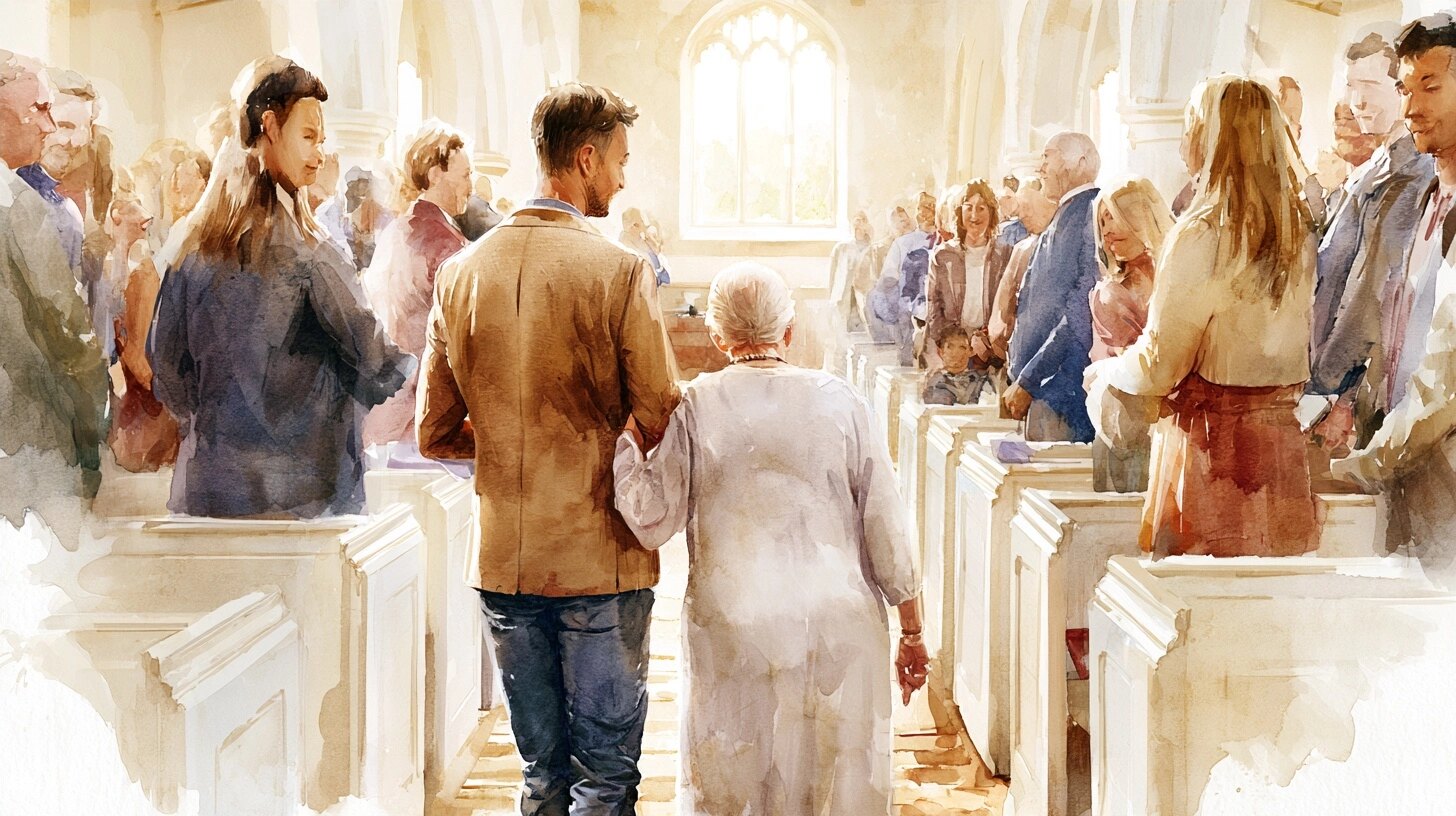
Grandparents do walk down the aisle, but not in the procession with the bride. In the usual order they are among the last people seated before the ceremony starts, so they have a place of honour at the front without having to make an entrance.
The order below is the one wedding etiquette guides commonly describe for a church or a civil ceremony. In a traditional British wedding the ushers show grandparents to their seats along with the rest of the close family, after most guests are in. A separate, announced walk for each grandparent, with an usher escorting each grandmother in turn, is more often described in American etiquette guides. You can borrow it if your grandparent would enjoy the moment.
None of this is a rule. The Church of England says there are no legal requirements for how the bride enters the church, and the same freedom applies to everyone who comes in before her. At a register office or an approved venue, the order is whatever you agree with the registrar. So if your grandparent is frail, you can keep the honour of the front row and drop anything that makes the start of the day harder for them.
The order people come in, and what changes for a frail grandparent
Times are counted back from the start of the ceremony. Families change this order all the time, and none of it is a legal requirement.
About 45 minutes before
The usual order
The ushers arrive, hand out the order of service and show guests to their side: the bride’s family on the left facing the front, the groom’s on the right.
For a frail grandparent
Your grandparent arrives now, or earlier, before the doorway fills up. Their named usher meets the car, walks them in at their own pace and sees them into the reserved seat.
About 30 minutes before
The usual order
The groom and best man take their places at the front.
For a frail grandparent
This is a good time for a last trip to the toilet, with the seat kept for them. Check the walking aid has a place to go that does not block the aisle.
30 to 10 minutes before
The usual order
Guests come in and are seated, filling the rows from the front.
For a frail grandparent
Your grandparent is already settled, with water, a cardigan and their helper next to them, so nobody squeezes past their knees in a crowded row.
About 10 minutes before
The usual order
Where grandparents are walked in as part of the ceremony, they come now: the groom’s first, then the bride’s, each escorted by an usher or a grandchild.
For a frail grandparent
If a short walk in front of everyone matters to them, make it from a seat near the back to the front row rather than the full length of the room, and let them stop to sit if they need to.
About 5 minutes before
The usual order
The groom’s parents take their seats, and the mother of the bride comes in last of the family, which tells the room the bride has arrived.
For a frail grandparent
Their helper stays in the seat beside them. Nobody should need to move along the row to make room for the parents.
The ceremony begins
The usual order
Guests stand as the bride comes in with whoever is walking with her, with the bridesmaids before or after her.
For a frail grandparent
Your grandparent stays seated if standing is hard. Tell the officiant beforehand so they can say that anyone who prefers to sit is welcome to.
Most of the notes for a frail grandparent come down to one idea: get a frail grandparent into their seat early, with someone beside them, before the room fills up. If you are still at the stage of choosing the venue and talking things through with your grandparent, the guide to planning a wedding with an older or disabled guest is the place to start.
Who walks them in
Who walks grandma down the aisle
Traditionally an usher walks each grandmother to her seat, with her husband following. Today it is whoever she will feel safest with, and for a frail grandparent that choice matters more than who looks right in the photographs.
Think about what the walk involves. Someone who walks well and only needs an arm for confidence can go in with any usher. Someone who uses a stick or a frame, who gets dizzy when they stand, or who is muddled in a new place needs a person they know, who will walk at their pace and who will not leave them once they are seated.
An usher
The traditional choice
A grandchild
A familiar face
Their husband, wife or partner
If both are steady
The person who usually helps them
If they are free
On their own, or seated early
Their choice
Whoever you choose, give them the whole job rather than only the walk. The person who brings your grandparent in should sit beside them through the ceremony, take their arm at the end and stay with them while the photographs start. And ask your grandparent first. The question "who walks grandma down the aisle" is one she may have an opinion on, and being asked is part of being included. There are more ideas for giving a grandparent a part in the day in ways to include a frail grandparent in the wedding.
Where they sit
Where grandparents sit at the ceremony, and the seat to keep for a frail one
Grandparents traditionally sit in the first or second row on their own family's side, behind or beside the parents. For a frail grandparent, choose the exact seat within that row with care.
In a church the bride's family sits on the left facing the front and the groom's on the right. Civil ceremonies at approved venues can follow the same pattern, though some couples ask guests to sit on either side. Grandparents go in the front row with the parents, or in the second row if the front is taken by the wedding party. The difference for a frail grandparent is which seat in that row is theirs.
| The seat to keep | Why it helps | |
|---|---|---|
| A church with pews | The aisle end of the front or second pew on their family's side, with a reserved card on it. | They do not have to shuffle along a pew past other people's knees, and they can get out for the toilet without disturbing the row. |
| A civil ceremony with rows of chairs | The aisle chair in the front row, ideally a chair with arms swapped in for the day. | Arms on a chair make standing up and sitting down much easier. Ask the venue whether they have one. |
| A wheelchair user | A space at the end of a row made by taking one chair out, with the companion chair next to it. | They sit with the family rather than in the aisle or at the back, and their helper is beside them. |
| Someone with dementia or who tires quickly | The aisle end of the second row, nearer a side door. | They can leave without fuss if they become unsettled, without walking past the couple in the middle of the vows. |
| A grandparent with hearing loss | The front row on the side nearest whoever is leading the ceremony. | They can see faces and hear the vows. Ask whether the venue has a hearing loop and where it works best. |
A church with pews
- The seat to keep
- The aisle end of the front or second pew on their family's side, with a reserved card on it.
- Why it helps
- They do not have to shuffle along a pew past other people's knees, and they can get out for the toilet without disturbing the row.
A civil ceremony with rows of chairs
- The seat to keep
- The aisle chair in the front row, ideally a chair with arms swapped in for the day.
- Why it helps
- Arms on a chair make standing up and sitting down much easier. Ask the venue whether they have one.
A wheelchair user
- The seat to keep
- A space at the end of a row made by taking one chair out, with the companion chair next to it.
- Why it helps
- They sit with the family rather than in the aisle or at the back, and their helper is beside them.
Someone with dementia or who tires quickly
- The seat to keep
- The aisle end of the second row, nearer a side door.
- Why it helps
- They can leave without fuss if they become unsettled, without walking past the couple in the middle of the vows.
A grandparent with hearing loss
- The seat to keep
- The front row on the side nearest whoever is leading the ceremony.
- Why it helps
- They can see faces and hear the vows. Ask whether the venue has a hearing loop and where it works best.
Put a named card on the seat and tell the ushers it is held. A reserved seat is easily taken by an early guest who does not know.
Seating at the reception needs a different kind of thought: a table near the toilets and the door, away from the speakers and the dance floor, with a good view of the speeches. That is covered in full in where grandparents should sit at the ceremony and the reception.
Walking aids and the aisle
Walking aids, wheelchairs and the aisle itself
The aisle is the stretch of floor your grandparent has to cross with everyone watching. It is worth walking it yourself at the venue visit, looking for the things that make a short walk harder than it needs to be.
A frame or a stick is nothing to hide, and asking a grandparent to leave theirs behind for the photographs makes a fall more likely. The NHS advice on preventing falls includes wearing shoes that fit well, do not slip off and have a good grip, and considering a walking aid. Both apply on the day, and both may mean new wedding shoes are worn in for a few weeks first. If your grandparent's walking aid no longer suits them, how to choose a walking aid explains the options, and the guide on fear of falling may help if the worry about the walk is bigger than the walk itself.
What helps
- Walk the route from the car to the seat at the venue visit, counting the steps and noting any slope or threshold
- Ask the venue to put a chair at the end of the aisle or halfway along if the walk is long
- Keep the walking aid with them and find a place to rest it beside the seat, out of the aisle
- Choose shoes with a low heel and a grip, worn in beforehand
- Ask the venue about ramps or another entrance if there are steps, since venues have a duty to make reasonable adjustments for disabled people
What makes the aisle harder
- Petals, confetti or a loose runner on a polished floor before the grandparents have walked in
- A long, slow walk the full length of the room when a short one from a nearby seat would do
- Asking them to leave the stick or frame outside so it does not show in photographs
- Gravel paths, wet grass or a step down into a marquee with no one on their arm
- Hurrying them because the music has started, when the organist or the playlist can wait for them
Under the Equality Act 2010, venues and other service providers have a duty to make reasonable adjustments for disabled people, which can mean changing how they do things or providing an extra aid. In practice that is a conversation with the venue coordinator: ask for a chair with arms, a ramp, the step-free entrance or a nearer drop-off point, and give them notice. The accessible wedding venue checklist has the full list of questions to ask on the visit.
If your grandparent manages a few steps but not a long walk, a wheelchair for the day lets them save their energy for the parts that matter. You can hire a wheelchair for a wedding day rather than buy one. And if the grandparent in a wheelchair is a parent who is walking the bride in, the aisle, the first dance and the photographs need their own plan, which is set out in walking down the aisle with a parent in a wheelchair.
Arriving and the vows
Arriving before the bride, and sitting through the vows
The half hour before a ceremony is the busiest time at the door. A frail grandparent who arrives in the middle of it may have to queue in the doorway and then walk faster than is comfortable. Arriving earlier, while it is quiet, avoids that.
Guests stand when the bride comes in, and often again for the vows or a hymn. For an older person that can be the hardest part of the ceremony. The NHS advises people with low blood pressure to get up slowly from sitting to standing and not to stand for long periods, because some people feel light-headed when they stand up. A grandparent who stays seated while everyone else stands is doing the sensible thing, and it is worth telling them beforehand that the couple want them to.
- 1
Arrive well before the other guests
About 45 minutes beforeDrop them as close to the door as you can. Ask whether the car can wait at the entrance while they get out, then park. A quiet arrival with the ushers is much easier than joining a queue in the doorway. - 2
Go to the toilet before sitting down
About 30 minutes beforeFind the accessible toilet when you arrive and use it before the ceremony starts. Ask the registrar or the minister how long the ceremony will last, and plan for that long in the seat without a break. - 3
Settle them in the reserved seat
Before the room fillsWater, a cardigan or a blanket, any tablets due during the ceremony, a hearing aid switched on, and the walking aid beside the seat. Their helper sits next to them. - 4
Tell the officiant
Before the dayAsk the person leading the ceremony to say that anyone who would rather sit is welcome to. It takes the pressure off your grandparent and anyone else who finds standing hard. - 5
Stay seated until the aisle clears
After the ceremonyOnce the couple have walked out, the room empties in a rush. Let it go. Your grandparent can follow when the aisle is clear, on the same arm that brought them in.
If your grandparent has dementia, the arrival and the wait before the ceremony can be when they are most unsettled, because the place is new and the room is noisy. Keep the wait short, and have a familiar person beside them in a seat near a side door. Taking a parent or grandparent with dementia to a wedding covers the whole day, including how long to stay.
After the ceremony
Who stays with them once the ceremony is over
The walk in is ten minutes of the day. A wedding can run for ten hours or more, and the moments that need planning come straight after the ceremony, when the family is called away for photographs.
The person who walks your grandparent in may be needed somewhere else as soon as the ceremony ends. That is when a frail grandparent can find themselves standing alone in a doorway. Plan the hours after the ceremony before the day, with a named person for each part.
- Ceremony ends
Out of the room, once it has cleared
The same helper takes their arm and walks them out, then finds them a seat in the shade or indoors.
- Photographs
Family photos first, while they have energy
Ask the photographer to take the grandparents' pictures at the start, with a chair for them in the shot if standing is hard. Then they can sit down.
- Drinks reception
Someone stays with them through the drinks
An hour or more of standing, sometimes outside, with everyone busy. Someone sits with them, brings a drink and food, and offers the toilet.
- The meal
A seat at a table near the door and the toilets
With someone they know beside them, and their tablets if a dose is due.
- Going home
An agreed time and an agreed driver
Decide in advance who takes them home and when. Leaving before the evening party is perfectly fine, and it is easier when the time is agreed in advance.
One good way to cover it is to share the day out in short shifts, with one person in charge of the plan. Looking after an elderly relative at a wedding sets out an example rota, from getting ready in the morning to getting home, with a hand-over note that passes from one helper to the next. It also covers the toilet, medicines and the journey home.
Sometimes nobody in the family can give the whole day to it. The person who usually helps your grandparent may be the mother of the bride, the grandchildren may all be in the wedding party, and the help needed may include the toilet or getting in and out of a wheelchair. Then it is worth looking at a wedding carer who stays with them all day, from the journey there to the journey home. On PrimeCarers, £350 covers one carer for an agreed wedding assignment of up to 12 hours, and longer days, overnight support and travel expenses are agreed separately.
Carers on PrimeCarers are self-employed, and PrimeCarers is an introductory service rather than a care agency. Before a carer appears on the site they have had an ID check, a right to work check, an enhanced DBS check issued within the last two years (PVG in Scotland, Access NI in Northern Ireland) and an online interview. Carers are covered by the insurance we arrange for visits booked through PrimeCarers, within its terms (no clinical procedures). Their experience and training are their own account on their profile, so ask each carer about the help your grandparent needs and check it with them.
Questions
Questions families ask about grandparents and the aisle
In the usual order, grandparents are seated about ten minutes before the ceremony, after most guests are in and before the parents of the couple. In the formal order the groom's grandparents come in before the bride's. The mother of the bride is the last family member to be seated, just before the bride arrives. A frail grandparent can be seated earlier, before the room fills up.
They can, but they do not have to. In a traditional British wedding the ushers show grandparents to their seats at the front with the rest of the close family. Some couples give each grandparent a short walk to the front as part of the ceremony. There is no legal requirement either way, so do whatever suits your grandparent best.
Traditionally an usher, with grandad following. Today it can be a grandchild, her husband or partner, or the person who usually helps her. For a frail grandmother, choose someone steady who knows how she moves and who will sit with her once she is in her seat, rather than leaving her there.
In the first or second row on their own family's side, with the bride's family on the left facing the front and the groom's on the right in a church. For a frail grandparent, keep the aisle seat at the end of the row, close to a way out and with room for a walking aid. Seating at the ceremony and the reception has more.
No. Guests usually stand when the bride enters, but anyone who finds standing hard can stay seated. Ask the person leading the ceremony to say so before the bride arrives. If your grandparent wants to stand for the vows, have someone stand with them with the chair right behind them.
Yes. A civil ceremony in England and Wales needs at least two witnesses, who sign the paperwork with the couple and the registrar afterwards. A grandparent can be one of them. Ask the registrar or the person leading the ceremony what a witness needs to do, and make sure they can sign seated at the table.
There is no fixed role. Grandparents are guests of honour, seated near the front and usually included in the family photographs. Some do a reading, give a short toast or walk the bride in. For a frail grandparent, choose a part that suits their energy, and plan who will be with them through the rest of the day.