
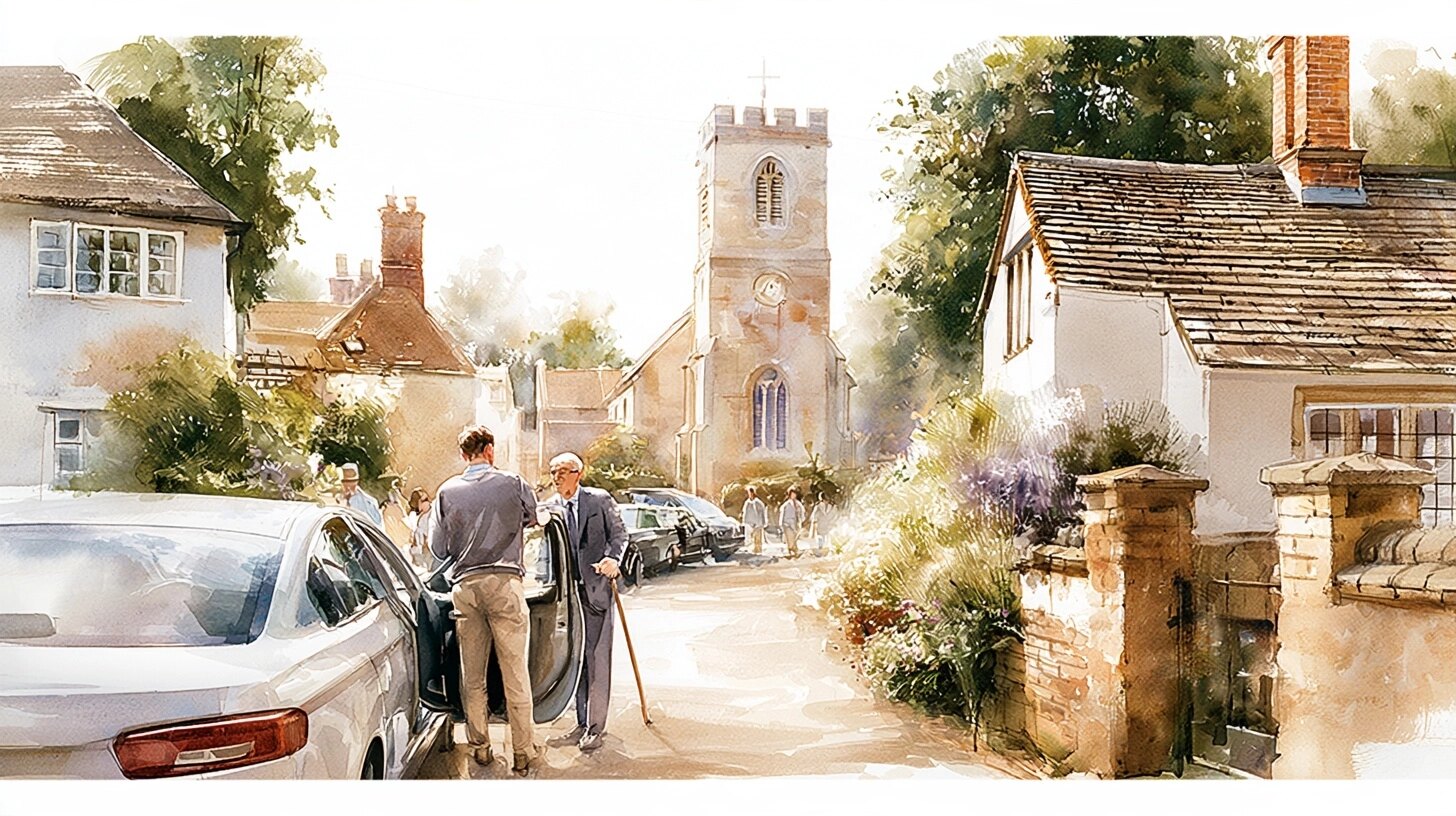
The short answer
- Choose the vehicle by how they get in and outSomeone who can stand and turn into a car seat can travel in the family car. Someone who has to stay in their wheelchair needs a wheelchair accessible vehicle, booked weeks ahead.
- Taxi drivers must help without charging moreIn England, Scotland and Wales, taxi and private hire drivers must give a disabled passenger reasonable help getting in and out and with a wheelchair, at no extra charge.
- A Blue Badge does not guarantee a space at the venueHotel and venue car parks set their own rules. Ask the venue for a space near the door, or a place to drop off at the entrance, before the day.
- Name one driver who will not drinkAgree who drives, when they will leave, and how your relative tells you they have had enough. Settle it before the day, not at the reception.
- Plan the journey home with the same careBy the evening your relative will be tired, getting in and out of the car will be harder, and it may be dark. Someone should go into the house with them and stay until they are settled.
The rules on taxis and Blue Badges here are for England unless the text says otherwise. Scotland, Wales and Northern Ireland differ in places. October 2026.
Choosing the transport
Choose the transport by how they get in and out of a car
Distance and dress code matter less than you might expect. What decides the transport is how your relative gets into a vehicle and out again, and how that will change by the end of a long day.
Before you book anything, watch your relative get into a car on an ordinary day. Notice whether they can stand from a chair, turn and lower themselves onto the seat, and lift their legs in. That tells you more than any list of options, and doing it a few weeks ahead leaves time to book something different. If you are at the start of the planning, planning a wedding with an older or disabled guest sets out the order to do things in, and the journey is one of the first things to settle.
Find the row below that sounds most like your relative.
Walks short distances with a stick or frame
- What usually works
- The family car or an ordinary taxi, with the front passenger seat pushed back so there is room for their legs.
- What to arrange
- Ask the venue whether a car can pull up at the entrance, so the walk is from the car door to a chair and no further.
- What to watch for
- A low sports car or a tall four by four is harder to climb in and out of than an ordinary hatchback. Keep the walking aid in the same car as them.
Uses a wheelchair but can stand and turn into a car seat
- What usually works
- A car with a seat at about hip height, or any taxi, with the folded wheelchair in the boot.
- What to arrange
- Fold the wheelchair into the boot of the car you will use before the day. A taxi or private hire driver must help load it without charging extra.
- What to watch for
- Standing and turning gets harder as the day goes on, so the transfer at the end of the evening is the one to plan for.
Needs to stay in the wheelchair, or uses a hoist at home
- What usually works
- A wheelchair accessible taxi, a wheelchair accessible vehicle hired for the day, community transport, or a specialist wheelchair accessible wedding car.
- What to arrange
- Book weeks ahead and give the wheelchair's width and the height of your relative sitting in it. Ask about the ramp or lift, the headroom, and the straps that hold the chair down.
- What to watch for
- The chair must be suitable for travelling in, fixed to the floor in line with the direction of travel, and your relative needs a separate seat belt fixed to the vehicle.
Has dementia or gets anxious when travelling
- What usually works
- A car they know, driven by someone they know, with a familiar person sitting next to them.
- What to arrange
- If a taxi has to be used, ask the firm whether the same driver can do both journeys, and tell them about the dementia when you book.
- What to watch for
- Being hurried out of the house, and then waiting outside in a crowd. Arrive when the venue is still quiet, and know how you will leave if they become distressed.
A few situations change the choice. If your relative uses a hoist to move between bed and chair at home, they cannot be lifted into an ordinary car seat on the day, and they will need a vehicle they can stay seated in. Transfers, hoists and two carers explains why a hoist transfer needs the right equipment and the right number of people. If they walk at home but would struggle with the distances at the venue, a wheelchair for the day may be the answer, and hiring a wheelchair, scooter or commode for a wedding covers where to get one and how to check it fits in the car.
If your relative lives in a care home, the home will have its own arrangements for outings, and some homes have a minibus or know a local accessible taxi firm. Speak to the manager early. Bringing a relative from a care home to a wedding covers the conversation with the home and what to agree about collection and return times.
Wheelchair accessible wedding carsSection titled Wheelchair%20accessible%20wedding%20cars
Some wedding car firms have vehicles with a ramp or a lift. These are worth looking for when your relative is part of the ceremony, for example a father who uses a wheelchair and is travelling with the bride. For a guest who only needs to get there and back, a wheelchair accessible taxi or a hired vehicle does the same job.
Accessible taxis and vehicle hire
Booking an accessible taxi or a wheelchair accessible vehicle
When the family car will not do, there are three main choices: a taxi or private hire firm, a wheelchair accessible vehicle hired for the day, or community transport. Each needs booking well ahead, and each has its own questions to ask.
What taxi and private hire drivers must doSection titled What%20taxi%20and%20private%20hire%20drivers%20must%20do
The Taxis and Private Hire Vehicles (Disabled Persons) Act 2022 added new duties to the Equality Act 2010. Since 28 June 2022, in England, Scotland and Wales, when a taxi or private hire vehicle is booked by or for a disabled passenger, the driver must carry them, carry their wheelchair or other mobility aid, and give reasonable help getting into and out of the vehicle and with loading the wheelchair and luggage. They must make sure the passenger travels in safety and reasonable comfort, and they cannot charge extra for any of this. The Department for Transport's guidance, Access to taxis and private hire vehicles for disabled users, explains how councils enforce this.
That law makes a taxi a dependable option for someone who can transfer to a car seat. It does not mean every taxi can carry a person who has to stay in their wheelchair, so when you book, say clearly that you need a wheelchair accessible vehicle and that your relative will travel seated in the chair.
Hiring a wheelchair accessible vehicle for the daySection titled Hiring%20a%20wheelchair%20accessible%20vehicle%20for%20the%20day
Some vehicle hire firms rent out wheelchair accessible vehicles on a self-drive basis, which lets a family member drive. Ask the firm who is allowed to drive under their insurance, and ask for someone to show you how the ramp or lift and the wheelchair straps work. Practise loading the chair once before the day if you can.
Community transportSection titled Community%20transport
Community transport schemes are run by charities, community groups and some councils for people who find ordinary buses and taxis difficult, and some use accessible minibuses and cars. The Community Transport Association map lists operators across the UK. Schemes differ in where they go, when they run and who can use them, so contact your local scheme early and ask whether they can help with a weekend or evening journey.
Questions to ask when you book
0 of 7 ticked
Any taxi or private hire firm
Self-drive wheelchair accessible vehicle hire
Community transport
Blue Badge and drop-off
Blue Badge parking and drop-off at the venue
Wedding venues such as hotels, country houses, barns and churches usually have their own car parks, and the Blue Badge rules for streets do not automatically apply on private land. Ask the venue before the day rather than finding out on arrival.
The badge goes with your relative
In any car they travel in
Private car parks set their own rules
Hotels, venues and some churches
Yellow lines near the venue
Up to 3 hours in England
Only use it when they are in the car
A criminal offence otherwise
The source for these rules is the government's guide, the Blue Badge scheme: rights and responsibilities in England. The scheme runs separately in Scotland, Wales and Northern Ireland and the street parking rules differ, so check the local rules if the wedding is in another part of the UK. Applications in England, Scotland and Wales start on the apply for a Blue Badge page, and in Northern Ireland at nidirect. If your relative does not have a badge yet, apply as early as you can, since the council has to assess the application before a badge is issued.
Ask for a drop-off at the doorSection titled Ask%20for%20a%20drop-off%20at%20the%20door
Ask the venue whether a car can drive right up to the door of the ceremony room and the reception, whether the route from there is step-free, and where the driver should then park. Your relative then goes straight from the car to a seat while the driver parks. The accessible wedding venue checklist has the other questions to ask on the same call, about steps, toilets and a quiet room.
If the ceremony and the reception are in different places, you have two arrivals to plan, and the second one usually happens with everyone else leaving at once. Ask the driver to wait until the crowd has gone, or to leave a few minutes before the rest of the guests, so your relative is not standing in a queue of cars.
Who drives and leaving early
Who drives, when to arrive and the plan for leaving early
The journeys work best when one person is responsible for them from start to finish, and everyone knows the plan for going home before the day begins.
One driver who will not drinkSection titled One%20driver%20who%20will%20not%20drink
Choose a driver who will not drink at all, and tell them before the day that this is their job. The government's drink drive limit page says it is impossible to say how many drinks keep a person under the limit, because it varies so much from person to person. The limit in Scotland is lower than in England, Wales and Northern Ireland. The simplest arrangement is a driver who stays on soft drinks, or a taxi booked for the journey home.
It can be kinder to choose a driver who is not one of the people the couple most wants to celebrate with. A cousin or a friend who is happy to leave early may suit better than the guest's own son, who might be making a speech.
An early-leave plan, agreed beforehandSection titled An%20early-leave%20plan%2C%20agreed%20beforehand
Talk to your relative before the day about how long they want to stay. Agree a time to check how they are, and a simple way for them to say they have had enough, so they are not left trying to find the right moment to interrupt somebody. If they are living with dementia, watch for signs of tiredness or distress rather than relying on them to tell you. Taking a parent or grandparent with dementia to a wedding covers this in more detail.
Here is how the journeys might fit around a wedding with a ceremony at two o'clock.
- Day before
Get the car ready
Fill the tank, fold the wheelchair into the boot to check it fits, and put the Blue Badge and the parking clock in the glovebox. Pack a bag with medicines, a spare layer, continence products and a bottle of water.
- 12.15
Leave home in good time
Leave with time to spare, so nobody is hurrying your relative into the car.
- 1.15
Drop off at the door
Arrive while the venue is still quiet. Someone meets your relative at the entrance and takes them to their seat while the driver parks.
- 3.30
Move to the reception
If the reception is elsewhere, the same driver takes them before or after the rush.
- 6.30
Check how they are
After the meal and the speeches, ask whether they want to stay or go. This is the natural point to leave for anyone who is tiring.
- 8.30
The latest time in the plan
Agree in advance that by this time you will go home whatever happens, unless your relative is clearly enjoying themselves and wants to stay.
- 9.15
Home and settled
Into the house, evening medicines, a drink and help getting ready for bed. Someone stays until they are settled.
Write the times, the driver's name and phone number, and the taxi firm's number into the plan for the day, so everyone helping has the same information. The wedding day care plan template is a good place to keep it. For toilet stops on the way, toilets, continence and medicines across a long wedding day covers what to pack and how to plan breaks. If the wedding is more than a couple of hours away, a wedding far from home with an older relative covers the longer journey and an overnight stay.
The journey home
Getting them home safely when they are tired
The journey home is easy to leave until last, and it can be the hardest part of the day for an older guest. By then they are tired, and the person who brought them may well be enjoying the party.
What helps on the way home
- Book the taxi home, or confirm the driver, before the day
- Have the car parked near the door and warmed up before your relative goes outside
- Go into the house with them, put the lights and heating on, and help with evening medicines
- Stay until they are in bed or settled in their chair, and arrange for someone to check on them the next morning
What tends to go wrong
- Leaving the journey home to whoever is sober at the end of the night
- Dropping them at the front door and driving off before they are inside
- Forgetting that their usual evening routine, and their usual carer visit, may have been missed
- Expecting them to manage the stairs or the bathroom alone after a much longer day than usual
Tiredness makes a fall more likely, so leave a hall light on before you set out and keep the route to the bathroom clear. If your relative is already nervous about falling, fear of falling explains how that worry shows itself and what helps. If they normally have a carer visit in the evening, tell the carer about the wedding in advance so the visit can be moved rather than missed.
Who will do all of this on the day?Section titled Who%20will%20do%20all%20of%20this%20on%20the%20day%3F
At this point some families realise that the person who usually looks after their relative is the same person who wants to be at the wedding as a guest: the mother of the bride, or the groom's father. If nobody else can be the driver, the companion and the person who leaves early, one option is a wedding carer who stays with them all day, from getting ready in the morning to being settled at home at night. Whether a carer drives, and in whose car, is agreed with them in advance. A carer who drives a client needs business use cover, on their own policy or as a named driver on yours, which carer car insurance explains. Under the PrimeCarers contract, travel expenses are only charged if they are agreed in advance and in writing.
Questions
Questions families ask about getting an older guest to a wedding
It depends on how they get in and out of a vehicle. If they can stand and turn into a car seat, the family car or an ordinary taxi is usually the most comfortable, with a driver they know. If they need to stay in their wheelchair, book a wheelchair accessible taxi, hire a wheelchair accessible vehicle, or ask your local community transport scheme. Whatever you choose, arrange a drop-off at the venue door and plan the journey home before the day.
Yes. Some wedding car firms have cars with a ramp or a lift, including classic-style vehicles. They are worth finding if your relative is part of the bridal procession. For a guest who only needs to get there and back, a wheelchair accessible taxi or a hired wheelchair accessible vehicle does the same job. Ask any firm whether the wheelchair is strapped to the floor and whether your relative will have a separate seat belt.
Not automatically. Government guidance for England says it is up to the owner of an off-street car park whether Blue Badge holders can park free, and warns not to assume you can. Wedding venues are usually on private land, so ask the venue in advance about disabled spaces, any charge, and whether a car can drop your relative at the door.
In England, Scotland and Wales, when a taxi or private hire vehicle is booked by or for a disabled passenger, the driver must carry them and their wheelchair, help them in and out, and help load the wheelchair, without charging extra. Not every vehicle can carry someone who stays seated in their chair, so say when you book that you need a wheelchair accessible vehicle. The law is different in Northern Ireland.
Only in a vehicle designed for it. NHS wheelchair services recommend moving to a vehicle seat where possible. If your relative has to stay in the chair, it should be crash tested, strapped to the floor in line with the direction of travel, and they need a seat belt fixed to the vehicle, not just the strap on the wheelchair. Their wheelchair service can tell you whether their chair is suitable.
Plan for it. Agree before the day who will take them, keep that person off the alcohol, and have a taxi number that answers on a Saturday evening. Agree a time to check how they are, usually after the meal and the speeches, and a simple way for them to tell you they are ready to go.
That is agreed with the carer before the day, including whose car is used and whether they have business use on their insurance. £350 covers one carer for an agreed wedding assignment of up to 12 hours, and travel expenses are agreed separately. How wedding carers work has the details.