
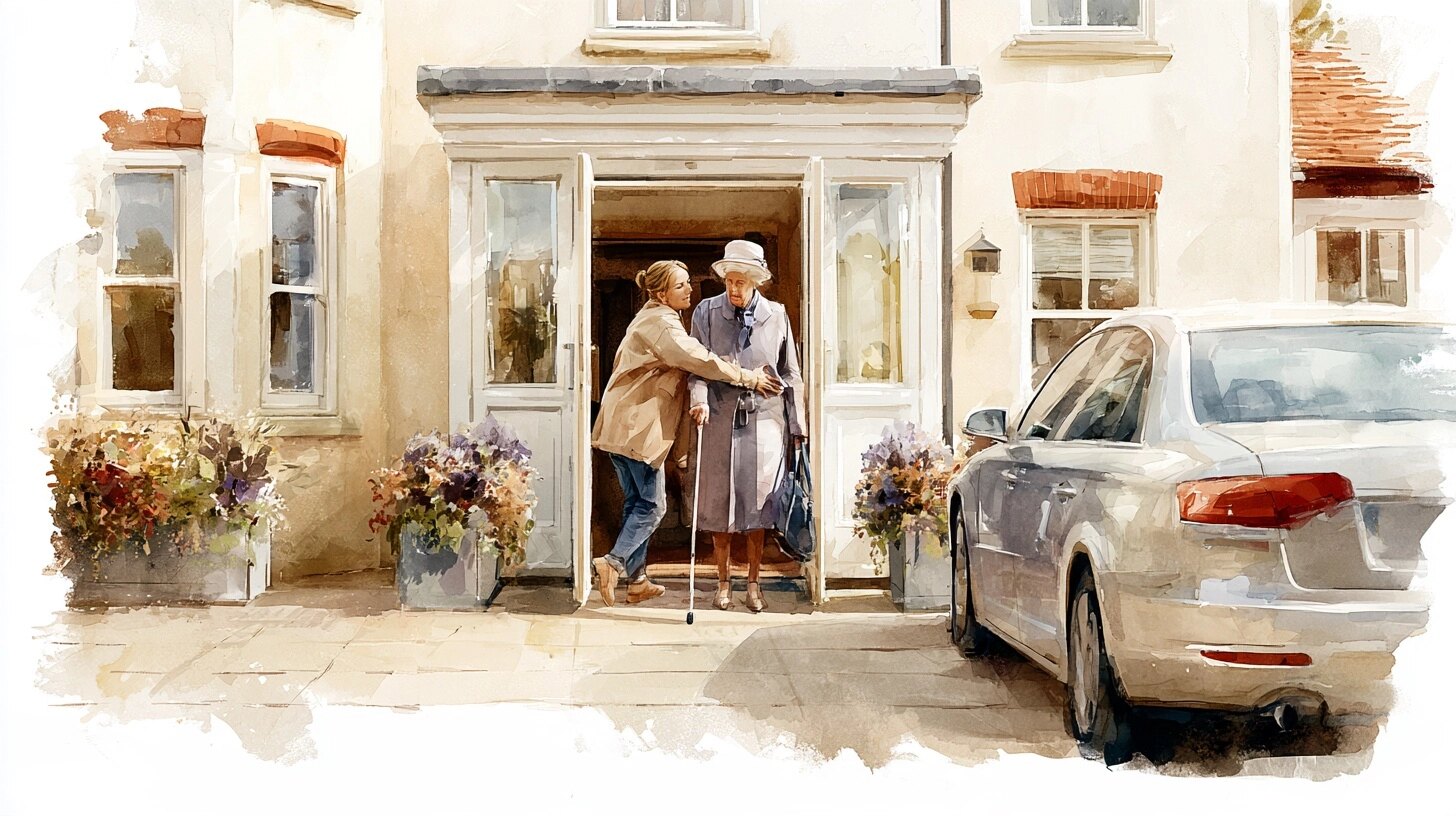
The short answer
- They can go if they want toIn England the home must not discourage a resident from going out with family, unless there are exceptional circumstances.
- Talk to the manager six weeks aheadThat gives the home time to update the care plan, order medicines and plan the morning around your collection time.
- The home packs the medicinesYou should leave with the medicines, written directions, the time of the last and next dose, and a number to ring.
- Staff may not be able to comeThe home has to keep enough staff for everyone else, so plan for a family member, a friend or a paid carer to stay with them.
The rules described here apply to care homes in England. Homes in Wales, Scotland and Northern Ireland have their own regulators, and the manager can tell you the home's policy.
Can they go?
A care home resident can go to a wedding, and the home should help
People sometimes assume that once someone has moved into a care home, a day out needs special permission. It does not. The question to settle is how your relative goes safely, not whether they are allowed.
Since April 2024, care homes in England have had to follow Regulation 9A of the care regulations, which covers visits and going out. It says residents must not be discouraged from taking visits out of the home unless there are exceptional circumstances. The Care Quality Commission's guidance adds that a home should not make going out difficult, for example with lengthy paperwork before and after, and that decisions should be supported by a risk assessment and good care planning.
The person who decides whether to go is your relative. If they can understand the choice and want to come, that is their decision, even if the family or the staff have worries. The law says a person must be assumed to have capacity unless it is shown otherwise, and that making a choice others think unwise does not mean they lack it. If dementia or illness means they cannot make this decision, it is made in their best interests, with the family involved, and how mental capacity is assessed explains how that works. If you are still deciding whether the day would be good for someone with dementia, how families decide whether someone with dementia should come goes through it.
Words the home may use
- Regulation 9A
- The rule, in force in England since 6 April 2024, that care homes must not discourage residents from going out with family and friends unless there are exceptional circumstances.
- Risk assessment
- The home's written look at what could go wrong on the day and what will reduce it, such as who goes with your relative, the journey and their medicines. Ask to see it and add to it.
- Mental capacity
- Whether your relative can understand, weigh up and communicate this particular decision. It is judged decision by decision, and a diagnosis alone does not settle it.
- Best interests decision
- If your relative cannot make the decision, whoever is making it must act in their best interests, weighing up their past and present wishes and feelings and talking to the family.
- DoLS authorisation
- A council authorisation for someone who lacks capacity to decide where to live and is not free to leave the home permanently. It can carry conditions, which the home must follow, so ask whether any affect a day out.
If the home is reluctant, ask the manager to explain the reason in writing and what would make the day possible, such as a particular person going with your relative or a shorter visit. A restriction should be the least restrictive option and should be reviewed. If you still disagree, the home's complaints procedure is the next step.
Asking the home
How to ask the care home, and when to start
Start with a conversation with the manager or your relative's key worker, then put the details in an email so everyone works from the same plan. The earlier you ask, the more the home can do.
Explain the date, the venue, how long the day is, and who will collect your relative. Ask what the home will need from you and what it can do on its side. The home may have a form for outings, and it may want to update the care plan or risk assessment first. If the plan includes an overnight stay away, ask whether that changes anything in your relative's contract with the home.
- 6 weeks
Talk to the manager
Give the date, the venue, the timings and who will collect. Ask what the home needs and whether the care plan or risk assessment should be updated.
- 4 weeks
Settle who stays with them
Name the person who will be with your relative all day, and give the home their phone number. If that is a paid carer, arrange it now.
- 2 weeks
Medicines and the morning
Ask the home to make sure the medicines needed on the day are in stock. Agree the collection time, so staff can plan washing, dressing and breakfast around it.
- The week before
Confirm in writing
Send one email with the collection and return times, the venue address, the escort's number and anything the home has asked for. Mention any changes to the plan.
- The day
Sign out and set off
Collect the medicines, directions and contact sheet. Check the return time with the staff on shift, since they may not be the ones you spoke to.
- The day after
Ask how they are
Ring the home and ask how your relative slept and whether they seem tired or unsettled. Tell the staff anything from the day that they should know.
Write down the names of the staff you speak to and keep the plan in one email thread. On the day, the staff on duty may not be the people who agreed the plan, and a written plan saves your relative waiting in the hall while somebody checks.
What the home needs
What the home will ask of you, and what to ask the home for
A day out is an exchange of information in both directions. The home tells you how to look after your relative while they are away, and you tell the home how the day went when you bring them back.
The national guidance for care homes on managing medicines, from NICE, says that when a resident is away from the home for a short time, the home should have a process to make sure they have the medicines they need. It lists what the resident or their family should be given: the medicines, clear directions on how, when and how much to take, the time of the last and next dose of each, and a contact for questions, such as the home, the pharmacy or the GP. You can read it in NICE's guideline on managing medicines in care homes, section 1.14.
The medicines and written directions
From the home
Notes from the care plan
From the home
A contact sheet
Both ways
Equipment and spare clothes
Agree who brings what
Who is responsible, and when
Agree with the manager
Ask for the care plan notes even if the day seems simple. A resident who has been helped to the toilet in a particular way, or who eats a softened diet, needs the same at the wedding. Put everything on one page with the wedding day care plan template, and read toilets, continence and medicines across a long wedding day for the practical side of a ten-hour day away from home. If you are not sure whether the person with them can give a medicine, can carers give medication? explains what is and is not allowed.
Who goes with them
Why care home staff may not be able to come, and who can
It is natural to hope a familiar member of staff will come along. Some homes can arrange this and others cannot spare anyone, and it helps to understand why before you ask.
A care home has to have enough suitably skilled staff on duty to look after every resident; that is a legal requirement. A member of staff away for ten hours at a wedding is a gap on the rota that has to be filled. The CQC guidance on going out is clear that it is about the home not discouraging visits out, not about the home paying for them, and that where a resident already pays for extra staff to go out with them, that arrangement carries on. So if the home offers someone, ask whether the staff time is charged on top of the fees, and how much.
| Works well when | Worth thinking about | |
|---|---|---|
| A family member | They know your relative well, have nothing else to do that day, and can help with the toilet and medicines. | If they are a parent of the couple or in the wedding party, they will be pulled in two directions all day. |
| A close friend | Your relative is comfortable with them and they can stay for the whole day. | Personal care is a lot to ask of a friend. Agree beforehand exactly what they will and will not do. |
| A member of the home's staff | The home can release someone and your relative knows them. | Ask whether the staff time is charged on top of the fees. The home may only be able to spare someone for part of the day. |
| A paid carer for the day | Nobody in the family is free, or personal care is needed throughout. | Have a call or a meeting first, and share the care plan notes. Nursing tasks still need a nurse. |
A family member
- Works well when
- They know your relative well, have nothing else to do that day, and can help with the toilet and medicines.
- Worth thinking about
- If they are a parent of the couple or in the wedding party, they will be pulled in two directions all day.
A close friend
- Works well when
- Your relative is comfortable with them and they can stay for the whole day.
- Worth thinking about
- Personal care is a lot to ask of a friend. Agree beforehand exactly what they will and will not do.
A member of the home's staff
- Works well when
- The home can release someone and your relative knows them.
- Worth thinking about
- Ask whether the staff time is charged on top of the fees. The home may only be able to spare someone for part of the day.
A paid carer for the day
- Works well when
- Nobody in the family is free, or personal care is needed throughout.
- Worth thinking about
- Have a call or a meeting first, and share the care plan notes. Nursing tasks still need a nurse.
Whoever it is, give the home their name and number, and make sure they have the contact sheet and the medicines bag.
If the family member closest to your relative is also a parent of the bride or groom, they will have very little time to spare on the day. If nobody in the family can be free for the whole day, a wedding carer who stays with them from collection to the return is one way to do it. What a wedding chaperone or carer for an older guest does sets out what to expect and what to agree.
If your relative lives in a nursing home and has nursing needs, such as a feeding tube or injections, ask the nurse in charge what the person with them needs to know or do, and whether a registered nurse needs to be involved. PrimeCarers does not check nursing registration or training, so do not plan for a wedding carer to do nursing tasks. Any experience a carer describes is their own account on their profile, for you to check with them.
The day, door to door
Planning the day around the home's routine
A care home runs to a routine of meals, medicines and rest, and your relative's body is used to it. The more of that routine the day can keep, the better they are likely to feel by the evening.
- 1. MorningThe care home
Getting ready at the home
- What changes hands
- Staff help with washing, dressing and breakfast as usual, then pack the medicines with written directions and the time of the last and next dose.
- Worth watching
- Agree the collection time with the home in advance, so staff can plan the morning around it and your relative is not rushed.
- 2. CollectionThe person with them
Signing out and the journey there
- What changes hands
- The medicines bag, the contact sheet, the Blue Badge if they have one, the wheelchair or frame, a coat and a change of clothes.
- Worth watching
- Ask a member of staff to show you how they help your relative in and out of a car, and do it the same way.
- 3. CeremonyThe person with them
The service
- What changes hands
- A seat on the end of a row near the door, with the route to the accessible toilet already checked.
- Worth watching
- Offer the toilet before it starts. The person sitting with them is best someone with no part to play in the ceremony.
- 4. AfternoonThe person with them
Photographs, the meal and the speeches
- What changes hands
- Any medicines due at the times on the sheet, food and drink that suit their diet, and regular drinks of water.
- Worth watching
- Watch for tiredness, cold, noise and confusion. A quiet room to rest in for half an hour can be the difference between staying and leaving.
- 5. Agreed timeThe person with them
The journey back
- What changes hands
- Leave at the time agreed with the home, and ring ahead so the evening staff know when to expect you.
- Worth watching
- Gather the coat, the wheelchair and the medicines bag before the goodbyes start, so leaving does not drag on while they tire.
- 6. ArrivalThe care home
Handing back to the staff
- What changes hands
- Any medicines not used, which doses were taken and when, what they ate and drank, toilet visits, and anything that went wrong, including a stumble.
- Worth watching
- Ask the home to let you know how they were that night and the next day, and visit again soon if you can.
Think about which parts of the day matter most to your relative and the couple. For some families that is the ceremony and the photographs, with a return before the evening; for others it is the meal with the speeches. Arriving after the morning routine and leaving before the evening dancing is a full day for someone who usually rests in the afternoon. Make sure the plan allows for a rest and a quiet room, a toilet nearby and a seat out of the cold.
Transport needs the same thought. A Blue Badge belongs to the person, not the car, and the Blue Badge rules allow it to be used in any vehicle your relative travels in, including when someone is dropping them off or collecting them. Getting an older guest to and from the wedding covers cars, accessible taxis and wheelchair transfers. Ask the venue the questions in the accessible wedding venue checklist before the day, so you know where the step-free entrance, the toilets and the quiet room are.
Settling back in
Getting back to the home and settling in afterwards
The return deserves as much planning as the journey there. Your relative may be tired, overexcited or confused, and the evening staff need to know what has happened during the day.
Ring the home when you set off back, hand over properly, and stay until your relative is settled if they would like you to. Your relative may be unsettled for a day or two afterwards, particularly if they have dementia, and it helps to expect this so that it does not come as a shock. A difficult evening does not mean the day was a mistake. Family occasions and dementia has more on helping someone settle after a gathering.
What helps
- Leave the wedding before they are exhausted, even if the party is just getting going
- Ring the home when you set off, so staff can have a drink and their bed ready
- Hand over the medicines left, which doses were given and when, and what they ate and drank
- Tell the staff about any stumble, upset or change you noticed, however small
- Bring a few photographs or the order of service to talk about over the next few days
What tends to make it harder
- Staying for the evening because everyone is enjoying themselves, when your relative is fading
- Dropping them at the door and leaving before the staff know how the day went
- Forgetting to give back medicines that were not used
- Taking a difficult evening afterwards as a sign they should not have gone
If the home advises against the day, or your relative is not well enough when the date comes, there are still ways to include them. Bringing the wedding to a grandparent who cannot come covers visits in the wedding clothes, a video link and a small celebration at the home.
Questions
Questions families ask about a care home resident at a wedding
Yes. A care home is your relative's home, and in England Regulation 9A says the home must not discourage residents from going out with family and friends unless there are exceptional circumstances. If your relative can make the decision, it is theirs to make. If they cannot, it is made in their best interests with the family involved.
Only in exceptional circumstances, such as a significant risk to their health or safety that precautions cannot reduce. Any restriction should be the least restrictive option, explained to you and reviewed. If your relative has a DoLS authorisation, check whether it carries conditions that affect a day out. If you disagree with a decision, ask for the reasons in writing and use the home's complaints procedure.
Sometimes, but do not count on it. The home has to keep enough staff on duty for everyone else, and the CQC guidance says the rules on going out are not about the home paying for visits out. If the home can release someone, ask whether the staff time is charged on top of the fees. Plan for a family member, a friend or a paid carer instead.
Agree this with the manager before the day. In practice the person who takes your relative out looks after them from the time they leave until they are handed back to the staff. Agree those times, write them on the contact sheet, and make sure the person with your relative has the medicines, the directions and the home's phone number.
The home should give you the medicines needed for the day with clear directions, the time of the last and next dose of each, and a contact for questions. This is in the NICE guidance on managing medicines in care homes. Give back anything not used, and tell the staff which doses were given and when.
As long as they are comfortable, and no longer. Plan around the parts that matter most, often the ceremony, the photographs and the meal, and agree a return time with the home. Leaving before they are exhausted tends to make the evening and the next day easier for them.