
The short answer
- Adjustments are a legal dutyUnder the Equality Act 2010 health services must make reasonable adjustments, and they cannot charge the person for them. Ask for them to be recorded so they follow the person.
- Start with an ordinary dentistA general dental practice should make adjustments itself. If treatment cannot be done there, the dentist or another health professional can refer to the community dental service.
- Screening and everyday checksBowel, breast and cervical screening are taken up less by people with a learning disability. Adjustments help, and so does watching for constipation and weight gain.
- Ask whether each medicine is still neededSTOMP is the NHS programme to stop over-medication. The annual health check includes a medicines review, and you can ask the GP for one at any time.
This page is written for whoever is reading it: a parent, a brother or sister, a friend, or the person themselves. The person being treated has the first say in what they want.
Your right to adjustments
Reasonable adjustments are a legal duty, and you can ask for them
A reasonable adjustment is a change to the way a service works so that a disabled person is not put at a disadvantage. For an adult with a learning disability it can be small: more time, a quieter place to wait, plainer words. The law says the service has to make it.
Section 20 of the Equality Act 2010 sets out three duties. A service must change a way of doing things that puts a disabled person at a substantial disadvantage, change a physical feature that does the same, and provide extra help, which the Act calls an auxiliary aid, where that would avoid it. The service cannot charge the disabled person for any of this. The duty applies to GP surgeries, dental practices, hospitals and screening services alike, and NHS England's page on reasonable adjustments gives examples: easy read letters, a priority or longer appointment, a quiet space to wait.
Without a shared record, adjustments have to be asked for again at every new place, and the NHS has built a way round this. The Reasonable Adjustment Digital Flag is a marker on the person's national NHS record which shows the adjustments they need, so that any publicly funded health or social care service treating them can see it.
30 September 2026
The date by which every publicly funded NHS and social care service in England must be able to read, write and share the Reasonable Adjustment Digital Flag.
NHS England, What is the Reasonable Adjustment Digital Flag?
To use it, write down the adjustments your son or daughter needs, ask them which matter most, and ask the GP surgery to record them and add the flag. The details are on NHS England's page about the flag. The information is shared on the basis of implied consent, and the person can object to it being shared. Check that your son or daughter is also on the GP's learning disability register, which is what brings the annual health check from age 14. The wider picture of support is in the learning disability family guide and the disability care pillar.
What to ask for
What to ask for at the GP, the dentist, hospital and screening
Each kind of appointment has its own pressure points. The sheet below sets out the adjustments that help at each one, before, on the day and afterwards, and who to ask.
What to ask for, appointment by appointment
- Before
- On the day
- Afterwards
The GP surgery
Before
- The first or last appointment of the day, or a double appointment, so nobody is rushed.
- A letter or text in easy read, and a reminder the day before.
On the day
- Somewhere quiet to wait, or waiting outside until the doctor is ready.
- The doctor talks to your son or daughter first, in plain words, and checks they have understood.
Afterwards
- What was decided, written down simply, with what any new medicine is for.
Who to ask: Ask the receptionist or the practice manager, and ask for it to be written on the record.
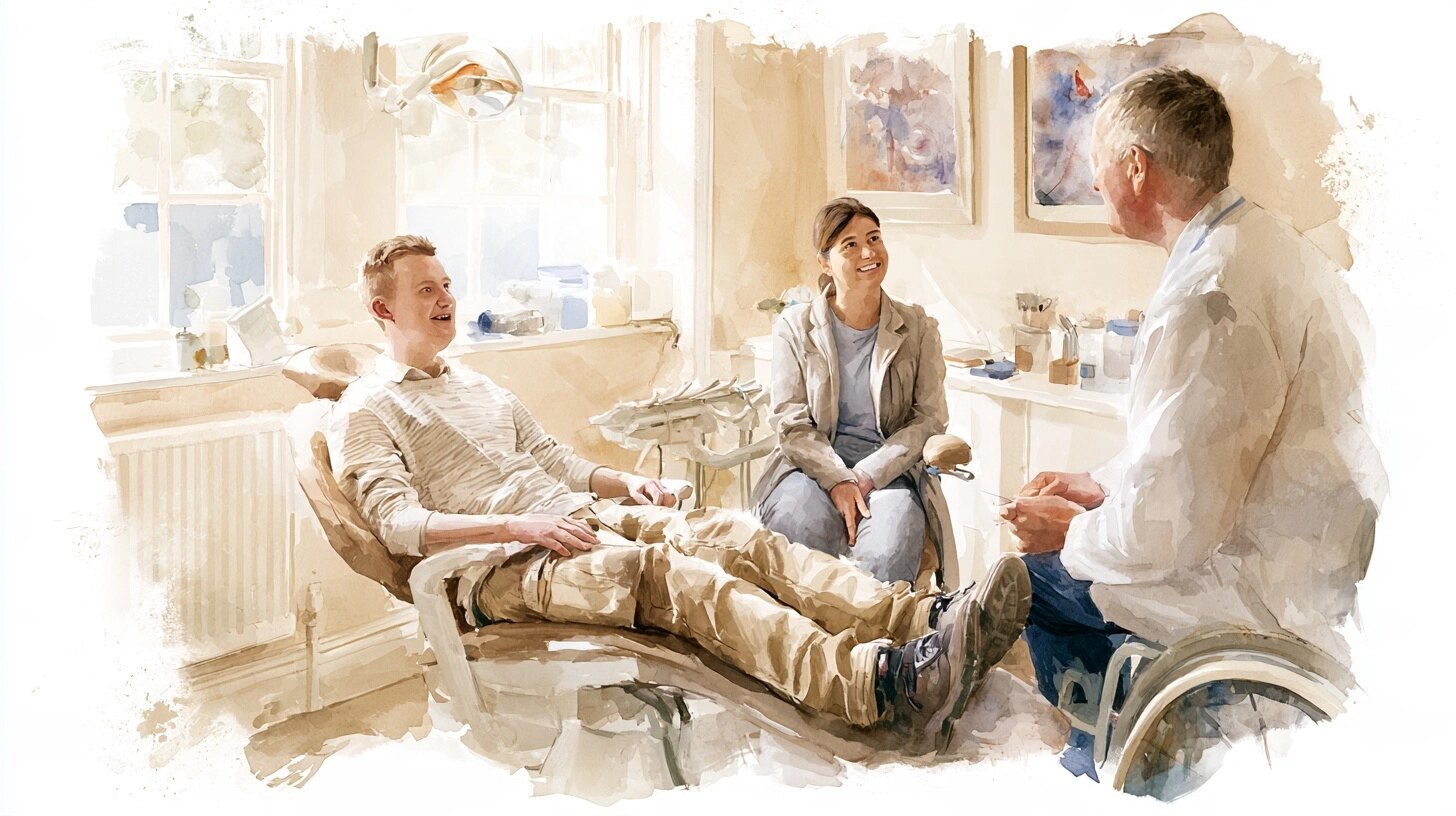
The dentist
Before
- A visit to see the room, meet the dentist and sit in the chair, with no treatment.
- Photos of the surgery and the dentist to look at at home.
On the day
- A short appointment with one job in it, and an agreed sign for stop.
- Someone they know in the room, and the light and the noise explained before they start.
Afterwards
- Advice on brushing written for whoever helps at home, and the next visit booked at the same time.
Who to ask: Ask the practice first. If treatment cannot be done there, ask them to refer to the community dental service.
A hospital appointment or stay
Before
- A chance to meet the learning disability nurse before the day.
- The hospital passport sent in, so staff know how the person communicates and shows pain.
On the day
- A longer appointment, and information in easy read or plain English.
- A family member or carer allowed to stay, overnight if needed.
Afterwards
- The discharge plan explained to the person and to whoever supports them at home.
Who to ask: Ask for the learning disability nurse at the hospital, and send the hospital passport ahead.
A screening appointment
Before
- An easy read guide to the test, and a visit beforehand to see the room and the equipment.
- Practising the position at home, for cervical screening.
On the day
- The first appointment, or a longer one, and a supporter in the room.
- Another venue if the usual one is too much.
Afterwards
- For the bowel kit, help at home to collect the sample. If the person decides not to go ahead, that is their choice and it should be recorded.
Who to ask: Ask the GP surgery for cervical screening, or ring the number on the invitation letter for breast or bowel screening.
Preparation helps as much as any adjustment. Before an appointment, talk through what will happen using words and pictures your son or daughter knows, and show them where it is if the place is new. Write down two or three things you want to ask, and one thing they want to say for themselves. Bring the list of medicines, and the hospital passport if there is one. It describes how the person communicates, what upsets them and how they show pain, and it is useful at a GP or dental appointment too.
In the room, the doctor should speak to your son or daughter first. You are there to help them understand and be understood, not to answer for them. If a decision about treatment is one they cannot make even with help, the Mental Capacity Act requires the person making it to act in their best interests and to consult anyone caring for them. Making decisions for a grown-up son or daughter covers who has the final word and when.
The dentist
Getting to a dentist, and when the community dental service takes over
NHS England expects most people with additional needs to be seen by an ordinary dental practice, once it makes the right adjustments. Where that is not enough, a specialist service exists, usually called the community dental service or special care dentistry. It works by referral.
- 1
Find a general dental practice
The starting pointAny NHS dentist can be asked for an appointment. If you cannot find one taking NHS patients, the integrated care board for your area manages dental services and may be able to say where there is one. - 2
Ask for the adjustments
Before the first visitA visit to see the room and meet the dentist with no treatment, a quiet time of day, short appointments, and a familiar person in the room. Under the Equality Act an NHS dental practice has to make reasonable adjustments like these. - 3
Ask for a referral if treatment cannot be done there
Community dental serviceThe dentist, the GP or another health professional such as the community learning disability team can refer. The service decides whether to accept the referral. Where professional referral is not possible, some areas accept one from a family. - 4
Treatment in the way that works for the person
Clinic, home or hospitalCommunity dental services work from clinics and health centres, and some visit people at home. Where treatment is not possible awake, it may be offered with sedation or under a general anaesthetic in hospital. - 5
Back to the ordinary dentist for check-ups
AfterwardsSpecialist care may be for one course of treatment. Once it is done, the person may be discharged back to their general dentist for routine care, so keep that practice.
The route above follows the NHS England clinical standard for special care dentistry, which says that most people with additional needs are seen in general dental practice and that specialist care is for when their treatment needs more than a practice can give. How to reach a dentist at all is covered by the NHS guide to finding a dentist.
Treatment is not free because of a learning disability. It is free for some groups, including people on income-related Employment and Support Allowance and people on Universal Credit whose income is below a set amount, and the NHS Low Income Scheme can help others. The NHS page on who gets free dental treatment has the full list.
Between appointments, cleaning teeth at home does more than any single visit. If your son or daughter needs help with it, or will only let one person near their mouth, write down how they like it done so anyone helping does it the same way. Mouth, nail and foot care covers how a carer helps with brushing and dentures.
Screening, eyes and ears
Cancer screening, sight tests and hearing checks
Screening finds cancers early, when treatment works best, and adults with a learning disability take it up less than other people. NHS figures for 2021 to 2022 showed 47.2% of women with a learning disability aged 50 to 69 had been screened for breast cancer, against 61.9% of women without one. For bowel screening at 60 to 74 the figures were 50.3% and 66.8%.
| Who is invited, and how often | What happens | Adjustments that help | |
|---|---|---|---|
| Bowel screening | Everyone aged 50 to 74, every 2 years, by post | A home test kit: a small sample of poo, posted back | Help at home to collect the sample, and an easy read explanation of the kit |
| Breast screening | Women from 50 up to their 71st birthday, every 3 years | An x-ray of each breast at a screening unit or mobile van | A visit beforehand to see the machine, a longer appointment, an easy read guide |
| Cervical screening | Women and anyone with a cervix aged 25 to 64, every 5 years | A nurse takes a small sample from the cervix, usually at the GP surgery | A pre-visit, the first or a longer appointment, a supporter present, practising the position at home |
| Sight test | Checked at the annual health check. A full test is at an optician, free for some groups | An optometrist checks sight and eye health | Pictures instead of letters, extra time, or a home visit for those who cannot go out without help |
| Hearing check | Checked at the annual health check, or whenever hearing seems to change | The GP looks for earwax and can refer for a hearing test | A quiet room, a longer appointment, someone who knows how the person responds |
Bowel screening
- Who is invited, and how often
- Everyone aged 50 to 74, every 2 years, by post
- What happens
- A home test kit: a small sample of poo, posted back
- Adjustments that help
- Help at home to collect the sample, and an easy read explanation of the kit
Breast screening
- Who is invited, and how often
- Women from 50 up to their 71st birthday, every 3 years
- What happens
- An x-ray of each breast at a screening unit or mobile van
- Adjustments that help
- A visit beforehand to see the machine, a longer appointment, an easy read guide
Cervical screening
- Who is invited, and how often
- Women and anyone with a cervix aged 25 to 64, every 5 years
- What happens
- A nurse takes a small sample from the cervix, usually at the GP surgery
- Adjustments that help
- A pre-visit, the first or a longer appointment, a supporter present, practising the position at home
Sight test
- Who is invited, and how often
- Checked at the annual health check. A full test is at an optician, free for some groups
- What happens
- An optometrist checks sight and eye health
- Adjustments that help
- Pictures instead of letters, extra time, or a home visit for those who cannot go out without help
Hearing check
- Who is invited, and how often
- Checked at the annual health check, or whenever hearing seems to change
- What happens
- The GP looks for earwax and can refer for a hearing test
- Adjustments that help
- A quiet room, a longer appointment, someone who knows how the person responds
Screening ages and intervals from nhs.uk, September 2026. Adjustments from GOV.UK guidance on cancer screening and cervical screening for people with a learning disability, and the nhs.uk page on free sight tests.
LeDeR (Learning from lives and deaths) is the NHS England programme that reviews the care people with a learning disability received. Its 2025 report on cancer found that among adults whose cancer it classed as avoidable, only 30% had had all the screening offered for their age and sex. The reasons it recorded included invitations that got no reply and people declining. An invitation letter that nobody reads with the person is easy to miss.
Nobody has to be screened, and your son or daughter can decide not to go. The GOV.UK guide on cancer screening and reasonable adjustments explains that where someone cannot consent, the staff must decide whether screening is in their best interests. There is an easy guide to cervical screening to read together first.
Sight and hearing changes can be mistaken for a change in mood or behaviour: somebody who stops joining in, or turns the television up, may not be able to see or hear it properly. Sight loss and care at home and hearing loss and care at home cover the day-to-day side.
Constipation and weight
Constipation and weight: two everyday risks to take seriously
Both can seem minor, and both need taking seriously. GOV.UK guidance says people with a learning disability are more likely to have constipation, and that left untreated it can lead to a blocked or twisted bowel and serious illness.
Signs that can look like behaviour
Easy to miss
Medicines that slow the gut
Ask the GP or pharmacist
What helps day to day
Food, drink, moving
When to ring someone
Same day
LeDeR looked closely at constipation in its report for 2023. More than half of the people in its sample were taking two or more medicines that commonly cause constipation, and very few were recorded as having been helped to understand what normal bowel habits are. The GOV.UK guidance on constipation and reasonable adjustments was written to help families and staff catch it early. It is worth asking the GP to write a bowel plan into the health action plan, so that anyone supporting your son or daughter knows what normal looks like for them. Where behaviour has changed and nobody knows why, pain is one of the first things to rule out, and challenging behaviour and positive behaviour support covers how to look for the cause.
Weight is checked at the annual health check, and it is worth asking what the number means rather than just hearing it. Some medicines add weight, which is one reason the STOMP programme below asks for regular reviews. Day to day, regular meals the person has helped to choose and cook, and some movement they enjoy, help both weight and the bowels. Healthy living with a carer's help has practical ideas.
STOMP and medicines
STOMP: asking whether every medicine is still needed
STOMP stands for stopping over-medication of people with a learning disability and autistic people. It is an NHS England programme to make sure medicines that affect mood, thinking and behaviour are only given for the right reasons, at the lowest dose and for the shortest time.
13.8%
of patients with a learning disability were prescribed antipsychotics in 2024 to 2025
Against 0.9% of patients without a learning disability.
15 times
more likely to be prescribed an antipsychotic
NHS England's estimate for people with a learning disability in 2025.
NHS England Digital, Health and Care of People with Learning Disabilities 2024 to 2025; NHS England, STOMP and STAMP.
These medicines are called psychotropic medicines. They include antipsychotics, antidepressants, sedatives and anti-seizure medicines. Some are prescribed for a diagnosed mental illness or epilepsy, and that is not what STOMP questions. Others are prescribed for behaviour that others find challenging, which is not a diagnosis, and NHS England says that use should be started by a specialist, reviewed regularly and have a plan for stopping. Side effects listed by NHS England include sleepiness, weight gain, a higher risk of diabetes and movement problems. STOMP is not against medicines: it asks that each one is doing more good than harm.
How a family asks for a review:
- Make a list of every medicine, what it is for, when it was started and who prescribed it. If nobody knows why one was started, write that down.
- Note what you have seen since it started: sleep, weight, appetite, bowels, mood, and whether the reason for it has changed.
- Ask the GP for a structured medication review, or raise it at the annual health check, which includes one from age 14. If a psychiatrist prescribed it, ask for the review to include them.
- Take the NHS England STOMP and STAMP family guide with you, and ask for the answer and any plan to reduce a dose to be written down in easy read.
If your son or daughter cannot take part in the decision, the doctor must still consult the people caring for them before deciding what is in their best interests. NHS England's STOMP page sets out what services are expected to do.
Questions
Questions families ask about health care
It is a change to the way a service works so that a disabled person is not at a disadvantage: a longer appointment, the first slot of the day, a quiet room to wait in, easy read letters, or a family member or carer staying with them. The Equality Act 2010 requires health services to make them and says the person cannot be charged for them. Ask for them to be recorded on the Reasonable Adjustment Digital Flag so they follow the person between services.
Start with a general dental practice and ask for adjustments there. If treatment cannot be done in the practice, the dentist can refer, and so can the GP or the community learning disability team. The community dental service decides whether to accept the referral. If you have no dentist at all, the integrated care board for your area manages dental services and can tell you where to go.
Not because of the learning disability alone. NHS dental treatment is free for some groups, including people on income-related Employment and Support Allowance and people on Universal Credit with income below a set amount, and the NHS Low Income Scheme helps with costs for others. The NHS list has the details.
No. STOMP asks that each psychotropic medicine is given for the right reason, at the lowest dose that works and for no longer than needed, and that it is reviewed regularly. A review may keep a medicine, lower the dose or plan to stop it slowly. Any change should be planned by the prescriber, and nobody should stop a medicine suddenly on their own.
Yes. Anyone can tell the GP they are worried about a medicine, and the annual health check includes a medicines review. If your daughter can decide about her own treatment, the GP will talk to her and share details with you if she agrees. If she cannot, the Mental Capacity Act requires the doctor to take account of the views of anyone caring for her before deciding what is in her best interests.
Yes. A carer you choose on PrimeCarers can go with him to appointments as part of an hourly visit, at £18 to £25 an hour with our fee included. Travel costs are only charged if you agree them in writing beforehand. We check each carer's identity and right to work, an enhanced DBS check (or PVG in Scotland, Access NI in Northern Ireland) issued within the last 2 years, and interview them online, and carers are covered by the insurance we arrange for visits booked through PrimeCarers, within its terms (no clinical procedures). We do not check training, and there is no way to search for learning disability experience, so ask each carer about it at interview. A carer cannot consent to treatment on his behalf.