
The short answer
- Most symptoms can be eased at homeMarie Curie says most pain can be kept under control with medicines, and that pain which cannot be managed is rare. The same nursing team plans for sickness, breathlessness, agitation and noisy breathing.
- Just in case medicines are prescribed before they are neededA doctor or specialist nurse prescribes injections for sudden symptoms, kept in the house in a box. A district nurse called out to the house usually gives them.
- A syringe driver is a small pump the nurse sets upIt gives a steady flow of medicine under the skin when swallowing gets hard. It is not only used at the very end, and there is no evidence it speeds up dying.
- Get the night-time number nowOut of hours cover is arranged locally. Ask the district nurse or GP which number to ring in the evening and at weekends, and write it down before you need it.
Clinical information is from the NHS, NICE guideline NG31, Marie Curie and Hospice UK, checked in September 2026. This page gives no doses. Only the doctor or nurse caring for your relative can decide what medicine they need and how much.
Can it be done at home
Most symptoms can be eased at home, with the right people and medicines in place
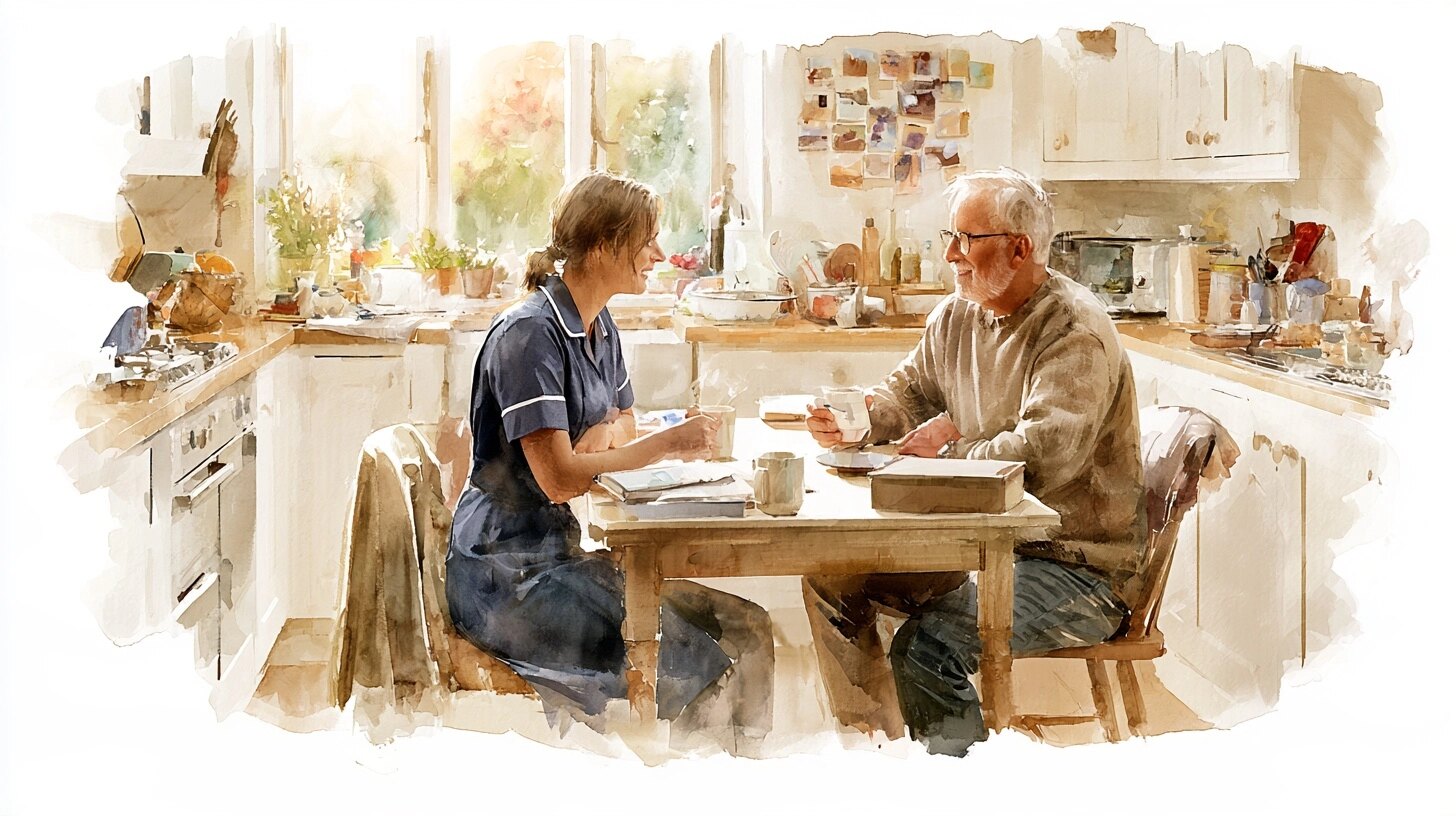
You may be worried that if your relative is in pain or distress at home, the only answer will be an ambulance. For most symptoms that is not so. The people and medicines that ease them can come to the house.
A nursing team that visits
Medicines ready in the house
A number for every hour
Somebody in the room
Not everyone has pain or distress near the end of life. Guidance for doctors and nurses from NICE, NG31, care of dying adults in the last days of life, covers how they should plan for the symptoms that can come: pain, breathlessness, nausea and vomiting, anxiety, agitation and delirium, and noisy breathing. It also says that non-drug measures, such as changing someone's position or using a fan, are an important part of good care. Those are the parts a family can help with.
End-of-life care at home is the starting point for this stage, and the end of life care section has the rest of the guides. If you are not yet sure who the district nurses, the palliative care team and the hospice are, who is in the team goes through each of them. The changes of the final days, such as sleeping more and breathing differently, are covered in the last days and hours.
Symptom by symptom
What each symptom may look like, what you can do, and when to ring
These are the seven symptoms the nursing team plans for. For each one there are things a family can do straight away, and there is a point at which the right thing is to ring for help. It helps to know where that point is before the night it matters.
Seven symptoms the nursing team plans for, what each may look like, what you can do, and when to ring
Pain
Not everyone has pain, and when they do it can usually be kept under control.
What you may see
They may tell you it hurts. If they cannot, look for frowning or grimacing, a change in how they lie, restlessness, turning away from people, or breathing that changes when they are moved.
What you can do
Give prescribed tablets or patches at the times on the label, and write down when pain comes and what eased it. Move them gently and sit with them, because pain can feel worse when somebody is anxious, tired or alone.
Ring the nurse or GP if
The pain is new, worse or different, it has not eased with what is prescribed, or they can no longer swallow their tablets.
From Marie Curie: pain and NICE NG31.
Breathlessness
Some people are short of breath through their illness, and it can get worse near the end.
What you may see
Quick, shallow breaths, working hard to breathe, wanting to sit up, and fear or panic when it comes on.
What you can do
Open a window or turn a fan towards their face, sit them up with pillows, keep the room calm, hold their hand and talk to them calmly. Anxiety makes breathlessness worse, so having you close by helps.
Ring the nurse or GP if
It is new, getting worse or distressing them. There are medicines that ease it. Oxygen helps only some people, and the doctor or nurse decides.
From Marie Curie: breathing changes and NICE NG31.
Feeling or being sick
Medicines, constipation and the illness itself can all cause it.
What you may see
Retching or vomiting, turning food away, looking pale, sweating or feeling cold.
What you can do
Keep a bowl, tissues and water close. Offer small cold snacks and fizzy or flavoured water rather than meals, keep cooking smells and perfume away, help them sit up slowly, and note when it happens.
Ring the nurse or GP if
It keeps happening, tablets are coming back up, or they cannot keep drinks down. Anti-sickness medicine can be given by injection or through a syringe driver. Do not stop any medicine without asking.
Constipation
Strong painkillers such as morphine commonly cause it, and so does moving and drinking less.
What you may see
Fewer bowel movements than is normal for them, straining, pain, a swollen tummy or feeling sick. Watery leakage after a spell of constipation can be overflow from a blockage, not diarrhoea.
What you can do
Offer the drinks they want, help them to the toilet or commode when they feel the urge, and keep a simple note of bowel movements for the nurse.
Ring the nurse or GP if
They have not been for longer than usual for them, have pain in the tummy or bottom, are being sick, or pass watery poo after being constipated. Ask before giving any medicine for it.
From Marie Curie: bowel and bladder problems and Hospice UK: the last few days.
Restlessness and agitation
It can be out of character and very upsetting to watch.
What you may see
Fidgeting, pulling at the bedclothes, trying to get up when they cannot, calling out, confusion, or seeing people or things that are not there.
What you can do
Sit with them, speak clearly and calmly, and tell them who you are as often as they need. Keep the room quiet and familiar, and try not to correct them.
Ring the nurse or GP if
It comes on suddenly or does not settle, or you think pain, a full bladder or constipation may be behind it. The team looks for a cause first, and there are medicines that ease distress.
From NHS: changes in the last hours and days, Hospice UK: the last few days and Marie Curie: delirium.
Dry mouth
Near the end, a dry mouth does not always mean somebody is dehydrated.
What you may see
A dry or sticky mouth and tongue, cracked lips, difficulty talking or swallowing.
What you can do
If they can swallow, offer sips from a straw or a teaspoon. Otherwise moisten the mouth with a damp mouth sponge or ice chips, put balm on the lips, and clean teeth or dentures gently with a small soft brush.
Ring the nurse or GP if
The mouth looks sore, red or bleeding, has white patches, which can be thrush, or swallowing tablets has become difficult.
From Marie Curie: mouth care and Hospice UK: the last few days.
Noisy breathing
It is unlikely to be painful for them, though it can be hard to listen to.
What you may see
A wet, gurgling or rattling sound in the last days, because they are too weak to cough and clear saliva and mucus from the throat.
What you can do
Ask the nurse to show you how to turn them onto their side with the head and chest raised. Put music or the radio on, and take a break if the sound is hard to hear.
Ring the nurse or GP if
It is new, or they seem to be working hard to breathe or look uncomfortable. The nurse can give medicine that dries the secretions, though it does not always stop the sound.
From Marie Curie: noisy chest secretions and Hospice UK: the last few days.
At night, at weekends and on bank holidays, use the out of hours number the nursing team gave you, or ring NHS 111. Only give a medicine that has been prescribed for that person, and never change a dose yourself.
Marie Curie puts it simply: you do not have to deal with these symptoms alone, and the doctor or nurse can assess them, explain them and see what can help. If you are unsure whether something counts, ring and describe what you are seeing. Say when it started, what you see and what you have tried.
Eating and drinking tends to worry families as much as any of these, and it has its own page: eating and drinking near the end of life explains why appetite fades and what to offer instead.
Pain they cannot describe
How to tell someone is in pain when they cannot tell you
Near the end, people spend more of the day asleep and may not be able to find the words. Some have dementia and have not been able to say for a long time. Pain still shows, in the face, the body and the way someone reacts to being moved.
Signs that may mean pain
- Frowning or grimacing
- A change in mood
- Refusing food, or a change in routine
- A change in how they sit or lie
- Agitation or distress
- Unable to concentrate
- Withdrawn, or avoiding eye contact
- A change in their breathing
What to write down for the nurse
- The time, and what they were doing when it started, such as being turned or washed
- What you saw, and where it seemed to hurt
- Which prescribed medicine was given, and when
- How they seemed half an hour later
When the doctor or nurse assesses pain, Marie Curie says they ask where it is, what it feels like, how bad it is on a scale of 0 to 10, and what makes it better or worse. Somebody who cannot answer those questions needs a different approach. NICE tells doctors and nurses to use a validated behavioural pain assessment for a person who is unable to explain that they are in pain, and gives someone with dementia or a learning disability as examples. It is reasonable to ask the nurse whether they use one, and which signs they would like you to watch between visits.
Your notes matter because you are there and the nurse is not. Marie Curie suggests a pain diary, which people around the person can help keep, so the nurse and GP can see a pattern and judge whether a medicine needs to change. A notebook by the bed is enough.
If your relative has dementia, end-stage dementia care at home covers the other changes to expect.
Just in case medicines
Just in case medicines: what they are, who gives them and how to store them
Just in case medicines are also called anticipatory medicines or end of life medicines. They are prescribed before they are needed, so that when a sudden symptom comes, often at night or at a weekend, nobody has to wait for a prescription and a pharmacy.
- 1
A doctor or specialist nurse prescribes them
Before they are neededThey are prescribed for symptoms that can come in the last days of life: pain, feeling or being sick, breathlessness, agitation or restlessness, and noisy breathing. - 2
You collect them from a pharmacy
Ask which oneNot every pharmacy stocks them, and one that does not may need to order them in. Marie Curie suggests asking the GP or district nurse which pharmacies near you keep them. Some pharmacies deliver. - 3
They are kept in the house in a box
Somewhere safeThe medicines come with the needles and syringes to give them, and are kept together in a just in case box. Store them out of the reach and sight of children, somewhere cool and dry, away from heat and light. You will be told if any need the fridge. - 4
If a distressing symptom starts, ring the team
Day or nightRing the GP, the specialist nurse or the district nurse, or the out of hours number at night. In most cases a nurse comes to the house and gives the medicine. If they cannot come, they will tell you what to do. - 5
The team reviews what was used
Within a couple of daysThe GP usually prescribes enough for a few days. If they are needed for longer, the GP or specialist nurse will usually review your relative within a couple of days and prescribe more. NICE also says the team should consider a syringe driver if several doses are needed in a day.
These are injections, given under the skin. Marie Curie says they are usually given by a district nurse who is called out to the house. It also says you may be asked to give your relative a dose yourself, with the doctor or nurse guiding you, and that you should tell them if you do not feel able to. Saying no is a perfectly acceptable answer.
Some just in case medicines can make people drowsy, and the nurse or pharmacist can explain what each one is for. When they are no longer needed, the nursing team will tell you what to do with them. The first days after a death at home covers that time, and says unused medicines go back to a pharmacy to be disposed of safely.
Syringe drivers
What a syringe driver is, and what the family needs to know about it
A syringe driver, also called a syringe pump, is a small battery-powered pump that gives medicine continuously under the skin. It is used when somebody can no longer swallow tablets, is being sick, or needs medicine more steadily than tablets or injections can give it.
What a syringe driver looks like, and the parts you will see
The pump
A small battery-powered pump that gives a steady flow of medicine under the skin. A green light flashes while it is working.
The screen and the locked box
The screen shows how much medicine is being given and how long it will take. The pump is often kept in a clear locked box to protect it from damage.
The line and the small tube
A thin line runs to a very small tube just under the skin of the arm, leg, tummy or back, held by a clear dressing.
Ring the nurse if
- The alarm sounds, or the pump stops
- The skin around the tube is swollen, sore or a different colour
- The pump gets wet or is dropped
- The tube or the dressing comes loose
- Symptoms are not easing. It takes at least three to four hours for the medicine to reach a steady level
A nurse sets the syringe driver up, and Marie Curie says the nurse will usually top up or change the medicines once every 24 hours and change the tubes every three to seven days. The family never sets or adjusts it. Your part is to keep the pump dry, take care with the line when you wash or dress your relative, and look at the skin around the tube. An alarm can mean something like a low battery or a line that has been lain on, and the nurse needs to know either way.
Marie Curie answers two common worries. A syringe driver does not by itself mean the end is close: it can be used at any stage of an illness, and some people have one for a short time and go back to tablets. And there is no evidence that it speeds up dying. Near the end it is often the gentlest way to give the medicines that keep someone comfortable, once they are sleepy and cannot swallow.
If symptoms come back while a new syringe driver is building up, or at any point, ring the nurse, who can give an extra dose.
Who to ring
Who to ring in the day, at night and at weekends
Out of hours care is organised locally, so the number to ring at night is different from one area to the next. The one thing to do this week is ask the district nurse or GP which numbers apply to you, and write them on one sheet.
Numbers to keep by the phone
Ask the nurse or GP for the local ones, write them in, and keep the sheet where everyone in the house can find it.
The GP surgery
In surgery hours, for anything new or changing and for prescriptions
The district nursing team
For just in case medicines, the syringe driver and pressure care. Ask whether they take calls at night
The out of hours number the team gave you
Evenings, nights, weekends and bank holidays
The hospice or palliative care advice line
Ask whether your local team has one, and when somebody answers it
A pharmacy that stocks just in case medicines
Not every pharmacy does. The GP or district nurse will know which ones near you do
NHS 111
When you cannot reach the team and think somebody needs medical help now
111
Marie Curie Support Line
Free. Someone to talk to, and practical information from its nurses
0800 090 2309
Emergency
A life-threatening emergency. Keep any ReSPECT form or advance decision where a crew would see it
999
During surgery hours, the GP and the district nursing team are the people to ring about anything new or changing. In the evening, overnight, at weekends and on bank holidays, ring the out of hours number the team has given you. If you do not have one, or cannot get through, ring NHS 111. The NHS says 111 can help if you think you need medical help right now, and can direct you to the right place when you cannot contact your GP. Say that your relative is receiving end of life care at home and that just in case medicines are in the house.
Ask your hospice team or district nurse whether a hospice or palliative care advice line covers your area, and when it is answered. Hospice care explained covers what a local hospice may offer at home.
999 is for a life-threatening emergency. Where your relative has a ReSPECT form, an advance decision to refuse treatment or a do not attempt resuscitation decision, keep it where an ambulance crew would find it, because it records what was agreed about emergency treatment. Advance decisions and advance statements explains what each one covers.
The Marie Curie Support Line, on 0800 090 2309, is free. It is there for anyone affected by terminal illness, including family, for emotional support or to speak to one of its information and support nurses.
What a paid carer can do
What a paid carer can and cannot do with medicines and symptoms
A carer can do a great deal to keep someone comfortable, and they are often the person in the room when a symptom starts. Medicines at this stage are where the line between care and nursing matters most.
| A paid carer | The nurse or GP | |
|---|---|---|
| Tablets, liquids and patches already prescribed | Can prompt or help, as agreed with you, and write down what was taken and when | Prescribes them and decides any change |
| Just in case injections | No. Knows where the box is and rings the nurse | Usually a district nurse called out to the house |
| The syringe driver | Keeps it dry, takes care with the line, reports the alarm or sore skin | Sets it up, refills it and changes the tubes |
| Mouth care, changing position, a fan, sitting with them | Yes, and turning somebody as the nurse has shown | Advises how often and how |
| A symptom that is new or getting worse | Notices it, writes it down and rings the number agreed | Assesses it and treats it |
Tablets, liquids and patches already prescribed
- A paid carer
- Can prompt or help, as agreed with you, and write down what was taken and when
- The nurse or GP
- Prescribes them and decides any change
Just in case injections
- A paid carer
- No. Knows where the box is and rings the nurse
- The nurse or GP
- Usually a district nurse called out to the house
The syringe driver
- A paid carer
- Keeps it dry, takes care with the line, reports the alarm or sore skin
- The nurse or GP
- Sets it up, refills it and changes the tubes
Mouth care, changing position, a fan, sitting with them
- A paid carer
- Yes, and turning somebody as the nurse has shown
- The nurse or GP
- Advises how often and how
A symptom that is new or getting worse
- A paid carer
- Notices it, writes it down and rings the number agreed
- The nurse or GP
- Assesses it and treats it
Controlled drugs, injections and any change to a medicine stay with the NHS team. A carer can only give or prompt a medicine to somebody who agrees to take it, or whose attorney for health and welfare has agreed.
The law treats injections, and everything given through a syringe driver, as nursing. A nurse can occasionally train and sign off a named carer for one task, but PrimeCarers does not check that, and the insurance we arrange does not cover injections, so these normally stay with the district nurses. What carers are not allowed to do sets out the full line, and can carers give medication? explains the difference between prompting a tablet and giving it. What a carer does in the last weeks describes the day of care, and night care at the end of life covers the nights.
When the nurses are managing the symptoms, what many families need is somebody to help with washing, changing position and company through the day or the night. You can search for carers near you and compare their rates. Carers on PrimeCarers charge £18 to £25 an hour with our fee included, against £28 to £35 at an agency. A carer sleeping in the house is from £130 a night, and one awake all night is from £165. Our pricing lists every rate.
PrimeCarers is an introductory service, not an agency or a care provider, and it holds no CQC registration. The family chooses the carer, speaks to them first and agrees the hours directly. Carers are self-employed. Before a carer appears on the site, their identity and right to work are checked, along with an enhanced DBS check (or PVG in Scotland, Access NI in Northern Ireland) issued within the last 2 years, and they are interviewed online. Carers are covered by the insurance we arrange for visits booked through PrimeCarers, within its terms (no clinical procedures). There is no way to search for carers by palliative or end of life experience. What a carer says about their experience is their own account on their profile, and we do not check qualifications or training, so ask them about it in their own words when you speak.
Questions
Questions families ask about symptoms at home
Usually, yes. Marie Curie says most pain can be kept under control with medicines and that pain which cannot be managed is rare. The GP and district nurses manage it at home, including with just in case injections and a syringe driver. If pain is not easing, ring the nurse or GP, day or night.
Injections prescribed in advance for symptoms that can come suddenly in the last days of life, such as pain, sickness, breathlessness, agitation and noisy breathing. They are kept in the house in a box with the needles and syringes, and a district nurse called out to the house usually gives them. They are also called anticipatory medicines.
Sometimes. Marie Curie says the doctor or nurse may ask a family member to give a dose, and will guide them through it. Tell them if you do not feel able to. Nobody should give one without being shown how by the nursing team and agreeing to it.
Not necessarily. Marie Curie says syringe drivers can be used at any stage of an illness, that some people use one for a short time and go back to tablets, and that there is no evidence they speed up dying.
Ring the nurse as soon as you can, using the out of hours number at night. Marie Curie says the alarm tells you something is not working as it should, such as a low battery or a blocked line, and that the nurse will arrange to visit and fix the cause. Do not try to adjust the pump yourself.
The out of hours number the district nurses or GP gave you. If you do not have one, ring NHS 111 and say your relative is receiving end of life care at home. Ask your hospice or palliative care team whether it has an advice line out of hours. For a life-threatening emergency, ring 999.
It is unlikely to be painful for them. Marie Curie and Hospice UK both explain that the sound comes from saliva and mucus they are too weak to clear, and that it tends to affect the people listening more than the person. Changing their position onto their side can help. Tell the nurse if it is new or they seem to be working hard to breathe.
A carer can prompt or help with tablets, liquids and patches that are already prescribed, as agreed with the family, and write down what was taken. Just in case injections and the syringe driver are for the district nurses. Can a private carer give medication? explains where the line falls.