
The short answer
- One page covers it, if it has nine things on itWho the person is, what they need and when, the medicines, the numbers, how somebody gets in, the animals, what they can do alone, what frightens them, and who has to be told.
- Keep the copies where somebody would lookKeep a copy with your relative, one on the fridge, one with the neighbour who has a key, and one with whoever you would ring first.
- Three schemes take an evening to joinThe Herbert Protocol if your relative might go missing, Message in a Bottle for the emergency services, and a carers emergency card where a scheme runs locally.
- Ask the council for a carer's assessmentIt is free, it does not depend on anybody's savings, and by law it has to consider whether you are able and willing to carry on caring.
Written for England. Where money comes up, the figures are what families pay carers on PrimeCarers, £18 to £25 an hour with our fee included.
The one page
What goes on the page, and how to write it
Write it for a stranger. Whoever picks this up may be a sister who visits twice a year, a neighbour, or a carer booked at short notice, and none of them knows the tablets are in the second drawer.
This is not the same as a care plan. A care plan describes how care is given over weeks and months. This page answers one question for somebody standing in an unfamiliar hall: what does this person need today, and who do I ring. Keep it to a single side, because a stapled document gets put down.
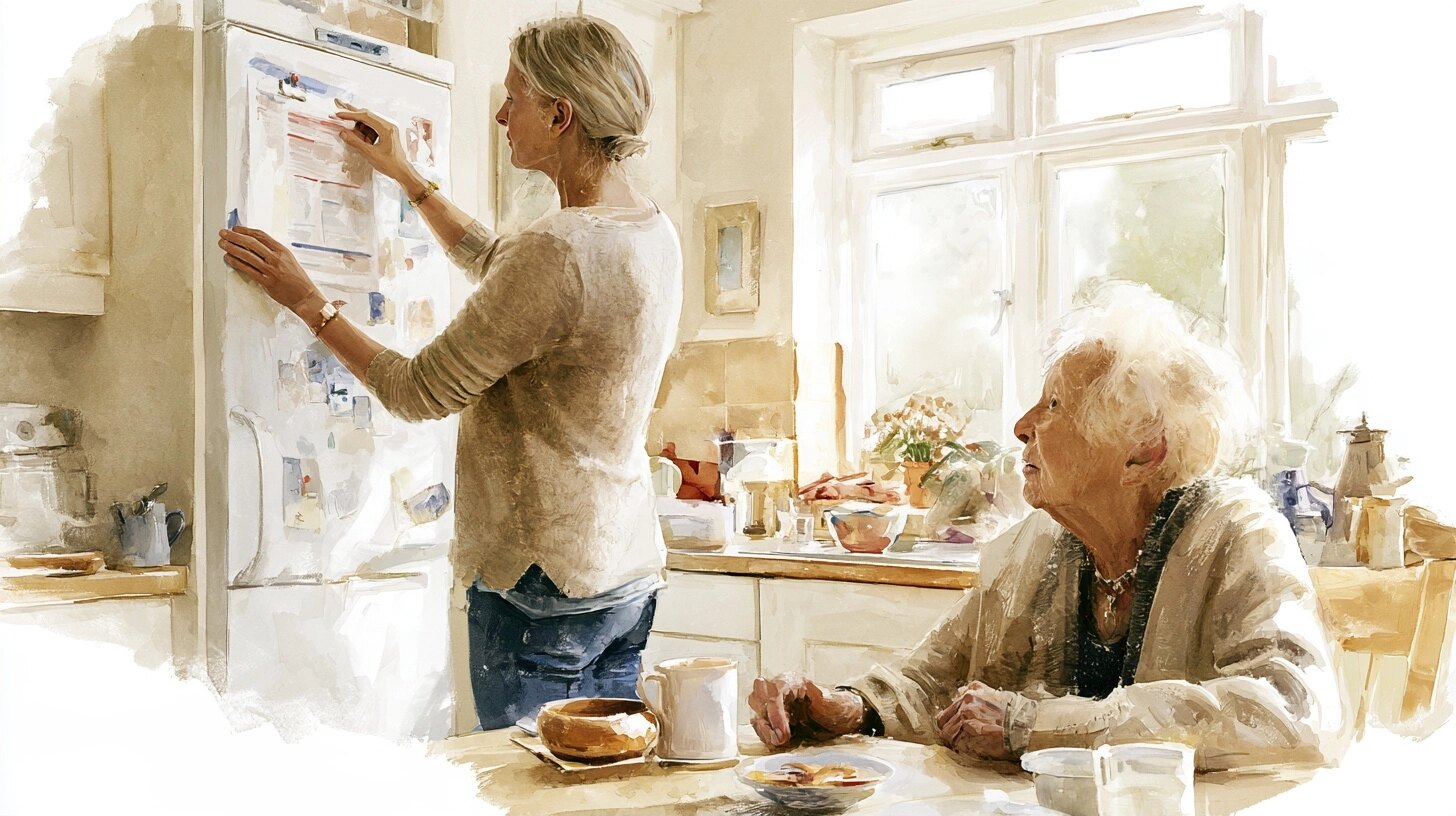
One page, by the phone
If I am not there
One page, written by whoever does the caring, for whoever picks it up.
- Your name and phone number, at the top
- The date you wrote it, and the date you last checked it
Who the person is
- Full name, the name they like to be called, date of birth
- Address, and how to find the house
- NHS number, and the hospital they normally go to
What they need, and when
- Getting up, washing and dressing, and how long it takes
- Meals and drinks: what they eat and what they refuse
- Bedtime, and whether anybody is needed in the night
Medicines, and where they are
- Each medicine, the dose, and the time it is taken
- Where the blister pack lives, and where the spares are
- Allergies, written at the top so they are not missed
The GP, the pharmacy and anybody else
- GP surgery, and the out-of-hours number
- The pharmacy, and whether it delivers
- District nurse, social worker, day centre
How somebody gets in
- Who holds a key, and how to reach them at night
- The key safe and where it is, or the door code
- The alarm, the back door that sticks, the stair light
The animals
- What they eat, when, and where the food is kept
- The vet, and who could take the animal for a few days
- Who walks the dog, and where the lead is
What they can do alone
- Stairs, the bath, the kettle, the cooker, the front step
- Whether they can be left alone, and for how long
- Whether they go out alone, and what they take
What frightens them, and what helps
- Being woken suddenly, a new face, the late afternoon
- What settles them: the radio, a chair, a cup of tea
- Words that go down badly, and the ones that do not
Who has to be told
- Family, in the order you want them rung, with numbers
- Anybody who would turn up expecting them
- Your own employer, and anybody depending on you
Two blocks take longer than you expect. Copy the medicines off the boxes or the printed repeat slip rather than from memory, and ask the pharmacy to confirm the list if anything changed lately. Whether a carer can give medication is worth reading first. The other slow block is what your relative can still do alone, because it is easy to write down only what has gone. Somebody covering for a fortnight needs both halves. The care plan guide has a fuller day-to-day template.
Where the copies go
Where to keep the copies so somebody finds them
The plan has to be findable by somebody who has not been told it exists. That means more than one copy, in places people look.
With your relative, in the open
By the phone or in the hall
On the fridge
Where ambulance crews look
With a neighbour who has a key
Somebody who could get in tonight
With whoever would come
Brother, daughter, friend
Tell the people on the list that they are on it. A neighbour who has agreed to hold a key and a copy will act within the hour, while one who finds out at the door rings somebody else. Using friends, family and neighbours to help with care covers asking for something specific rather than open-ended. If you have brothers or sisters, settle the order of the list first: sharing care between siblings is about that conversation.
Schemes to join
Three schemes worth joining before anything happens
Each of these exists because families kept hitting the same problem: nobody knew who the person was, what they were taking, or that somebody relied on them.
| What it is | Who it suits | How to get it | |
|---|---|---|---|
| The Herbert Protocol | A form filled in ahead of time with a photograph, a description, medication, the daily routine and places the person might head for, so police can start searching with it in front of them. | Anybody caring for a person with dementia who might leave the house and not find their way back. | Fill it in through the MedicAlert database, or ask your police force or a health professional for a paper copy. |
| Message in a Bottle | A bottle holding a form with the person's identity, medical details, allergies and emergency contacts. It lives in the fridge, with a green cross sticker on the fridge door and another inside the front door. | Anybody living alone, or anybody whose medical history a paramedic would need in a hurry. | Free from Lions Clubs International British Isles, and pharmacies and GP surgeries often hand them out. |
| A carers emergency card | You register your plan with a scheme and carry a card showing an identification number and a 24-hour phone number rather than personal details. | Any unpaid carer, and especially one who is out of the house a lot or lives at a distance. | Councils and local carers organisations run these under various names, so ask what is available where you live. |
The Herbert Protocol
- What it is
- A form filled in ahead of time with a photograph, a description, medication, the daily routine and places the person might head for, so police can start searching with it in front of them.
- Who it suits
- Anybody caring for a person with dementia who might leave the house and not find their way back.
- How to get it
- Fill it in through the MedicAlert database, or ask your police force or a health professional for a paper copy.
Message in a Bottle
- What it is
- A bottle holding a form with the person's identity, medical details, allergies and emergency contacts. It lives in the fridge, with a green cross sticker on the fridge door and another inside the front door.
- Who it suits
- Anybody living alone, or anybody whose medical history a paramedic would need in a hurry.
- How to get it
- Free from Lions Clubs International British Isles, and pharmacies and GP surgeries often hand them out.
A carers emergency card
- What it is
- You register your plan with a scheme and carry a card showing an identification number and a 24-hour phone number rather than personal details.
- Who it suits
- Any unpaid carer, and especially one who is out of the house a lot or lives at a distance.
- How to get it
- Councils and local carers organisations run these under various names, so ask what is available where you live.
Carers emergency card schemes are local. The name, the cover and whether one exists at all vary from one council to the next, so ask what runs in your area.
The Herbert Protocol is named after a man who lived with dementia and died while he was missing, which is why the form asks about childhood addresses and old workplaces. If your relative has already been found somewhere they should not have been, read wandering and leaving the house alongside it. Message in a Bottle is run by Lions Clubs International British Isles. Carers Trust can point you to the carers service for your area, and Carers UK has its own emergency planning guidance.
The first twelve hours
Who would come in the first twelve hours
Nobody takes over automatically when a family carer stops. Somebody has to ring, and what arrives depends on who they ring and what they say.
- Hour 0
Somebody has to make the call
If you are taken to hospital, tell the ward staff you care for somebody at home and give the name and address, so it reaches the hospital social work team.
- First 2 hours
A neighbour or a relative with a key
Whoever can be in the house this evening is almost always somebody who lives nearby. This is what the key and the copy of the page are for.
- Same day
The council, if you use the word urgent
Ring adult social care for the area your relative lives in, and ask for the emergency duty team out of hours. A council may meet needs that appear to it to be urgent before any assessment.
- Same day
An NHS urgent community response team
Where a team covers the area, 111 or a GP can refer somebody for a visit at home within two hours. It is a short health-led response, not a care package.
- Day 2 onward
Paid care, booked by the family
A carer booked directly can often start within a day or two. A council package or a short care home stay takes longer, because both need an assessment first.
It helps to be clear about what a council emergency response is for. It keeps somebody safe through a crisis, and it is measured in days. If you will be out of action for a fortnight after an operation, what fills that fortnight is family, or care the family arranges and pays for, or an assessed council package. If you are reading this today rather than in advance, what to do when the family carer is in hospital is written for the middle of it, and emergency care is the pillar for care arranged at short notice. Where the person you care for is your husband or wife and your children are the ones who would step in, what a couple's arrangement rests on, and what nobody is watching is written for them.
Arranged in advance
What you can settle now, and what has to wait
Some of this can be finished this month and left alone. Some of it cannot be booked ahead at all, and it is better to know which is which than to believe something is in place when it is not.
What you can settle now
- A carer's assessment from the council, free and not dependent on savings
- A needs assessment for your relative, which a council care plan is built on
- Telling your GP surgery that you are an unpaid carer, so it is on both records
- A key safe, or a spare key with somebody close enough to walk round
- Talking to one or two carers now, so there is a number you would ring
- Agreeing with your family who is first on the list, and telling them so
What cannot be arranged in advance
- A carer held on standby for a week you cannot name, unpaid
- A council package arranged before anybody has been assessed, unless needs appear urgent
- A respite bed reserved indefinitely, since short stays are booked for dates
- A promise from a neighbour that has never been discussed out loud
- An assumption that the hospital will tell social services that your relative exists
Start with the carer's assessment, because it has a legal footing behind it. Under the Care Act 2014 a council must assess a carer who appears to have needs for support, whatever either of you has in savings, and it has to consider whether you are able and willing to carry on caring. That is where the plan for you being ill belongs, so say it in the meeting rather than waiting to be asked. Respite care covers planned breaks, which are easier to arrange than unplanned ones.
Paid care is the awkward part. A carer on PrimeCarers is self-employed and agrees work directly with the family, and the contract covers visits already agreed rather than obliging either side to offer or accept future work, so nobody holds a fortnight open for a week that may never come. What you can do is stop the search being a cold start. Search for carers near your relative and compare their rates and availability while nothing is wrong, speak to one or two, and book an afternoon every few weeks so a carer already knows the house. Then the call on a bad day is to a person rather than to a list.
Questions
Questions family carers ask about planning ahead
Who the person is, what help they need and when, their medicines and where they are kept, their GP and pharmacy, how somebody gets into the house, the pets, what they can and cannot do alone, what frightens them and what settles them, and who has to be told. Put your name, number and the date at the top, so a reader knows how current it is.
Nobody takes over automatically, so somebody has to ring. Tell the ward that you care for a person at home and give her name and address, ring adult social care for the area she lives in and say the need is urgent, and ask the person on your list to get to the house. What to do when the family carer is in hospital is written for that day.
It is a form filled in ahead of time about a person with dementia who might go missing, recording a recent photograph, a description, their medication, their routine and places they have a connection to, so police can use it straight away rather than gather it during a search. Complete it through the MedicAlert database, or ask your police force or a health professional for a paper copy.
It depends on the area. Councils and local carers organisations run these schemes under various names and each works slightly differently, so ask your council or carers service what is available. Where a scheme runs, you register your plan with it and carry a card showing an identification number and a 24-hour phone number rather than personal details.
Not as a standby arrangement. Carers on PrimeCarers are self-employed and agree visits directly with the family, and the contract covers visits already agreed rather than obliging either side to offer or accept future work. What helps is meeting carers before you need one, and booking somebody for a regular afternoon so the house and the routine are already familiar. Visits are £18 to £25 an hour with our fee included.
It should. The Care Act 2014 requires the council to look at whether you are able and willing to keep caring, now and in the future, as part of assessing your needs for support. Say what would happen to your relative if you were in hospital for a fortnight, and ask for it to be written into the plan. The assessment is free whatever anybody's savings. What is a carer's assessment explains how to ask.
Not straight away. You have to tell the Department for Work and Pensions if you or the person you care for will be in hospital, a nursing home or respite care for more than 12 weeks, or if you stop caring for more than 28 days for any other reason. Report it once you know roughly how long you will be away. Carer's Allowance explained covers the rules.